
Vandaag of morgen in huis

Kwaliteit gegarandeerd

Welkomstaanbiedingen ontgrendelen: GRATIS bezorging | Tot 80% korting | Gratis 30 dagen JoyPlus-proefperiode
Download de app
A marker set may seem simple to choose: select a number of colours and place your order. However, there are clear differences in ink, nib shape, ease of use and safety. An inexpensive set may prove less suitable if the nibs become misshapen quickly, the caps go missing or the ink does not come out of clothing.
This buying guide helps parents, schoolchildren, hobbyists and hand-lettering enthusiasts compare products more effectively. We focus on verifiable product specifications, without presenting marketing claims as guaranteed results.
A large number of colours does not automatically mean that a set is versatile. Large areas require a broad nib, while writing and detail work are easier with a fine nib. Brush pens are suitable for varying line widths, but they often require a little more control.
A set with multiple nib shapes, such as dual-tip markers, can therefore be more practical than a larger set containing only standard felt-tip pens.
Washable markers are useful for children, but always check exactly what the manufacturer states. “Washable from skin” is not the same as “washable from textiles”. Some products recommend treating stains with water first or pre-washing clothing.
Water-based ink can still soak into porous materials. For this reason, use a protective covering and clean up stains as quickly as possible.
Permanent markers adhere to materials including plastic, metal and glass, but they are less suitable for young children. The ink may give off odours and is not designed to be easily washed out of clothing or furniture. Check the age recommendation and only use these markers under supervision where this is stated in the product information.
Before buying, pay attention to the combination of nibs:
A children's set with a sturdy or spring-loaded nib may be more practical for intensive colouring. For hand lettering or illustrations, a flexible brush nib is more appealing.
Water-based ink is generally a sensible choice for paper, card and use around the home. Check whether the product specifications describe the ink as odourless, alcohol-free or washable. A manufacturer's safety or washability claim should be understood as that brand's product information, not as a guarantee for every situation.
Alcohol markers dry quickly and may become water-resistant or permanent once dry. They can bleed through thin paper. Preferably use marker paper or thicker paper, and place a protective sheet underneath your work.
Acrylic markers work on more types of surface, but they usually need to be activated by shaking and pumping. According to Faber-Castell's product description, the markers mentioned are suitable for surfaces including paper, metal, ceramics, plastic, glass, fabric, stone, canvas and wood. Always test them on an inconspicuous area first.
Do not just look for terms such as “child-friendly”; also check the specific information:
A CE mark is not a quality ranking. It is a conformity mark through which the manufacturer indicates that the product meets applicable European requirements. Keep small parts away from young children and always follow the warnings on the packaging.
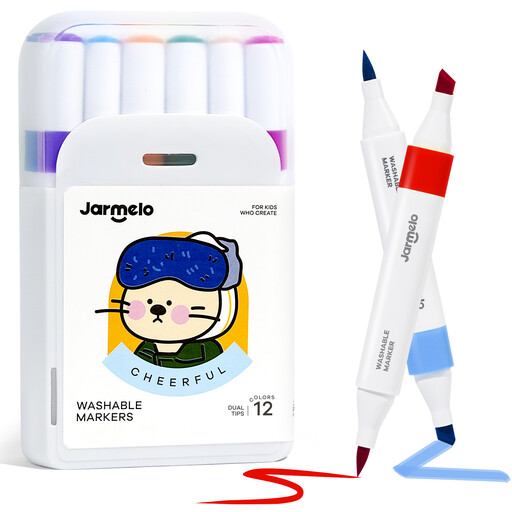
Why this suits the profile: A compact set for children who want to switch between colouring, drawing and simple lettering. The storage case with handle is practical for use at home, school or on the go.
The combination of a brush nib and chisel nib means you do not need two separate sets for broad and fine lines. According to the product description, the water-based ink is washable from skin in 90% of cases and from most fabrics; treat stains promptly.
12 colours, two nib shapes, water-based ink, alcohol-free and odourless ink according to the product information, plus ventilated caps and a sturdy oval barrel.
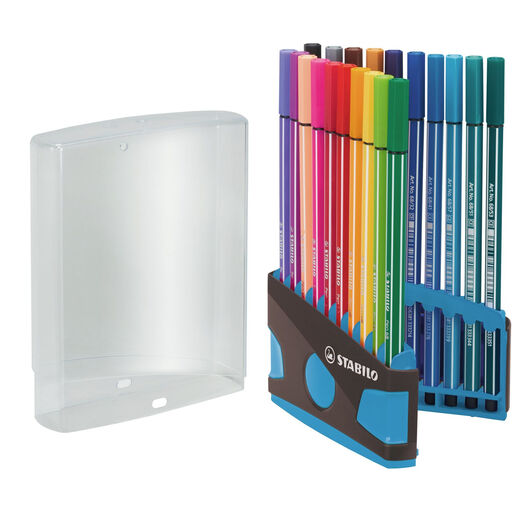
Why this suits the profile: Suitable for anyone looking for a consistent fibre tip for colouring, drawing and schoolwork, with a tidy desk set for everyday use.
The product information states that it has a robust nib and an approximately 1 mm writing width. This means the set does not rely on one extremely broad nib for every application.
20 colours, water-based ink, odourless ink and a nib that, according to the product description, can be left uncapped for up to 24 hours without drying out immediately.

Why this suits the profile: For creative projects on more than just paper, such as decorating wood, glass, ceramics, canvas or plastic. The six metallic colours are designed for accent work and eye-catching details.
The set is clearly intended as an acrylic or paint marker, rather than an ordinary colouring pen. The activation steps involving shaking and pumping make usage more predictable than with a marker promoted as ready for every surface.
6 metallic colours, two nib sizes of 1 and 3 mm, water-based ink and an ink-level indicator according to the product description.
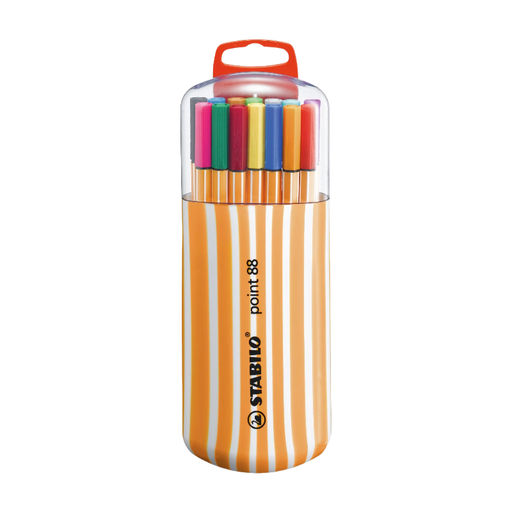
Why this suits the profile: A logical choice for precise writing, sketching, hatching and hand lettering, where a fine line matters more than broad areas of colour.
The fixed writing width of 0.4 mm makes the purpose of this set clear. You are not buying broad colouring pens, but fineliners for detailed work.
20 colours, water-based ink, odourless ink, ventilated cap and a fine nib for writing, drawing and sketching.
We have put together a complete, up-to-date list of products that fully meet these strict selection criteria and the applicable European safety regulations.
Choose washable markers with an appropriate age recommendation, sturdy nib and clear safety information. Products such as STABILO Trio Scribbi and STABILO Cappi are, according to the product description, aimed at children. Also check that caps and any small parts remain out of reach of young children.
Replace each cap immediately after use and store the set in a dry place, away from direct sunlight and extreme temperatures. Metallic markers are often recommended to be stored horizontally. A cap ring, such as the one on STABILO Cappi, can help keep the caps together. The stated drying time when uncapped varies by product and is not a reason to leave markers open regularly.
For school, basic colouring and drawing, a set of 10 to 24 colours is often easy to manage. Anyone who creates lots of colour gradients or hand-lettering projects may prefer 30 to 50 brush pens. For specific applications, such as acrylic work or permanent marking, a smaller set with the right ink and nib is often more effective than a large assortment of ordinary colouring pens.
