
Vandaag of morgen in huis

Kwaliteit gegarandeerd

Welkomstaanbiedingen ontgrendelen: GRATIS bezorging | Tot 80% korting | Gratis 30 dagen JoyPlus-proefperiode
Download de app
A marker set may seem like a straightforward purchase—until you have to choose between colouring pens, felt-tip pens, brush pens, fineliners, acrylic markers and gel pens. A large colouring set is not automatically practical. You may simply be paying for extra shades that barely differ from one another, while the nib or ink type is unsuitable for your project.
Parents also tend to consider washability and age recommendations. Adults, students and hobbyists are more likely to focus on line width, blendability and the right type of paper. The checklist below helps you avoid disappointing purchases and select a writing and drawing set based on verifiable features.
A set with 50 or more pens may look appealing, but first consider what you will use the markers for. For simple drawings or homework, a set of 12 to 20 colours may be sufficient. For journaling or illustration, additional colour nuances can be genuinely useful.
Also consider how easily the colours can be identified. A colour chart included in the packaging, as found with some Faber-Castell sets, makes it easier to find the right shade quickly.
According to the product descriptions of various brands, water-based ink is washable from hands or most fabrics. The result may depend on the material, drying time and how quickly the stain is treated. For STABILO power, for example, pre-treatment is recommended for clothing. Treat washable markers as a practical advantage—not as a guarantee against every stain.
For young children, a durable nib, clear age guidance and supervision are more important than colour choice alone. Small components, such as caps, may pose a risk to children below the stated minimum age.
A brush pen is suitable for varying line widths, while a fineliner is designed for fine details. Alcohol markers can bleed through paper, and acrylic markers are developed for different surfaces than standard colouring pens. Choose the application first, and the number of pens second.
Water-based ink is common in colouring pens and felt-tip pens designed for paper. This ink is generally low-odour and, according to the manufacturer, can sometimes be diluted or washed out with water. According to its product description, STABILO Pen 68 uses water-based ink and can be combined with water to create a watercolour effect. For this technique, use thicker paper or card to minimise bleed-through and warping.
Alcohol markers dry quickly and, according to the product information, become waterproof and permanent once dry. This makes them suitable for sketches and illustrations, but less suitable for young children or thin school paper. Using a protective sheet underneath is advisable.
Acrylic markers contain pigmented, opaque water-based acrylic paint, according to the product description. The Faber-Castell Shake & Paint sets are designed for use on, among other surfaces, paper, metal, ceramic, plastic, glass, fabric, stone, canvas and wood. Always test the marker on a small area of the surface first. Adhesion and coverage may vary depending on the material.
Check the nib before buying a set:
According to the product description, the Faber-Castell Duo Felt-Tip Pens combine a broad and a fine nib. The set contains 20 colours and water-based ink which, according to the manufacturer, can be washed out of most fabrics.
Check the stated minimum age, warnings and any product labels such as CE or EN 71. This information helps with selection, but does not replace supervision or the usage instructions.
Close pens securely after use. This is especially important for felt-tip pens and brush pens. Store metallic markers horizontally, according to the product information. Acrylic markers often need to be shaken first, with the nib activated using a pumping motion. Always check the specific instructions for each product.
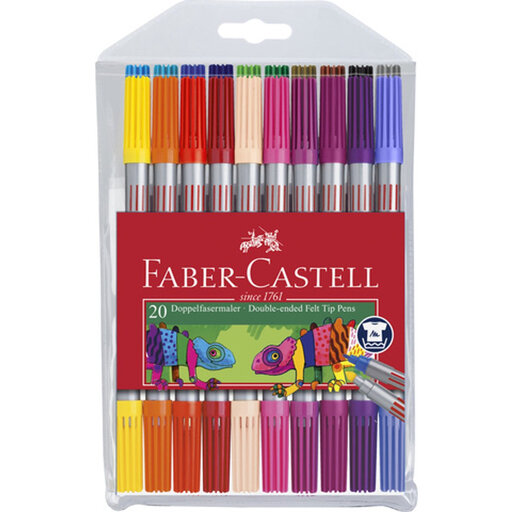
Why it’s a good fit: A well-organised colour set for children, parents and adults looking for one set for colouring, drawing and simple details on paper.
The broad and fine nibs make the set more versatile than a standard felt-tip pen. The colour chart eliminates the need to search for the right shade.
20 different colours, water-based ink and a cardboard storage box. According to the product description, the ink can be washed out of most fabrics.

Why it’s a good fit: For adults and creative makers who want to use metallic markers on more than just paper.
You are not buying a large colour set for a single purpose: according to the description, these markers are suitable for materials including wood, glass, ceramic and canvas.
Two nibs measuring 1 and 3 mm, an ink-level indicator and six metallic colours. The marker must be shaken 20 to 30 times and activated before use.

Why it’s a good fit: For sketches, concept drawings and illustrations requiring both broad areas of colour and fine contours.
The set clearly indicates that these are alcohol markers. Use suitable marker paper and place a protective sheet beneath your work.
A brush tip with a line width of approximately 1 to 5 mm and a 0.6 mm metal fineliner tip. The set contains 24 colours and a cardboard box.
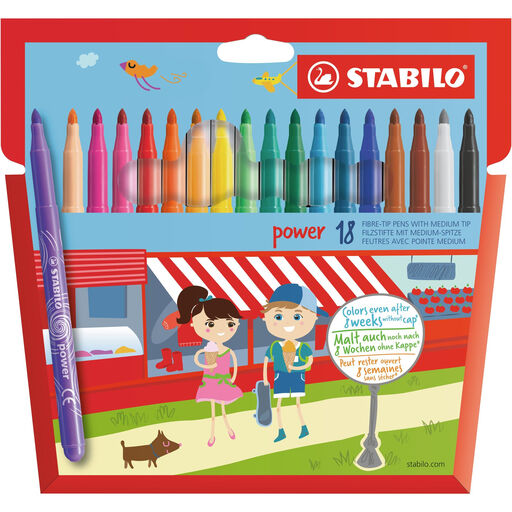
Why it’s a good fit: A practical choice for children from the stated minimum age of 3 who enjoy colouring in large areas.
According to the product information, the nib is pressure-resistant and the ink is washable, according to STABILO; pre-treatment is recommended for clothing.
A 2 mm medium nib and a set of 18 colours. According to STABILO’s own information, the pens can continue writing for up to eight weeks without their caps; nevertheless, always recap them after use.
Explore a current selection of pens and markers that matches these practical selection criteria and relevant product information.
Look for the recommended minimum age, a pressure-resistant nib and washable ink. Sets such as STABILO power, STABILO Cappi and Faber-Castell Castle list features suited to children. Also check that caps and other components are kept out of reach of young children.
Replace the cap immediately after use and press it firmly into place. Store the set according to the product instructions: some markers are best kept horizontally, while other sets can be stored upright. Do not leave a pen uncapped for an extended period, even if the manufacturer specifies a longer open time.
Felt-tip pens are generally designed for colouring and writing on paper. Brush pens have a flexible tip for variable line widths and are useful for hand lettering and illustration. Alcohol markers dry quickly and, according to the product information, become waterproof and permanent once dry. They require suitable paper and are less naturally suited to children’s craft activities.
