
Fans of chunky salsa
You want to keep recognisable chunks of mango, pepper and herbs. Fairtrade Original’s recipe uses diced mango, so first decide whether you need a stick blender for this recipe or simply want to chop and mix the ingredients.


For a smooth mango base, a stick blender without a chopper will do the job. For salsa with recognisable chunks, it’s better to chop and mix by hand, or use a set with a chopper to prepare the individual ingredients. If equipment is shared during a workshop, also consider whether the blending foot is detachable, how to clean it, how it’s operated and how far you’ll be from a plug socket.
You want to keep recognisable chunks of mango, pepper and herbs. Fairtrade Original’s recipe uses diced mango, so first decide whether you need a stick blender for this recipe or simply want to chop and mix the ingredients.
You want to blend mango into a smooth dip or sauce base. The Consumers’ Association distinguishes between stick blenders for puréeing and models that come with a chopper. Compare the blending foot and controls before choosing extra attachments.
Participants take turns using the same equipment. Check how the blending foot detaches and needs to be cleaned, and whether the workspace is close enough to a plug socket. The Consumers’ Association and the Netherlands Nutrition Centre also offer advice on following instructions and keeping kitchen utensils clean.
Choose this when: the salsa needs to retain individual chunks of mango and finely chopped additions. Fairtrade Original’s recipe combines chopped ingredients in a bowl.
Bear in mind: you’ll chop the ingredients by hand; this method won’t make a smooth sauce.
Choose this when: you want to blend mango into a smooth base and don’t need a chopping function.
Bear in mind: a blending foot won’t replace a chopper for ingredients such as pepper, onion or herbs.
Choose this when: participants want to blend mango and chop other ingredients separately.
Bear in mind: extra parts need storage space and must be cleaned after use. Check which attachments are included with the model.
First decide what texture you want and which tasks the workshop involves. Then compare the controls, cleaning requirements and space needed.
| What to consider | What should you check? | Who is this important for? |
|---|---|---|
| Chunks or purée | Decide on the texture you want; check whether you need a blending foot, chopper, or just a knife and chopping board. | If I want to keep chunks of mango or recognisable pieces of pepper and herbs, I’ll choose the preparation method that suits the recipe. The texture they want is the main reason for buying for around 33% of consumers. |
| Chopping and blending | Check which attachments are included and whether the chopper is suitable for the ingredients and quantities. | If I want to make both a smooth mango base and separately chopped additions, I’ll look for a set that can do both. Around 27% of consumers particularly value this combination. |
| Cleaning between participants | Check the cleaning instructions for each part and see which parts, if any, are dishwasher-safe. | When equipment is shared, I want to be able to clean the parts that come into contact with food thoroughly between preparations. Around 27% of consumers prioritise ease of cleaning. |
| Workspace and ease of use | Measure the distance to the plug socket and compare the cord length, weight and space needed for loose parts. | If the plug socket isn’t next to the worktop, I’ll look for enough room to move around and a workspace where everyone can use the blender. Around 13% of consumers prioritise the space available. |
A smooth purée and salsa with recognisable chunks require different preparation methods. The Consumers’ Association distinguishes between blending with a stick blender and chopping with a chopper; wattage alone won’t tell you what texture you’ll get.
First choose between chunks, chopped additions and a smooth sauce base. Then compare the models.
A model may have a blending foot but no chopper. The Consumers’ Association describes these as different functions, and what’s included can vary between models and versions.
Check the list of included parts for the exact model rather than relying on the product range name alone.
Cleaning instructions can vary from one part to another. The Consumers’ Association recommends checking the manual before cleaning any parts.
Read the manual before the workshop and unplug the blender before removing attachments. Wash your hands and clean any kitchen utensils you’ve used thoroughly.
An optional service plan and your statutory rights are not the same thing. According to the Dutch government, there is no fixed statutory guarantee period in the Netherlands; if a consumer product is faulty, the retailer is your point of contact.
Compare the additional terms offered by the plan, and contact the retailer about a faulty product.
These examples highlight differences between specific product ranges and models; they are not a general recommendation for an entire brand.
The ErgoMixx models show the difference between a standalone blending foot and a version with a chopper.
The MultiQuick 5 Pro range is worth considering when comparing speed controls and the attachments included with specific models.
The Quickchef HB65LD38 is an extensive set for workshops involving a range of chopping tasks as well as blending.
This product selection focuses on stick blenders for making a smooth mango base; some sets are also suitable for chopping ingredients separately.
 No image available
Suits a workshop where you want to blend mango and chop other ingredients separately.
The product name lists a chopper and whisk, in a black and stainless steel design.
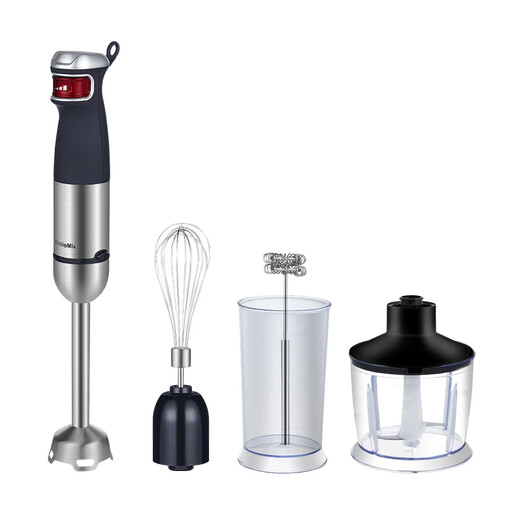 No image available
An option if you want to chop ingredients separately as well as make a smooth mango base.
The product name lists 1200 W, variable speed control and a stainless steel blade.
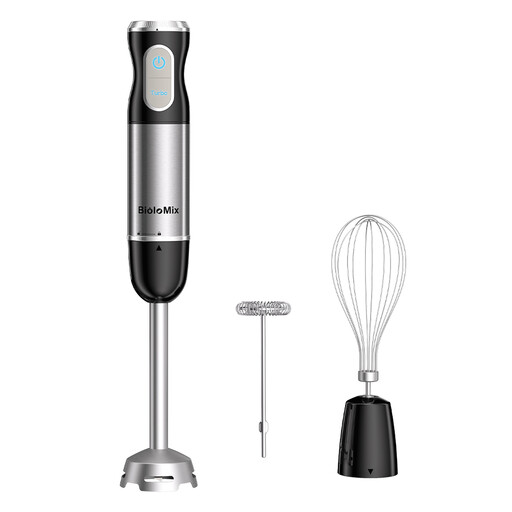 No image available
Suits anyone who mainly wants to blend mango into a smooth base.
The product name lists a detachable design and a splash-resistant construction.
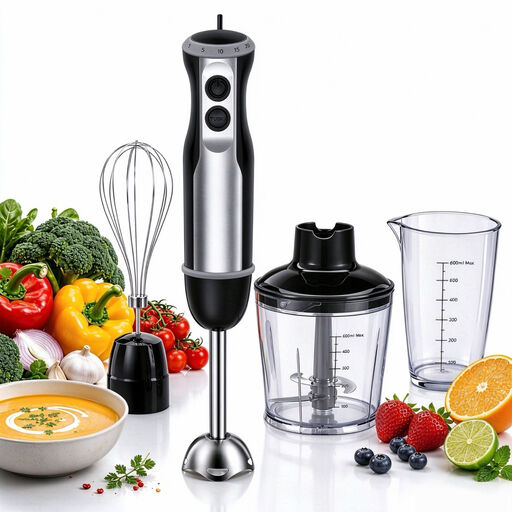 No image available
A suitable category to explore if you want to make a smooth sauce and adjust the speed.
The product name lists six speeds and a turbo function.
 No image available
Suits anyone who wants to blend mango and values adjustable speed; check which attachments are included with this model.
According to Braun, model MQ55254M has a 1000 W motor and 25 speeds, plus turbo.
No. Fairtrade Original’s recipe dices the mango and mixes it with the other ingredients. Use a blending foot if you want a smooth base; chop the ingredients by hand or with a chopper when the recipe calls for chunks.
Unplug the blender before removing any attachments. Check the manual to see whether each part is dishwasher-safe, and clean your hands, fruit and any kitchen utensils you’ve used thoroughly.
According to the Netherlands Nutrition Centre, it’s best to store cut mango in a sealed container in the fridge. A whole mango should be stored differently.
No. According to the Dutch government, there is no fixed statutory guarantee period in the Netherlands. When you buy as a consumer, you’re entitled to a product that works properly for as long as you can reasonably expect it to. If there’s a fault, contact the retailer. If you’re buying for a business, check which terms apply to that purchase.
The description ‘cookery workshop’ alone doesn’t determine this. According to the Netherlands Food and Consumer Product Safety Authority, the relevant food safety rules apply to businesses that sell food or drink to customers. The requirements for a workshop depend on how it’s organised. Check whether food is being sold to consumers before applying the requirements to your situation.