
Vandaag of morgen in huis

Kwaliteit gegarandeerd

Welkomstaanbiedingen ontgrendelen: GRATIS bezorging | Tot 80% korting | Gratis 30 dagen JoyPlus-proefperiode
Download de app
A make-up bag might seem straightforward, but the wrong choice can quickly become a source of frustration. A bag that's too small means loose products rattling around in your handbag. An awkward fastening can pop open during travel, and a material that's difficult to clean will hold onto stains and residue for ages.
So don't just focus on colour or appearance. Instead, pay close attention to the dimensions, layout, closure and material. Below, you'll discover which features really matter and which models suit different situations.
A compact make-up bag is handy for daily use, but small dimensions also mean limited capacity. So check whether you mainly need to carry lip products, mascara and a powder, or whether you also need room for brushes, skincare and accessories.
A bag measuring roughly 20 × 12 × 8 cm can work for a minimal daily routine. For a full set, a wider cosmetic bag with multiple compartments is far more practical.
Product descriptions sometimes use terms like waterproof, water-resistant or water-repellent. These don't automatically mean the bag can be submerged. Check whether the seams, zip and interior offer protection against minor leaks.
The MISSLYN bag, for example, states it is water-resistant but not designed to be fully immersed. Always make sure liquids are properly sealed, even in a waterproof make-up bag.
A make-up organiser shouldn't just look tidy. Without separate compartments, brushes, jewellery and cosmetics can all get mixed up. This increases the risk of damage and makes it harder to find what you need quickly.
For travel, a transparent make-up bag, a removable brush pouch or a separate jewellery compartment are handy features. For bathroom use, a simple, washable model may be all you need.
Look at the external measurements and the shape. A longer model can be useful for brushes, while a square toiletry bag offers more room for pots and bottles.
Use this guide:
Also consider the weight. A bag weighing 90 grams adds very little to your luggage, whereas a model with a mirror and multiple compartments can be heavier.
Many make-up bags are made from nylon, PU, PVC or silicone. Each material has practical implications:
When maintaining your bag, don't use harsh cleaning products unless the product information explicitly allows it. Allow a damp bag to dry completely before storing it away.
A sturdy zip, press stud or metal spring mechanism helps keep products in place. A hard outer shell provides extra protection for fragile items, while a soft pouch takes up less space.
With a make-up bag that includes a mirror, it's wise to check that the mirror is well protected and that the bag stays stable when you open it. A mirror is especially useful for quick touch-ups on the go, but it's not essential for everyone.

Why this fits the profile: The dimensions of 20 × 12 × 8 cm suit a daily selection of, for example, lip products, mascara and a compact powder.
According to the product information, silicone provides a wipe-clean surface. The dimensions make it clear this is a compact choice, not a bag for a full collection.
Compact size; silicone material; portable design with handle.
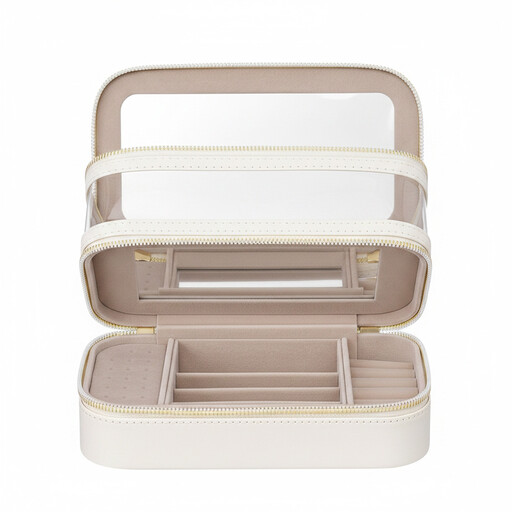
Why this fits the profile: This model combines a mirror, compartments and a transparent pouch for brushes. That suits anyone who wants to carry make-up and jewellery in an organised way.
The separate compartments reduce the risk of products mixing together. The manufacturer advises closing containers properly and not storing the bag in a damp or hot environment.
Dimensions of 22 × 12 × 12 cm; built-in mirror; separate PVC pouch for brushes.

Why this fits the profile: The transparent design is practical for travel and commuting, because you can quickly identify the contents without emptying the whole bag.
The contents remain visible and the bag is wipe-clean. According to the product information, the material is water-resistant but not suitable for submersion or for sharp, heavy objects.
Transparent design; foldable; multiple compartments; suitable for cosmetics and toiletries.
Don't overfill the bag beyond what the closure allows. Check bottles and pots regularly for leaks and store liquid products upright whenever possible. Clean the inside with a soft cloth and follow the manufacturer's care instructions.
For a travel toiletry bag, it's best to organise by use: daily make-up at the front, skincare products in a separate compartment and jewellery in a small jewellery pouch. This prevents metal accessories from scratching powder compacts or mirrors.
We've put together a full, up-to-date list of products that fully meet these strict selection criteria and comply with current European safety regulations.
A make-up bag is usually designed for cosmetics, brushes and small accessories. A toiletry bag often offers more room for shampoo, skincare products and larger bottles. A model with multiple compartments can combine both functions.
Generally, use a soft, slightly damp cloth and a mild cleaning product. First check the material and the product instructions. Do not submerge the bag in water if the manufacturer only recommends wiping it clean. Allow the bag to dry completely before putting your products back inside.
A compact or transparent make-up bag is handy for quickly checking the contents. For liquids, you'll also need to follow the current rules of the airport and airline. Check those rules in advance and seal all bottles properly to minimise leaks in your luggage.
