
Vandaag of morgen in huis

Kwaliteit gegarandeerd

Welkomstaanbiedingen ontgrendelen: GRATIS bezorging | Tot 80% korting | Gratis 30 dagen JoyPlus-proefperiode
Download de app
Magnetic building blocks are popular with children who enjoy creating houses, vehicles and imaginary worlds. Parents and grandparents often look for a magnetic building set for children that combines creative play with developing fine motor skills and spatial awareness. However, not every magnetic set is the same.
A low price may seem attractive, but it says little about the quality of the connections, the finish or whether the set is suitable for the child’s age. Use these checks to avoid a disappointing purchase and choose construction toys that suit both the child and how they will be used.
A box containing 100 or 150 pieces sounds comprehensive. However, a set may consist mainly of repetitive shapes. For three-dimensional building, combinations of squares, triangles and additional shapes are often more practical than simply having lots of small pieces.
So don’t focus solely on the number of pieces. Also look at:
Magnets should be securely fixed inside each piece. If tiles or blocks become damaged, magnets may come loose. Swallowing multiple strong magnets can cause serious injury. Check the pieces regularly and stop using them immediately if you find cracks, loose parts or exposed magnets.
According to Tokky’s product information, the magnets in the tiles are ultrasonically welded in place and the material has been tested in accordance with EN 71. This is relevant product information, but it is not a reason to stop supervising young children. The same information includes a warning about small parts and strong magnets.
Terms such as “STEM toy”, “Montessori” and “fine motor skills toy” do not automatically mean that a product is suitable for your child. A 3-year-old has different needs from a 9-year-old. Check the stated age range, piece size and warnings before placing your order.
For example, an activity table for children aged 6 to 36 months, such as the 6 12 18 Months Baby Toys Musical Activity Table, is designed for music, lights and sensory play. It is not a set of magnetic building blocks. The 8-in-1 Baby Activity Cube is likewise designed for turning, pressing and sound-based play for children aged 1 to 3 years.
Magnetic tiles and other magnetic building pieces often have a minimum age of 3 years. This does not mean that every child can play independently without supervision from that age. Consider the manufacturer’s warning and the child’s development.
Sets with small parts are not suitable for children under 3 years old. For babies and toddlers, larger, non-magnetic blocks with rounded shapes are generally a more logical choice. According to the product information, the YEEHOO Navia Forest Mystery 22-Piece Building Blocks is suitable from 12 months, but it does not feature magnetic construction.
Many magnetic building sets are made from ABS plastic. Check whether the product information mentions smooth, burr-free edges and whether the magnets are fully enclosed. Also look for:
According to Tokky’s own product information, the 50-piece set is made from ABS plastic, with rounded edges and embedded neodymium magnets. The same source states that the set complies with EN 71 and the relevant REACH requirements mentioned. Check the current product page for precise documentation and sales information.
A small 50-piece set is suitable for trying magnetic construction for the first time or taking it with you. For building with several children or creating large structures, an 85- or 150-piece set may be more practical.
Also consider the connection strength. Magnetic building blocks should connect firmly enough to create simple layers and shapes, while still allowing children to separate them themselves. A connection that is too weak can make tall structures frustrating. One that is too strong may be difficult for younger children to manage.
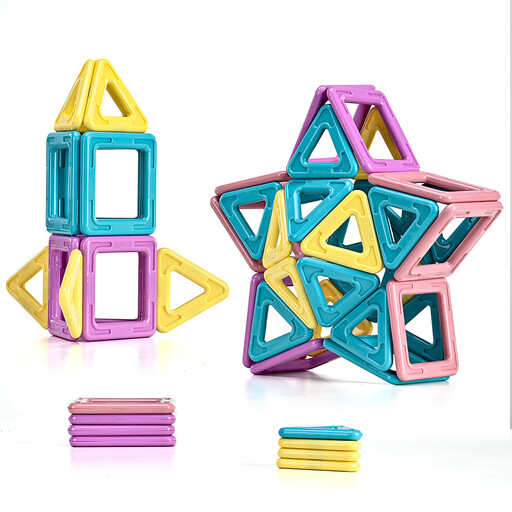
Why it suits this profile: A manageable starter set with 50 pieces, pastel colours and basic shapes for children aged 3 and over.
The product information clearly lists the pieces, basic shapes, age limit and warnings, so you don’t have to judge the set by the number of pieces alone.
50 pieces, ABS plastic, rounded edges, gift box and no batteries required.
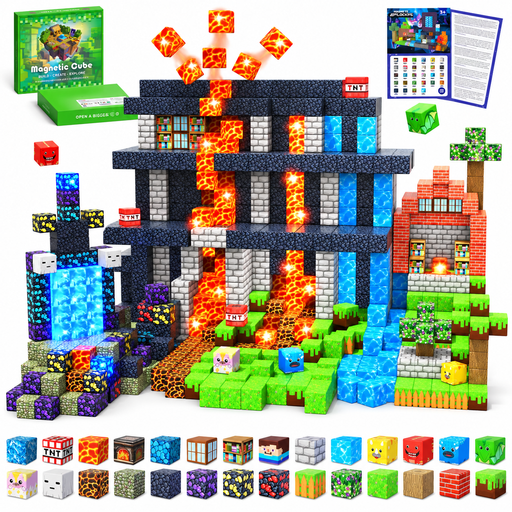
Why it suits this profile: The number of pieces is ideal for families planning larger builds or shared play.
The product title states that it contains 150 pieces, has rounded edges and is suitable from age 3. Before buying, however, check the full shape selection and safety information.
150-piece set, natural appearance according to the product name, and designed to support fine motor skills and spatial imagination.
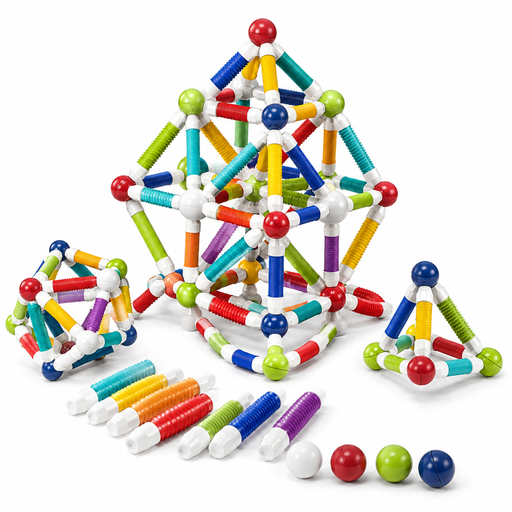
Why it suits this profile: The 85-piece version is an appealing choice for children who already build regularly and want more material than a starter set provides.
The product name states that it contains 85 pieces and features a retractable design. Before buying, check exactly how the storage function works and which shapes are included.
85 pieces, ABS plastic according to the product name, and supplied with a gift box.
We’ve put together a complete, up-to-date list of products that fully meet these strict selection criteria and the applicable European safety regulations.
Magnetic building blocks do not require batteries and generally need very little maintenance. Store them somewhere dry, away from direct sunlight and preferably in a box where you can quickly spot damaged pieces. Follow the manufacturer’s cleaning instructions. For the Tokky set, for example, a dry, soft cloth is recommended instead of water or liquid cleaners.
Before every use, check:
A set with lots of pieces can remain engaging for longer when children are free to build while also receiving examples, such as model cards. Don’t expect every child to automatically engage with STEM principles: asking questions together about balance, shapes and height often makes play more educational.
That depends on the specific set. Many magnetic tiles are labelled as suitable for children aged 3 and over, but contain small parts and strong magnets. Supervise children, check the warnings and do not let them put the blocks in their mouths.
For a first introduction, a set of around 50 pieces is often manageable. For larger builds, siblings or shared play, 85 to 150 pieces may be more useful. The selection of shapes is at least as important as the total number.
Yes, as long as the age range, interests and safety information are appropriate. Choose a compact 50-piece set for a beginner and a larger magnetic building set for children who already enjoy building. Always check the pieces before giving the gift and keep the packaging with its safety information.
