
Vandaag of morgen in huis

Kwaliteit gegarandeerd

Welkomstaanbiedingen ontgrendelen: GRATIS bezorging | Tot 80% korting | Gratis 30 dagen JoyPlus-proefperiode
Download de app
Magnetic building blocks combine construction, colours and free play. Children can create flat patterns before moving on to 3D constructions such as houses, vehicles or towers. For parents and grandparents, a set with lots of pieces may seem appealing, but the number of pieces does not tell the whole story.
For example, an inexpensive set may consist mainly of small shapes, while a larger box may contain few useful basic shapes. Terms such as “strong magnets” and “STEM toys” are also sometimes used without clear information about size, material or age suitability. The points below will help you choose magnetic construction toys more carefully and reduce the risk of making a disappointing purchase.
A 150-piece set sounds comprehensive, but check how the pieces are distributed too. For simple constructions, squares, equilateral triangles and right-angled triangles are more important than a large number of decorative elements. A set with 36 or 50 well-chosen basic shapes may be more practical for a beginner than a box containing lots of small accessories.
Magnetic tiles are not all the same size. Some sets have tiles measuring approximately 5 cm, while others use a size of 7.5 cm. Mini pieces are useful for travelling and detailed constructions, but they can be more difficult to grip. So check the dimensions and make sure they are suitable for the child’s age and motor skills.
Magnets and small parts require extra care. Check whether the product information states that the magnets are fully enclosed and that the edges have a smooth finish. Product listings may refer to standards such as EN 71, ASTM F963 or other safety statements. Treat this as information to verify, not as a reason to stop supervising play.
If a piece is damaged, cracked or has a loose magnet, it must be taken out of use immediately. Swallowing magnets can cause serious injury. Magnetic building blocks are not suitable for children under 3 years old, and adult supervision is advisable, particularly for younger children.
For children who are just starting to build, larger tiles are generally easier to hold. According to the product information, the XINQIYUAN set with 7.5 cm tiles contains 120 pieces and is designed for space-themed constructions. A 2.5 cm mini set takes up very little room and may be suitable for travelling, provided the small pieces are stored appropriately.
As well as the size, pay attention to the shapes:
Many magnetic tiles are made from ABS plastic. Look for a smooth finish without sharp edges, as well as information about how the magnets are enclosed. According to the product information for several of the sets mentioned, the magnets are ultrasonically welded or fully sealed. Nevertheless, check every piece when you receive it.
Cleaning methods vary by product. Some sets can be wiped with a slightly damp cloth, while other product information specifies using only a soft, dry cloth. Therefore, do not immerse magnetic tiles in water if the manufacturer does not permit this.
An age rating of 3+ does not mean that every child can play with the set independently. Consider the size of the pieces, the weight of the box and whether a storage case is included. A set with instructions or an ideas booklet can help children get started, while open-ended toys leave more room for their own designs.
Check compatibility too. The XINQIYUAN set with 7.5 cm tiles states that it is compatible with other sets of the same size. This does not automatically mean that every brand or tile will connect; the dimensions and magnetic connections must match.
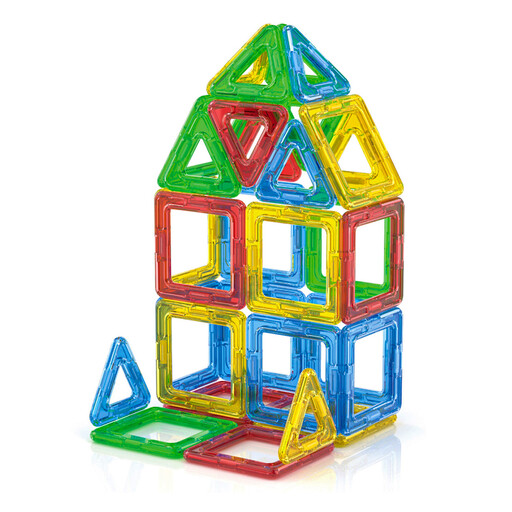
Why it suits this profile: This set of 36 mini magnetic tiles is a manageable starting point for children aged 3 and over, and comes in a colourful box.
The product states the exact number of pieces, the ABS material and the age rating. This means you do not have to rely solely on a general marketing claim.
36 lightweight pieces, smooth edges according to the product information, and no batteries required.
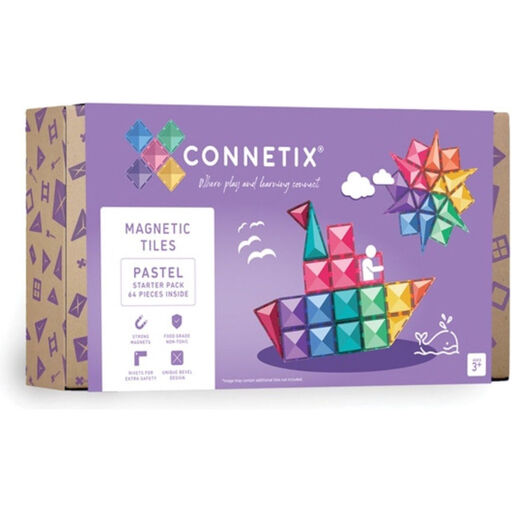
Why it suits this profile: This 64-piece set offers a range of basic shapes and is designed for children who want to spend longer on open-ended building activities.
The product information specifies the contents, the ABS material and ultrasonically welded pieces. It also states that the tiles are intended for 2D and 3D constructions.
64 pieces, eight pastel colours, and several types of triangles and squares.
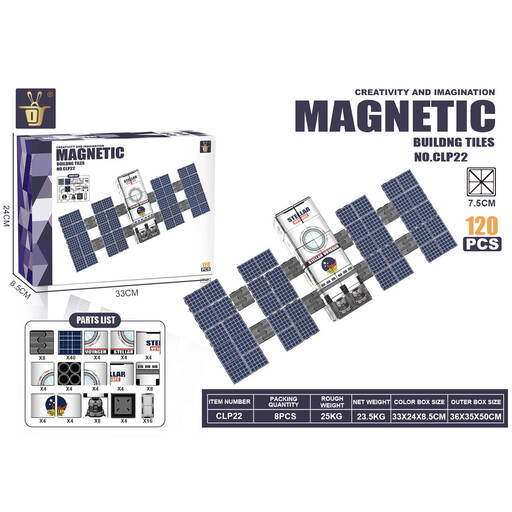
Why it suits this profile: The space theme, larger tiles and number of pieces are well suited to children who enjoy making elaborate constructions and playing together.
The product information states a tile size of 7.5 cm, 120 pieces and fully enclosed magnets. Nevertheless, check for damage when you receive it.
120-piece set, space theme and an ideas booklet included for guided building.
We have put together a complete, up-to-date list of products that fully meet these strict selection criteria and the applicable European safety regulations.
Many sets in this range have an age rating of 3+. However, they contain small parts and magnets. Therefore, supervise play, particularly with younger children, and check that the size is suitable for their motor skills.
For a first introduction, 36 to 50 pieces are generally manageable. If you want to build larger houses, towers or imaginary worlds together with a child, you could look at a set containing 64, 120 or 150 pieces. Always check which basic shapes are actually included.
Sometimes, but not always. Check the size of the tiles and the shape of the magnetic edges. Product information may mention compatibility, such as with certain sets measuring 7.5 cm, but do not assume that all brands will connect to one another.
