
Vandaag of morgen in huis

Kwaliteit gegarandeerd

Welkomstaanbiedingen ontgrendelen: GRATIS bezorging | Tot 80% korting | Gratis 30 dagen JoyPlus-proefperiode
Download de app
Magnetic building blocks may seem simple: a box of tiles, blocks or rods that children use to create shapes. However, sets can vary considerably in their age recommendations, magnetic connections, component sizes and materials. As a result, a low price may be less appealing if parts come loose easily, get lost or are not suited to your child’s stage of development.
In this buying guide, the Joybuy Product Recommendation Officer explains what to look for when choosing magnetic building blocks, magnetic tiles and other educational construction toys. You’ll also find recommendations for different needs, helping you choose a building set for children with greater confidence.
A set containing 150 parts may sound appealing, but the number alone tells you little without information about the mix of shapes. A good combination of squares, triangles and other shapes offers more possibilities than a large quantity of almost identical pieces. Also check whether examples or building ideas are included. These can help younger children get started and show whether the set is suitable for free-form building or mainly for creating specific models.
Brands often use terms such as ‘strong magnetic construction’. According to Tokky’s own product description, the magnets in its magnetic tiles are ultrasonically welded and enclosed. This is useful information, but you should also check the warnings for each product and inspect the condition of the parts after use.
Magnets must not be visible or loose. Swallowing multiple magnets can cause serious injury. Stop using the product immediately if a tile cracks or a magnet comes loose. You should also keep magnetic building blocks away from sensitive electronic devices, magnetic cards and medical equipment.
‘Toys for ages 3 and over’ does not mean that children can play without supervision. Small parts can pose a choking hazard. Consider your child’s motor skills, the size of the parts and the complexity of the building tasks. Most magnetic tiles and small ABS building blocks are not suitable for children under 3.
Larger tiles are generally easier for young children to hold. Mini tiles may offer more detail, but require better fine motor skills and closer supervision. For example, the XINQIYUAN set contains 2.5 cm magnetic tiles and, according to its product description, is intended for children aged 3 and over. Its compact size makes it convenient to take with you, but store all the parts carefully after play.
Also consider the surroundings. Play on a flat floor or sturdy table, check the parts before use and store the set in a box or storage container. This helps prevent loose tiles from disappearing under furniture.
Many magnetic building blocks for children are made from ABS plastic. Look for a smooth surface, rounded edges and a casing that securely encloses the magnets. According to Tokky’s own product description, the 50-piece and 36-piece sets are made from ABS and have smooth, burr-free edges. The stated EN 71 compliance should always be considered alongside the information on the product page and packaging.
Avoid products where the material, manufacturer, age recommendation or safety warnings are unclear. Clear product information makes it easier to compare options.
A starter set containing 36 or 50 parts is suitable for getting to know magnetic construction. A larger set of 100 to 150 parts offers more scope for large builds and shared play. However, check whether expansion sets use the same dimensions and connections. Not every magnetic building set is compatible with another.
Magnetic building blocks can support play centred around shapes, colours, balance and construction. For example, you could ask children why a tower falls over or which shape is needed for a roof. This helps develop spatial awareness, without turning the toy into an academic exercise.
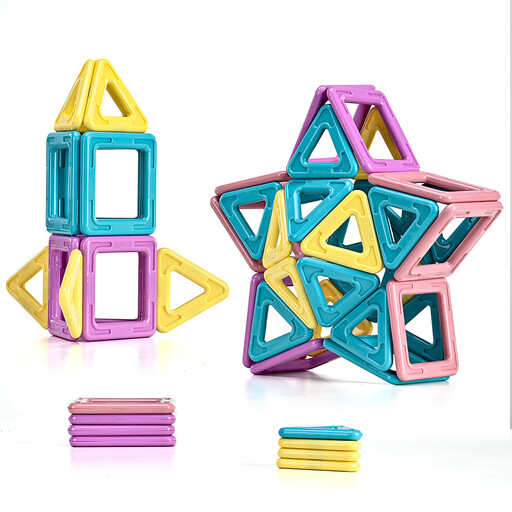
Why it suits this profile: The set contains 50 parts, soft pastel colours and gift packaging. This makes it easy to manage for a child’s first introduction to magnetic tiles.
The product description states that it is suitable from 3 years, with rounded edges and enclosed magnets. Nevertheless, check the parts regularly for damage.
50 ABS parts, triangular and square shapes, no assembly required, and suitable for flat and three-dimensional builds.
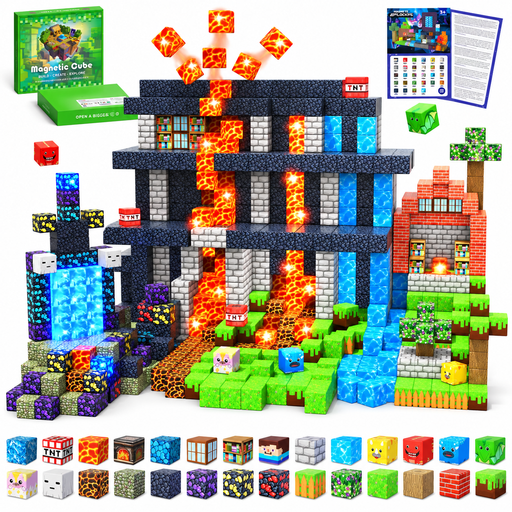
Why it suits this profile: With 150 parts, this set is a good choice for families who want to build larger structures together and enjoy one building set for longer.
The product name states that it has rounded edges and is suitable from 3 years. Read the full safety information before buying and check the magnet casing during use.
150 parts, natural design, rounded edges and a focus on fine motor skills and spatial imagination, according to the product listing.

Why it suits this profile: This model-building set is aimed at hobby builders and children aged 6 and over who enjoy assembling a specific aircraft model step by step.
The product description states that it is made from ABS and clearly recommends it for children aged 6 and over. The small parts make supervision essential for younger children.
511 parts, ABS material, aircraft theme, and suitable for building, parent-child interaction and hobby use.
We’ve put together a complete, up-to-date list of products that fully meet these strict selection criteria and the applicable European safety requirements.
That depends on the specific product. Check the age recommendation, the size of the parts and the safety warnings. Always supervise children when they are using magnetic toys and stop immediately if a part breaks or a magnet comes loose. Loose magnets must never be swallowed.
Always follow the product instructions. For various sets, the recommendation is to wipe the tiles with a soft, dry cloth and avoid using water or harsh cleaning products. Liquid can damage the casing or internal magnets.
Their lifespan depends on the material, use and storage. Store the parts in a dry place, away from direct sunlight and heavy pressure. Check for cracks, deformation and loose magnets before every use. A set that is stored carefully will generally remain usable for longer than toys left loose on the floor.
