What should you look for when buying?
First check your camera’s mount, then choose a magnification that suits your framing. Next, plan the space you need for lighting and decide whether a single plane of focus will be enough.
| What to consider |
What should you check? |
Who should consider this? |
| Camera mount |
Compare your camera’s mount with that of the exact lens version. Sigma, for example, offers separate versions for Sony E and L-Mount. |
I want to make sure I don’t choose a lens that won’t fit my camera. Around 31% of consumers prioritise compatibility. |
| Magnification |
Decide whether you’ll be photographing a complete figure or tiny details. Canon specifies a maximum of 0.5× for the RF 85mm F2 and a maximum of 1.4× for the RF 100mm F2.8L. |
I want brushstrokes or tiny ornaments to appear large enough in the frame. Around 25% of consumers give detail magnification top priority. |
| Room for lighting |
Check the working distance, not just the distance from the sensor. For the FE 90 mm F2.8 Macro G OSS, Sony specifies a working distance of around 13 cm at the close shooting distance discussed. |
I want to position a light beside the miniature while keeping the background dark. Around 25% of consumers focus mainly on having room for controlled lighting. |
| Sharpness across the figure |
Decide whether a single plane of focus will be enough, and check whether your shooting and editing workflow can combine multiple focus points. Keep your camera setup steady. |
I want features at different depths to appear sharp. Around 19% of consumers prioritise sharpness across the whole figure. |
Joybuy products
The Sony E lenses below are listed for close-up use, but their stated maximum magnification is below 0.5×. Check whether this is enough for the framing you want: one of the macro options described may be more suitable for very fine paint details.
 No image available
Sony E 50mm f/1.8 OSS Black
The Sony E mount fits a camera with the same mount, and the product details list close-up and macro photography as possible uses. The stated maximum magnification is 0.16×, so check whether this is enough for the framing you want.
Focal length: 50 mm. Maximum aperture: f/1.8.
View at Joybuy
 No image available
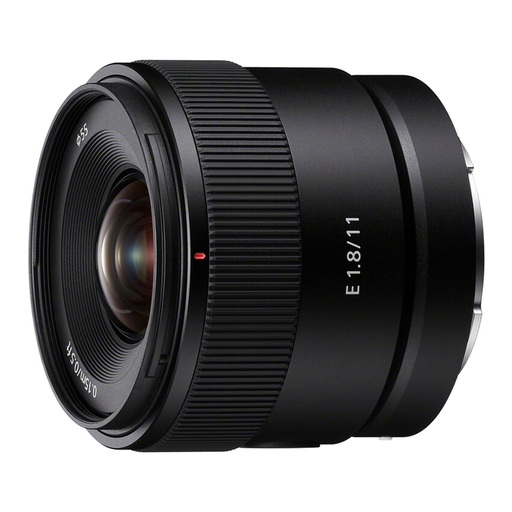
Sony E 11mm F1.8 APS-C ultra-wide-angle lens (SEL11F18)
The Sony E mount fits a camera with the same mount, and the product description mentions close-up photography. This lens is described as an ultra-wide-angle lens; check whether its stated magnification suits your subject.
Minimum focusing distance: 0.15 m. Maximum magnification: 0.20× with manual focus and 0.13× with autofocus.
View at Joybuy
Frequently asked questions
Is the minimum focusing distance the same as the space in front of the lens for a light?
No. Sony Netherlands distinguishes between the distance measured from the sensor plane and the working distance between the subject and the front of the lens. Check the working distance for your table setup.
Do you need to buy a faster macro lens for a dark background?
Not necessarily. Direct the light onto the miniature and limit the light on the background; also consider how much depth of field you need. Manufacturers’ guidance on low-key lighting and macro photography treats these as separate considerations.
How can you get protruding features of a miniature in focus at the same time?
With a stationary setup, you can combine shots taken at different focus points. Nikon Netherlands describes focus stacking as a way to increase the depth of field in a composite macro photo. Check which shooting and editing steps your equipment supports.
How should you store and maintain your lens?
Fit the appropriate lens caps whenever you’re not using the lens. Follow the instructions for your model when cleaning it or arranging any servicing; Canon, for example, describes cleaning the outer optics as a service procedure.
What consumer rights apply when you buy a lens online in the Netherlands?
According to ACM ConsuWijzer, for a standard online consumer purchase you generally have a statutory cooling-off period of up to 14 days after delivery, subject to applicable exceptions. You also have a statutory guarantee if the product, under normal use, does not do what you could reasonably expect; the retailer is your point of contact. This statutory right is not a guarantee period promised by the manufacturer.


