
Photographers capturing tiny fossil details
You want to fill the frame with small structures, so you compare the magnification of lenses that fit your camera.


First, choose a lens with the right mount and magnification for the fossil details you want to show. For an overall view, the angle of view and available working distance also matter. With fossils in relief, the lens alone won’t determine how much depth is in focus: plan for a stable setup, enough light and, if needed, focus stacking. The right option will depend on your camera and shooting conditions.
You want to fill the frame with small structures, so you compare the magnification of lenses that fit your camera.
You want to photograph a fossil so it’s clear from front to back. As well as the lens, you consider a stable setup, lighting and, if needed, focus stacking.
You’re looking for a lens with the right mount that lets you capture both full views and details within your available working distance.
Start with the mount and the framing you want. Then consider how much space, light and depth of field your fossil setup requires.
| What to consider | What should you check? | Who is this important for? |
|---|---|---|
| Mount and framing | Check your camera body’s mount and the lens version. Also compare the framing you want with the space available. | If I want to keep using my existing camera and frame the whole fossil, I check the mount and angle of view first. Around 33% of consumers prioritise compatibility and framing. |
| Fine structures | Compare the maximum magnification of the exact lens version with the size of the detail you want to capture filling the frame. | For small surface markings, I want to know how large the detail will appear on the sensor. Around 27% of consumers give detail magnification top priority. |
| Sharpness across relief | Consider whether you can take and combine a stable series of images with different focus points. | If my fossil has noticeable changes in height, I want the relief to remain clear from front to back. Around 20% of consumers prioritise sharpness across the relief. |
| Working distance and light | Look up the working distance for the exact model and the magnification you intend to use. It’s not the same as the minimum focusing distance. | When I need space to position lights around the fossil, I check how much room there is in front of the lens. Around 20% of consumers prioritise working space for lighting and the specimen. |
A close-up label doesn’t automatically mean a lens offers 1:1 reproduction.
Compare the maximum magnification of the exact version with the size of the detail you want to photograph.
If you later want to fill the frame with very small details too, you may need a different lens.
Minimum focusing distance is measured from the sensor; working distance is the space between the subject and the front of the lens. Nikon gives approximately 5 cm in front of the lens for the Z MC 50mm f/2.8 at its closest focusing distance.
Check the working distance of the exact model and try out your planned setup before you buy.
Depth of field can be shallow in macro photography. Focus stacking combines separate images taken at different focus points, but it requires extra shots and processing.
Plan for a stable setup and suitable lighting too. Check in advance that your camera and post-processing workflow are compatible with focus stacking.
Allow extra time to take and process the series of images.
The RF 100mm F2.8L Macro IS USM is an option for a compatible Canon RF camera, including if you’re looking for magnification above 1:1.
The NIKKOR Z MC 50mm f/2.8 and Z MC 105mm f/2.8 VR S are options for a compatible Nikon Z camera.
The FE 90mm F2.8 Macro G OSS and FE 100mm F2.8 Macro GM OSS are separate options for Sony E-mount cameras.
The 105mm F2.8 DG DN MACRO | Art is available for Sony E and L-Mount.
The 100mm f/2.8 2x Ultra Macro APO is designed for photographers who want to capture very small details at higher magnifications with a compatible version.
The FUJINON XF80mmF2.8 R LM OIS WR Macro is an option for the Fujifilm X system.
These Sony E lenses are options for close-ups and framing, but their stated magnification remains below 1:1. This is an important limitation if you want very small fossil details to fill the frame.
 No image available
An option for close-ups if a magnification ratio of 0.16 suits the framing you want; this isn’t 1:1 reproduction.
50mm prime lens with optical stabilisation. The stated weight is 202 g.
 No image available
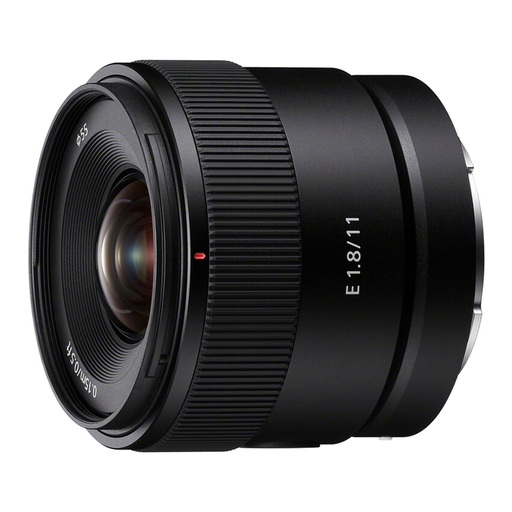
An ultra-wide-angle option for broad framing and close-ups, not for 1:1 images of very small fossil details.
Stated angle of view: 104°. Minimum focusing distance: 0.15 m. Magnification is 0.13× with autofocus and 0.20× with manual focus.
No, it depends on what you want to show. At 1:1, the subject is reproduced at life size on the sensor; Fujifilm describes 1:1 as life-size reproduction. For an overall view, the angle of view and available working distance may matter more than high magnification.
Use a stable setup and, if a single shot doesn’t provide enough depth of field, take several images at different focus points and combine them. Nikon describes focus stacking as combining images with different planes of focus; check that your camera and post-processing workflow are suitable for this technique.
Minimum focusing distance is measured between the subject and the sensor; working distance is measured from the subject to the front of the lens. Sony makes this distinction explicit. Look up the working distance for the exact lens and the magnification you plan to use.
Check whether your setup needs stable support and suitable lighting, and allow for extra shots and post-processing if you’re using focus stacking. The Government of the Netherlands states that there’s no fixed statutory warranty period in the Netherlands; ask the seller which service terms apply to your purchase.
Not in every case. The Government of the Netherlands states that a 14-day cooling-off period often applies to distance purchases, but there are exceptions. Check which terms apply to your purchase; this is separate from a remedy for a faulty product.