Who is this guide for?

Tile photographer with limited setup space

Wants to fit the whole tile into the frame on a small table, so compares angle of view, available camera height and tripod setup before considering maximum magnification. Canon Netherlands describes a tripod as a useful tool for achieving consistent product compositions.

Photographer capturing glaze details

Wants to photograph crazing, texture or other tiny surface details separately, and considers magnification and the space available for lighting in front of the lens. Nikon Netherlands, Tamron Europe, Sony Netherlands, Canon Netherlands and Sigma publish model-specific information about magnification and focusing distance.

Photographer with an existing camera body

Is looking for a lens that fits their camera mount and sensor format. Nikon Netherlands, Sony Netherlands, Tamron Europe and Sigma describe versions for different camera mounts, so check the exact version for your camera body.

What should you consider when choosing?

Shorter macro lens for wide views and details

Choose this option: if you usually need to fit the whole tile into the frame on a small table and can test the composition with your own setup.

Bear in mind: at maximum magnification, there may be limited space between the lens and the tile; Nikon gives a working distance of around 5 cm for the Z MC 50mm at its closest focusing distance.

Around 90–105 mm macro lens for small details

Choose this option: if you want to fill the frame with tiny details and have enough room to test your preferred tile composition too.

Bear in mind: with the same setup, the angle of view is narrower than with a shorter focal length. Tamron’s statement about flat-field correction is a manufacturer’s claim, not an independent test of tile photography.

Test your existing lens and setup first

Choose this option: if a full view of the tile matters more than a life-size detail; start by taking test shots with a lens that fits your camera body.

Bear in mind: a tripod helps you keep the composition fixed, but it won’t change the lens’s angle of view or maximum magnification.

What to consider What should you check? Who is this important for?
Framing the whole tile Note the tile dimensions, sensor format and available distance between the camera and the table. Test the framing with the exact lens version. If I want to photograph the whole tile on a small table, getting the framing right matters more than maximum magnification. Around 28% of consumers give framing top priority.
Magnification for details Compare the maximum magnification of the exact lens version and consider whether you want to capture the whole tile, a pattern or a tiny surface detail. If you want to fill the frame with crazing or texture, focus on magnification. Around 22% of consumers prioritise this level of detail.
Mount and sensor format Check the camera body, lens mount, sensor crop and version code. The model name alone doesn’t confirm compatibility. If I want to keep using my existing camera, the lens version needs to fit my camera body. For around 22% of consumers, compatibility is the first selection criterion.
Gloss and colour Allow room for lighting or diffusion, keep your setup consistent and check the white balance under the lighting you’re using. If gloss and colour reproduction matter to you, you’ll want to photograph the tile under controllable lighting. Around 17% of consumers prioritise these shooting conditions.
Equipment you’ll need besides the lens Check what tripod and lighting equipment you have, and find out which accessories are included with each version before you decide. If I want to get a clear picture of the complete setup for the table, I also consider the tripod, lighting and included accessories. Around 11% of consumers give the overall cost of the lens and setup top priority.

Common buying mistakes

  • Confusing maximum magnification with a full view of the tile

    Maximum magnification describes how large a small subject can appear in the image; it doesn’t tell you how much of the tile will fit in the frame.

    Test wide shots and detail shots separately, using the actual tile dimensions and available space.

    You may need a different setup or lens for wide shots than you do for tiny details.

  • Mistaking the minimum focusing distance for the clear space in front of the lens

    Focusing distance and working distance are measured from different points. For the Z MC 50mm, Nikon gives a distance of around 5 cm between the front of the lens and the subject at the closest focusing distance.

    Check the working distance of the exact lens and think about where you can position the light in relation to the lens and tile.

    A short working distance may mean adjusting your lighting position or camera angle.

  • Trying to fix reflections on glossy ceramics with a different lens alone

    Reflections and colour reproduction are also affected by the lighting setup and white balance; changing your lens won’t resolve these issues on its own.

    First, check the position of the light and the white balance. Only consider a polarising filter if the resulting change in visible gloss suits the look you want.

    Achieving the look you want may require more attention to lighting control or the use of a filter.

Brands to compare

Nikon

Nikon offers macro lenses for Z cameras, including the NIKKOR Z MC 50mm f/2.8 and the Z DX MC 35mm f/1.7.

  • For the Z MC 50mm, Nikon gives a maximum magnification of 1:1 and a working distance of around 5 cm at the closest focusing distance.
  • For the Z DX MC 35mm, Nikon gives a reproduction ratio of 0.67×, equivalent to 1:1 in 35mm/FX format; this is not an optical 1:1 specification.

Tamron

The 90mm F/2.8 Di III MACRO VXD (F072) is a 1:1 macro option that Tamron lists in Sony E and Nikon Z versions.

  • Tamron says the lens offers flat-field correction for flat subjects such as documents.
  • This is a manufacturer’s claim, not an independent measurement of sharpness on ceramic tiles. Also check that you have the right mount and that your setup can fit the whole tile in the frame.

Sony

The FE 90mm F2.8 Macro G OSS (SEL90M28G) is a Sony E-mount lens with a stated maximum magnification of 1.0×.

  • Sony gives a minimum focusing distance of 0.28 m and describes a working distance of around 13 cm in its macro guide; these are different measurements.
  • On an APS-C camera, the angle of view is narrower than on a full-frame camera, which matters when framing the whole tile.

Canon

The RF 100mm F2.8L Macro IS USM is an RF-mount lens with a maximum magnification of 1.4×, according to Canon.

  • Canon gives a minimum focusing distance of 0.26 m.
  • This is a focusing distance, not the clear space in front of the lens. Also test whether a 100mm angle of view suits the tile and your small table.

Sigma

According to Sigma, the 105mm F2.8 DG DN MACRO | Art is available with a Sony E or L mount.

  • Sigma gives a maximum reproduction ratio of 1:1 and a minimum focusing distance of 29.5 cm.
  • The focusing distance isn’t a stated working distance in front of the lens. Check the space you’ll need with your own camera and table setup.

Joybuy products

This Joybuy selection includes Sony E lenses for wide views or limited close-ups. Both models have a stated maximum magnification below 1:1, so check whether they’ll capture the glaze details you want.

Sony E 50mm f/1.8 OSS Black

Sony E 50mm f/1.8 OSS Black

May suit product photography and limited close-ups if this lens works with your Sony E camera and the framing you want. Its stated magnification isn’t intended as a substitute for a 1:1 macro lens when capturing very small details.

Focal length: 50mm. Maximum magnification: 0.16×.

View at Joybuy
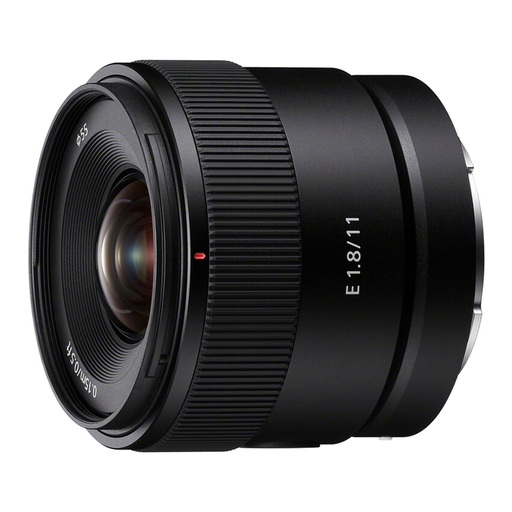
Sony E 11mm F1.8 APS-C Wide Angle Prime Lens SEL11F18

Sony E 11mm F1.8 APS-C Wide Angle Prime Lens (SEL11F18)

The stated angle of view may be useful if you want to try a wide view on a small table. Its limited magnification means this lens isn’t a substitute for a macro lens when you want to fill the frame with glaze details.

Focal length: 11mm. Angle of view: 104°. Maximum magnification: 0.13× with autofocus or 0.20× with manual focus.

View at Joybuy

Frequently asked questions

Do I need 1:1 magnification to photograph a whole tile?

No. 1:1 describes maximum magnification for small details; it isn’t necessary for a full view of the tile. For a wide shot, check the tile dimensions, angle of view and available camera distance. Use higher magnification if you want to take close-up detail shots.

How can I keep a series of tile photos consistent?

Keep the camera and tile in fixed positions, and check the framing using a tripod. Set the white balance for the lighting you’re using. With glossy ceramics, check the lighting position before considering a filter.

Is the minimum focusing distance the space I need for my light?

No. Focusing distance and working distance are measured from different points. Sony explains the difference; for the Z MC 50mm, Nikon gives around 5 cm of space in front of the lens at the closest focusing distance.

What are my rights if a lens from a Dutch retailer is faulty?

According to ACM ConsuWijzer, the retailer is responsible for the legal guarantee if the product doesn’t meet what you could reasonably expect when used normally. A solution could be a repair, replacement or refund; the appropriate option depends on the circumstances.

Can I return a lens I bought online after it arrives?

For a standard online consumer purchase, ACM ConsuWijzer says you’ll generally have a statutory cooling-off period of up to 14 days after delivery. Check the terms and exceptions that apply to your purchase; buying from a physical shop doesn’t automatically give you the same right.
