
Photographer with an existing camera
First, check that the lens fits your camera’s mount. The macro lenses researched are available for different systems, as shown in the specifications from Canon, Sony, Fujifilm and Sigma.


You don’t automatically need a macro lens to photograph a whole card on a white background: Canon Netherlands recommends a standard lens for flat lays, while CameraNU.nl recommends macro lenses for close-ups. If you want to capture the texture of the paper or small embellishments in detail, compare the magnification and exact camera mount, and make sure you have enough room for your camera and lighting. A fixed set-up helps you frame cards consistently, as Canon Netherlands explains.
First, check that the lens fits your camera’s mount. The macro lenses researched are available for different systems, as shown in the specifications from Canon, Sony, Fujifilm and Sigma.
For repeatable photos of whole cards against a clean white background, composition, lighting and a stable camera set-up are all important. Canon Netherlands describes a tripod as a useful aid for taking consistent product photos.
If you want to show embossing, paper texture or small embellishments individually and at a larger scale, look at close-focusing capability and maximum magnification. Manufacturers list these features for models including the Canon RF 100mm, Sony FE 90mm and Fujifilm XF30mm.
Choose this if: you mainly want to photograph the whole card from above and your current lens can focus on it.
Bear in mind: if you want to fill the frame with small embellishments, check whether the lens can focus close enough.
Choose this if: you want to photograph both the card and its details, and the version you choose fits your camera.
Bear in mind: Fujifilm lists 1:1 magnification and a minimum focusing distance of 0.10 m for the XF30mm, measured from the focal plane; this is not the working distance in front of the lens.
Choose this if: you want to capture small textures in detail and also have enough room to fit the whole card in the frame.
Bear in mind: a longer focal length may require a different camera distance or set-up to achieve the same framing; check that you have enough room before choosing.
| What to consider | What should you check? | Who is this important for? |
|---|---|---|
| Camera compatibility | Note your camera model and check the exact mount and lens version. Sigma, for example, offers versions with Sony E and L mounts; check the variant with Sigma. | I want to know in advance whether the lens will fit my camera. Around 33% of consumers say camera compatibility is their top purchasing priority. |
| Fitting the whole card in the frame | Take a test shot with a card in your usual size and check the framing and amount of white space you want. Canon Netherlands recommends a tripod as an aid to consistent composition. | I want to photograph the whole card clearly with the same framing each time. Around 27% of consumers prioritise capturing the entire card. |
| Small details | Compare the maximum magnification of the exact lens version. Fujifilm, Sony and Sigma list 1:1 for the macro models mentioned; Canon lists up to 1.4× for the RF 100mm. | I want to show paper texture or small embellishments individually and at a larger scale. Around 20% of consumers prioritise detailed close-ups. |
| Keeping whites and lighting consistent | Test the background, lighting and camera position together; also check that light-coloured details on the card remain visible. Canon Netherlands discusses the background and lighting as parts of the product set-up. | I want to photograph several cards against a similarly white background. Around 20% of consumers say a consistent photography set-up is their top priority. |
Maximum macro magnification describes how well a lens can capture details at close range. A standard lens may be enough for a flat lay; Canon Netherlands describes using a standard lens for flat lays.
First, take a test shot of the whole card. Then decide whether you also need separate close-ups of the details.
Fujifilm measures the XF30mm’s minimum focusing distance from the focal plane. This specification therefore doesn’t tell you how much room there is in front of the lens.
Check the space between the lens, card and lighting in your own set-up.
When working at close range, it can be harder to position the lighting in front of the lens.
A lens feature won’t automatically keep the background, lighting and framing the same for every card. Canon Netherlands recommends a tripod as an aid to taking consistent product photos.
Test the camera, background and lighting as one set-up before assuming that inconsistent photos are down to the lens alone.
The XF30mmF2.8 R LM WR Macro is an X system option for anyone looking to combine a relatively short focal length with detailed close-ups.
The FE 90mm F2.8 Macro G OSS, model SEL90M28G, is an E-mount option for individual close-ups.
The RF 100mm F2.8L Macro IS USM is an option for the RF system.
The 105mm F2.8 DG DN MACRO | Art is available in versions with Sony E and L mounts.
The AF-S DX Micro-Nikkor 40mm f/2.8G is a shorter macro option for a compatible Nikon DX DSLR.
These are standard lens options to consider if you mainly want to photograph the whole card. Check the mount and test your preferred framing with your card size; a macro lens may be more suitable for small details.
 Image unavailable
A standard 50mm prime to consider for photos of the whole card; take a test shot to check that the framing and focus you want suit your card size.
The product name lists a focal length of 50 mm and a maximum aperture of f/1.8.
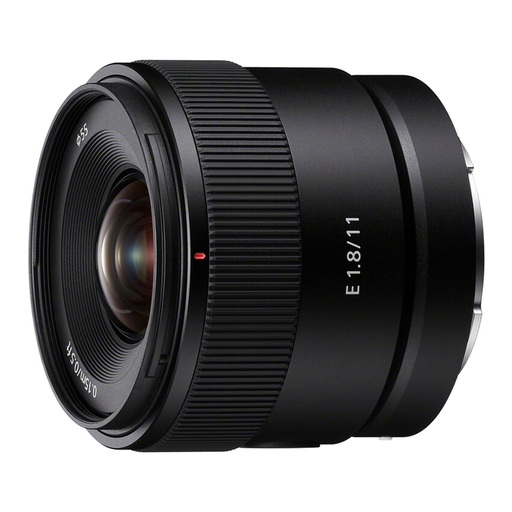 Image unavailable
An ultra-wide-angle option for photographing a whole card; take a test shot to see whether the framing suits your card and set-up.
The product name lists 11 mm, F1.8 and APS-C. Check that this lens version is compatible with your camera before choosing it.
Not necessarily. A standard lens may be enough for a flat lay; first, try to see whether your existing lens can capture the whole card in focus with the framing you want. A macro lens is most useful if you also want to photograph small details at a larger scale.
The depth of field can be very shallow when you’re taking photos at close range. If a single shot isn’t enough, you can use a stable camera to take several shots at different focus distances and stack the images; check whether your camera or software supports this technique.
Keep the camera set-up and framing the same, and check the exposure with a test shot. Canon Netherlands recommends a tripod as an aid to taking consistent product photos, and discusses the background and lighting as parts of the set-up.
For eligible online consumer purchases, you generally have a 14-day cooling-off period, according to the Dutch government. There is no fixed statutory warranty period in the Netherlands; if a product is faulty, the seller must provide a solution. The rules that apply depend on the purchase and the circumstances.