
Photographers focusing on nib details
You want to capture engravings, the shape of the nib and small finishing details clearly. Compare the maximum magnification and how precisely you can focus.


First, check that the lens mount and sensor size are compatible with your camera. Then choose the magnification you need for nib details and the angle of view for photos of the whole fountain pen. A shorter macro lens can help with both overall shots and close-ups, while a longer or more powerful model may give you more room around the pen, but will require different framing. The working distance in front of the lens, your lighting set-up and your focusing technique all matter too.
You want to capture engravings, the shape of the nib and small finishing details clearly. Compare the maximum magnification and how precisely you can focus.
You want to photograph the whole pen and sometimes highlight a particular detail too. Look at the angle of view and close-up capabilities, not just the maximum magnification.
You want to be able to position lights around a glossy pen. Consider the working distance in front of the lens and try diffused light to control reflections.
Start by checking the camera mount and sensor size. Then decide how small you need the detail to appear in the image, and check that your set-up has enough room for framing and lighting.
| What to consider | What should you check? | Who should pay particular attention? |
|---|---|---|
| Camera compatibility | Note your camera model, mount and sensor size, then check the exact lens version. | I want to avoid buying a lens that won’t fit my camera. Around 25% of consumers prioritise compatibility. |
| Magnification for nibs and engravings | Compare the maximum magnification of the exact model with the size of the smallest detail you want to photograph. | If you want small engravings to fill the frame, magnification is a top priority. Around 25% of consumers give detail magnification the highest priority. |
| Room for lighting | Distinguish the minimum focusing distance from the working distance between the front of the lens and the pen. Try your set-up with diffused light. | I want to be able to position lights around a glossy pen and minimise reflections. Around 20% of consumers prioritise working distance and lighting. |
| Framing the whole fountain pen | Measure the space between the pen, camera and background, and compare the angle of view for your sensor size. | When the whole pen is the main subject, suitable framing is more important than maximum magnification. Around 15% of consumers make this their top priority. |
| Depth of field and technique | Check the focusing controls and whether your camera and technique support the shots you want to take at different focus points. | I want to capture the nib and engraving in focus in a repeatable series of shots. Around 15% of consumers prioritise this technique. |
Maximum magnification varies by model and partly determines how large a small nib detail will appear in the image.
Compare the stated maximum magnification of the exact model with the detail you want to photograph.
The minimum focusing distance doesn’t tell you how much working space is left in front of the lens. For the NIKKOR Z MC 50mm f/2.8, Nikon states that the distance between the front of the lens and the subject is approximately 5 cm when focusing at close range.
Check the working distance at the magnification you want to use, and test your set-up on your table.
A higher stated magnification doesn’t remove the need to think about lighting and focusing. Diffused light can help with reflective surfaces; focus stacking involves taking and combining separate shots.
Plan your lighting and focusing technique at the same time as choosing your lens.
A diffuser or stable set-up may be part of your technique; taking and combining multiple shots also takes time.
Canon offers RF camera users, among other options, a 35mm lens for wider shots and close-ups, and a 100mm macro lens for greater magnification.
The NIKKOR Z MC 50mm f/2.8 is a Z-system lens for both 1:1 detail shots and wider framing.
The FE 90mm F2.8 Macro G OSS, model SEL90M28G, is a Sony E option for anyone looking for 1:1 magnification and 90mm framing.
The 90mm F/2.8 Di III MACRO VXD, model F072, is available in separate Sony E and Nikon Z versions for full-frame mirrorless cameras.
According to Laowa, the CF 65mm F2.8 CA-Dreamer Macro 2X is designed for APS-C and is available with various mounts.
These product choices are Sony E lenses with an APS-C designation. Their stated magnification ratios don’t reach 1:1, so assess them for the framing you want rather than as equivalent replacements for high macro magnification.
 Image unavailable
Compatible with a Sony E camera with an APS-C sensor, and may suit close-ups that don’t require high macro magnification; the stated magnification ratio is 0.16.
50 mm; maximum aperture f/1.8; minimum focusing distance 39 cm; weight 202 g.
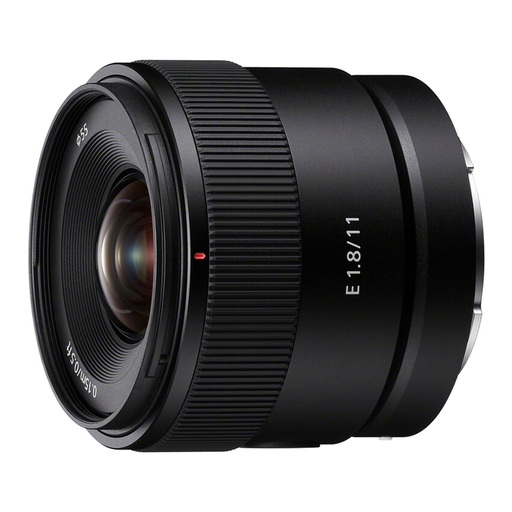 Image unavailable
An ultra-wide-angle lens for wide framing with a Sony E camera with an APS-C sensor. Its stated magnification ratio is up to 0.20 in MF, so it isn’t a high-magnification macro option for small pen details.
Angle of view 104°; minimum focusing distance 15 cm; magnification ratio 0.13 in AF and 0.20 in MF.
No. First decide how large you want the whole pen to appear in the frame. Canon states that the RF 35mm F1.8 MACRO IS STM offers up to 1:2 magnification, while the Nikon Z MC 50mm f/2.8 reaches 1:1. Whether you need extra magnification depends on your preferred framing and camera mount.
Try diffused light or a diffuser, and change the position of the light source and the pen. Basler describes diffused lighting for highly reflective surfaces; this use has not been tested specifically with fountain pens.
If your set-up allows, take shots with different focus points and combine them using focus stacking. Nikon describes this as a technique that combines multiple shots taken at different focus points. Check which shooting and software steps your camera requires.
According to ACM ConsuWijzer, the cooling-off period for online purchases generally ends 14 days after delivery; check whether an exception applies to your purchase. The Dutch government states that the Netherlands has no fixed statutory warranty period, and that if a product is faulty, you should contact the seller to get a product that works properly.