
Detail photographer
Want to capture a small feature, such as a clasp, gemstone or texture, on its own? Compare the maximum magnification and consider how precisely you can focus on that detail.


For costume jewellery accessories in a home studio, first choose a lens with a mount that fits your camera, then decide how much magnification you need: at 1:1, the subject is reproduced at life size on the sensor, while at 0.5× it appears smaller. Also compare the working distance in front of the lens with the space you need for your subject and lighting. As Sony Netherlands explains, the minimum focusing distance measured from the sensor plane is not the same as the working distance. For still accessories, precise focusing and focus stacking may be useful; Canon Netherlands describes focus bracketing and focus stacking for models including the EOS R7 and EOS R10.
Want to capture a small feature, such as a clasp, gemstone or texture, on its own? Compare the maximum magnification and consider how precisely you can focus on that detail.
If you have limited space around the accessory, check how much room there is between the front of the lens and your subject at the magnification you want. Sony Netherlands distinguishes between this working distance and the minimum focusing distance.
For repeated shots of still accessories, it’s worth considering how to keep the parts you want in focus and make your set-up stable. Canon Netherlands describes focus bracketing and focus stacking for the EOS R7 and EOS R10.
Start by checking your camera’s mount. Then decide how small a detail you want to show, and check that there’s enough working space for your accessory set-up and lighting.
| What to consider | What to look for when buying | Who might find this most important? |
|---|---|---|
| Magnifying small details | Compare the maximum magnification with the smallest feature you want to show on its own; distinguish between 1:1, more than 1:1 and 0.5×. | If I want to capture a clasp or gemstone separately and make it appear large, I look at the maximum magnification. Around 33% of consumers prioritise this level of detail. |
| Mount and version | Make a note of your camera model and mount, then check the full lens name and version. | I want to know in advance whether the lens will fit my camera, especially when a model is available in several versions. Around 27% of consumers prioritise compatibility. |
| Room for your subject and lighting | Compare the working distance at the magnification you want; don’t confuse it with the minimum focusing distance measured from the sensor plane. | When there’s little space around my accessory, I want to know whether I can still light the subject properly. Around 20% of consumers focus mainly on the available working space. |
| Keeping the accessory in focus | Check which focusing or bracketing functions your camera offers and whether a fixed set-up suits the way you work. | If I want to show several parts of a still accessory in focus, I look at my camera’s focusing options. Around 20% of consumers prioritise this. |
Maximum magnification varies from lens to lens. Canon lists a maximum of 0.5× for the RF 85mm F2 Macro IS STM and 1.4× for the RF 100mm F2.8L Macro IS USM.
Compare the stated maximum magnification with the smallest detail you want to photograph, rather than relying on the product name alone.
The minimum focusing distance is measured from the sensor plane; the working distance is the space between the front of the lens and the subject. For the Fujifilm XF30mmF2.8, Fujifilm states that at 1:1 the distance from the front of the lens is approximately 1.2 cm.
Check the working distance at the magnification you plan to use, and make sure there’s still room for your accessory and lighting.
Lenses aren’t automatically compatible with every camera. For example, Sigma lists versions of the 105mm F2.8 DG DN MACRO | Art for Sony E and L-Mount.
Before buying, check your exact camera model, mount and the full lens version. Choosing the wrong version could mean you need to select another one or return the lens.
Canon lists macro lenses for EOS R cameras with different maximum magnifications.
According to Sony Netherlands, the FE 90mm F2.8 Macro G OSS is a 1:1 lens with a Sony E mount.
According to Nikon Netherlands, the NIKKOR Z MC 105mm f/2.8 VR S is a 1:1 lens for the Nikon Z system.
According to Fujifilm, the FUJINON XF30mmF2.8 R LM WR Macro is a 1:1 lens for the X system.
Sigma lists the 105mm F2.8 DG DN MACRO | Art as a 1:1 lens for Sony E or L-Mount cameras, depending on the version.
OM SYSTEM lists macro lenses for Micro Four Thirds, including the M.Zuiko Digital ED 60mm F2.8 Macro and the ED 90mm F3.5 Macro IS PRO.
These Sony E lenses are options for general accessory and close-up shots. Their stated magnifications are limited if you want to fill the frame with very small details; for that, choose a lens with magnification suited to the detail.
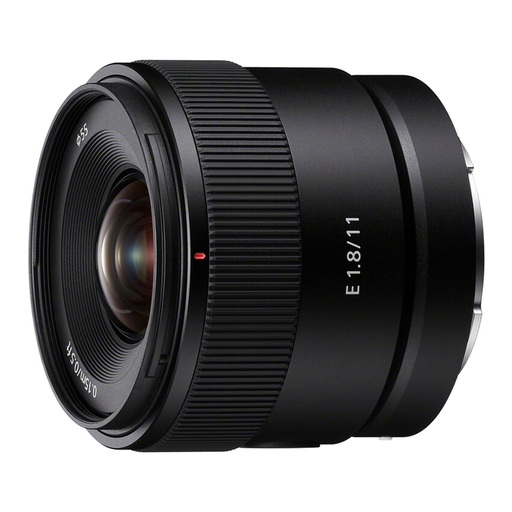 No image available
This lens may suit general accessory shots when you don’t need high magnification; its stated magnification is 0.13× with AF and 0.20× with MF.
11 mm; F1.8; minimum focusing distance 0.15 m.
 No image available
This lens may suit general accessory product photography if you don’t need 1:1 magnification; its stated maximum magnification is 0.16×.
50 mm prime lens; F1.8; autofocus; stated weight 202 g.
No. Lower magnification may be enough for an entire accessory. At 1:1, the subject is reproduced at life size on the sensor; at 0.5×, the image is half life size. Compare this with the smallest detail and the framing you want.
Depth of field can be very shallow in macro photography. For a still accessory, you can focus precisely and use a stable set-up; focus stacking combines shots taken at different focus positions. Check whether your camera has the functions you need: for example, Canon lists focus bracketing and focus stacking for the EOS R7 and EOS R10.
Consider whether you already have a suitable tripod and lighting for your set-up; these aren’t shown to be essential parts of every lens. Nikon Netherlands mentions a tripod as a way to prevent camera shake and focus precisely.
For many online purchases from a business, you have a 14-day cooling-off period, according to the Dutch government. There are exceptions, and the type of purchase matters: a business purchase or a purchase from a private seller doesn’t automatically fall under the same consumer rules.