First, check that the lens mount is compatible with your camera, then choose a magnification that suits your subject. A close-up lens may be enough to capture an entire shell, while 1:1 or greater magnification shows tiny details larger on the sensor. Also compare the working distance with the space available where you find your subject, and consider the weight, available light and limited depth of field. The highest magnification isn’t automatically the most practical choice on a walk.
Who is this choice relevant to?
Detail photographers with a mirrorless camera
If you want to capture ridges and coils in close detail, first check your camera’s mount, then compare magnification and working distance. Sony Netherlands, Canon Europe and Nikon Netherlands describe these lens features for their respective models.
Campers with a lightweight camera bag
If you want to take travel photos as well as pictures of shells, weigh up the complete camera kit against the magnification you need. Nikon Netherlands and OM SYSTEM Netherlands describe compact macro options for their own camera systems.
Photographers in shady spots
If you need room to focus and get light onto the shell, consider the working distance and the shallow depth of field in macro photography. Sony Netherlands explains the difference between working distance and focusing distance; Nikon Netherlands describes focus stacking for greater depth of field.
What should you look for when choosing?
| What to consider |
What to look for when buying |
Who is this important to? |
| Camera compatibility |
Check your camera model, mount and exact lens version; also consider what the magnification means for your sensor size. |
If I want to keep using my current camera, I first check that the mount and lens version are compatible. For around 36% of consumers who prioritise compatibility, this is their main concern. |
| Magnification for detail |
Compare the maximum reproduction ratio of the exact lens, for example 0.5×, 1:1 or 1.4×, with the detail you want to photograph. |
If you mainly want to show tiny ridges and coils in close detail, compare the reproduction ratio with the level of detail you want. Around 29% of consumers prioritise this level of detail. |
| Portability |
Compare the weight of the lens and camera body, and check whether the lens will also suit your usual travel photography. |
If I want to take one kit for both macro and travel photos on a camping trip, I consider the weight of everything I’ll be carrying. Portability is the main concern for around 21% of consumers. |
| Working space and focus |
Check the working distance from the front of the lens, and find out what focusing options are available for small subjects. |
In a shady or overgrown spot, I want enough room to frame and light my subject. Around 14% of consumers are most concerned about working space, light and focusing. |
Common purchasing mistakes
-
Assuming every macro lens offers 1:1 magnification
The word ‘macro’ alone doesn’t tell you how large a tiny detail will appear on the sensor. Canon specifies a maximum of 0.5× for the RF 35mm F1.8, while other lenses mentioned offer 1:1 or more.
Check the maximum reproduction ratio of the exact lens version and decide in advance how small the detail you want to show is.
You may need an additional lens if its magnification isn’t suited to the tiny details you want to capture.
-
Confusing working distance with focusing distance
Focusing distance is measured from the sensor; working distance is the space between the front of the lens and the subject. These measurements therefore don’t tell you the same thing about the clearance available in an overgrown spot.
Check the working distance at the magnification you’ll actually be using.
-
Assuming stabilisation or weather protection solves everything
Canon gives the RF 100mm a lower stabilisation rating at 1.0× than in other conditions. Dust- and moisture-resistant construction also doesn’t completely prevent them from getting inside; Sigma distinguishes between resistance to light rain and waterproofing for its 105mm DG DN.
Assess the focusing, support and weather protection of your camera and lens separately.
At a wet or dark spot, you may also need support or a way to keep your equipment dry.
Brands with macro lenses to compare
Canon
RF close-up options for compatible Canon cameras, from a versatile 35mm lens to a 100mm macro lens.
- Canon specifies a maximum of 0.5× for the RF 35mm F1.8 and a maximum of 1.4× for the RF 100mm F2.8L.
- Canon lists the RF 100mm as weighing 685 g. Its dust- and moisture-resistant construction doesn’t completely prevent ingress; the maximum stabilisation rating isn’t maintained unchanged at macro distances.
Nikon
Nikon Z options with 1:1 magnification, including 50mm and 105mm lenses.
- Nikon specifies a reproduction ratio of 1:1 for both the NIKKOR Z MC 50mm f/2.8 and the NIKKOR Z MC 105mm f/2.8 VR S.
- When considering the 105mm, factor in your preferred level of portability and your camera mount; descriptions of sharpness and stability are Nikon’s own claims.
Sony
The FE 90mm F2.8 Macro G OSS is a Sony E option for comparing 1:1 magnification, optical stabilisation and working distance.
- For this model, Sony specifies 1.0× magnification, a weight of 602 g and a working distance of around 13 cm at the closest focusing distance.
- These figures apply to the FE 90mm; Sony’s explanation of working distance isn’t an independent performance test.
Tamron
The 90mm F/2.8 Di III MACRO VXD is available in Sony E and Nikon Z versions.
- Tamron lists a reproduction ratio of 1:1.
- The listed weight varies by version: 630 g for Sony E and 640 g for Nikon Z. Check which mount you need.
Sigma
The 105mm F2.8 DG DN MACRO | Art is a 1:1 option for L-mount and Sony E.
- Sigma specifies 1:1 magnification and lists a weight of 710 g for Sony E and 715 g for L-mount.
- According to Sigma, the construction can withstand light rain, but the lens isn’t waterproof.
OM SYSTEM
The M.Zuiko Digital ED 60mm F2.8 Macro is a 1:1 option for Micro Four Thirds.
- OM SYSTEM lists 1.0× magnification on Micro Four Thirds and a 35mm-equivalent magnification of 2.0×.
- The 2.0× 35mm-equivalent figure doesn’t mean a physical 2:1 magnification on the sensor. Check that it’s compatible with your camera body.
Joybuy products for lightweight close-ups
These Joybuy products are lightweight Sony E lenses for close-ups with magnification below 1:1; they’re not a substitute for a macro lens if you want to capture very tiny shell details in close-up.
 No image available
Sony E 50mm f/1.8 OSS Black
A lightweight choice for close-ups on a camping trip, if its lower magnification suits the detail you want to capture.
Listed weight: 202 g. Maximum magnification: 0.16×.
View at Joybuy
 No image available
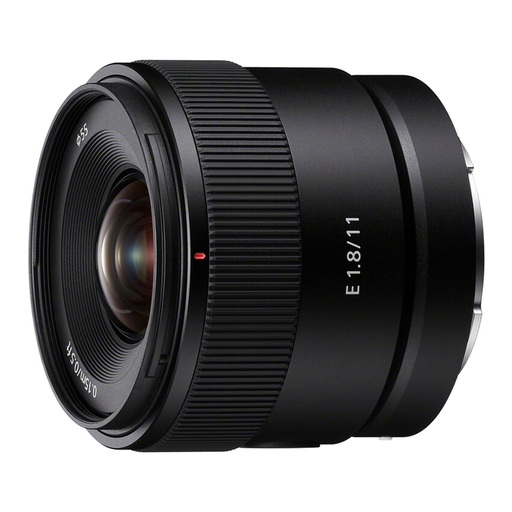
Sony E 11mm F1.8 APS-C Wide Angle Prime Lens (SEL11F18)
A lightweight wide-angle lens whose product description also mentions close-up photography; its low magnification means it isn’t a 1:1 macro lens.
Listed weight: 181 g. Aperture: f/1.8. Angle of view: 104°. Magnification: 0.13× with AF or 0.20× with MF.
View at Joybuy
Frequently asked questions
Is the closest focusing distance the clear space between the lens and the shell?
No. Sony defines the closest focusing distance from the sensor, and the working distance from the front of the lens. To check the space and light available where you find your subject, focus on the working distance of the exact lens.
How can I get more of a still shell in focus?
Support your camera, check where the plane of focus falls and, if needed, try taking several shots with different focus points. Nikon describes focus stacking as combining these images to increase depth of field; check which shooting and processing options your camera offers.
Does splash resistance mean I can leave my lens out in the rain?
No. Sigma distinguishes between use in light rain and waterproofing for the 105mm DG DN. Canon warns that dust or water can still get inside the RF 100mm. Follow the guidance for your exact lens and camera body.
What if a new lens develops a fault prematurely during normal use?
According to ACM ConsuWijzer, if a consumer product is faulty, the seller must offer an appropriate free remedy, depending on the circumstances. This could include repair, replacement or a refund. These are statutory rights and are separate from any manufacturer’s warranty.
Can I leave the path anywhere or move a live snail to take a photo?
Don’t assume you have unrestricted access or permission to move an animal. Staatsbosbeheer refers visitors to the access signs and local path rules for its areas; the Dutch government states that rules on protected wild animals are set out in the Environment and Planning Act. Leave the animal undisturbed and check the rules that apply to the campsite, location and species.


