Who is this buying guide for?

Collectors documenting details

You want to capture engravings, material texture and signs of wear separately. Compare the maximum magnification of lenses that fit your camera; Canon Netherlands, Nikon Netherlands and Sony Netherlands publish specifications for individual models.

Photographers of shiny buttons

You want to position the light without the camera or lens blocking the button or appearing in its reflection. Check the working distance of the exact lens you’re considering, as well as the direction of the light. Sony Netherlands explains how working distance is measured.

Photographers creating a button catalogue

You’re looking for a repeatable set-up that captures raised details in sharp focus. A tripod can help keep your framing consistent; Adobe explains focus stacking for macro and product photography.

What should you look for?

Start by checking the camera mount and the framing you want. Then compare the working distance for your lighting set-up and decide how you’ll handle the depth of field when photographing a raised button.

What to consider What to look for Who is this important for?
Room for lighting and reflections Compare the working distance at your desired magnification, and allow for a lens hood and the position of your light. With shiny buttons, I want to be able to move the light without the lens or camera getting in the way of the reflection. Around 33% of consumers put room for lighting and reflection control at the top of their list.
Magnifying small decorations Check the maximum magnification of the exact model and decide whether you want to photograph a whole button or a small engraving. If I want to fill the frame with fine engravings, I compare magnification before choosing a lens. Around 27% of consumers make detail magnification their top priority.
Sharpness across raised details Decide which parts need to be in focus and whether you can use a stable set-up to capture several focus points. For a catalogue photo, I want to show raised details sharply across a greater depth, and I’m willing to combine several shots. Around 20% of consumers make depth of field their top buying priority.
Using your existing equipment Check the camera mount, the magnification of your current lens, and which tripod and lighting equipment you already have. If my current kit might already be enough, I want to check the framing and compatibility first. Around 20% of consumers prioritise versatility and avoiding unnecessary purchases.

Common buying mistakes

  • Confusing focusing distance with working distance

    Focusing distance is measured from the camera sensor, while working distance refers to the space between the front of the lens and the subject. Nikon Netherlands states that, at its closest focusing distance, the Z MC 50mm leaves around 5 cm between the subject and the front of the lens.

    Check the working distance of the exact lens at the magnification you want to use, especially if you plan to position the light close to the button.

  • Assuming that ‘Macro’ or image stabilisation will keep the whole button in focus

    Not every lens with ‘Macro’ in its name offers 1:1 magnification, and a single plane of focus may not be enough for a button with raised details.

    Check the maximum reproduction ratio and assess the depth of field separately. For a stationary button, you could consider focus stacking; Adobe explains this technique for macro and product photography.

    Taking several shots means extra time spent photographing and editing.

  • Considering only the lens when planning your set-up

    A tripod can help you frame product photos consistently, but when using a dark background, how you position the light on a shiny button still matters.

    Test your set-up with the equipment you already have before buying accessories.

    Depending on the kit you already own, you may also need a tripod or tools to direct or soften the light.

Brands to consider

Canon

RF lenses for owners of a compatible EOS R camera, including a 100mm macro lens and RF close-up lenses.

  • Canon Netherlands specifies a maximum magnification of 1.4× for the RF 100mm F2.8L Macro IS USM.
  • This specification does not automatically apply to the RF 35mm and RF 85mm lenses with ‘Macro’ in their names. Check the exact model.

Nikon

Z-mount options that let you compare a 50mm macro lens with a 105mm macro lens.

  • Nikon Netherlands specifies a 1:1 reproduction ratio for both the Z MC 50mm and the Z MC 105mm.
  • At its closest focusing distance, the Z MC 50mm leaves around 5 cm of space in front of the lens. Bear this in mind when planning your lighting.

Sony

The FE 90mm F2.8 Macro G OSS is an option for a compatible camera with a Sony E mount.

  • Sony Netherlands specifies a maximum magnification ratio of 1.0× for this model and gives a working distance of around 13 cm.
  • The inclusion of optical stabilisation does not, by itself, guarantee that a button with raised details will be completely in focus.

Sigma

The 105mm F2.8 DG DN Macro | Art is available for compatible Sony E-mount and L-mount cameras.

  • Sigma specifies 1:1 magnification and a working distance of around 14.1 cm at the minimum focusing distance for this model.
  • With the lens hood fitted, Sigma gives a working distance of around 8.4 cm. These figures apply to this model and may affect how much room you have for lighting.

Fujifilm

The XF80mmF2.8 R LM OIS WR Macro is designed for a compatible Fujifilm X camera.

  • Fujifilm Netherlands specifies 1:1 magnification, optical stabilisation and a minimum focusing distance of 0.25 m.
  • The stated focusing distance is not the same as the distance between the button and the front of the lens.

Products at Joybuy

This selection includes two Sony E-mount lenses with different focal lengths. For small button details, check that the magnification of the model you choose suits the framing you want.

Sony E 50mm f/1.8 OSS Black

Sony E 50mm f/1.8 OSS Black

The product description mentions close-up and product photography. Check whether the framing shows enough detail of your antique button.

The stated magnification of 0.16× is lower than 1:1, which is worth bearing in mind if you want to capture small engravings large on the sensor.

Joybuy
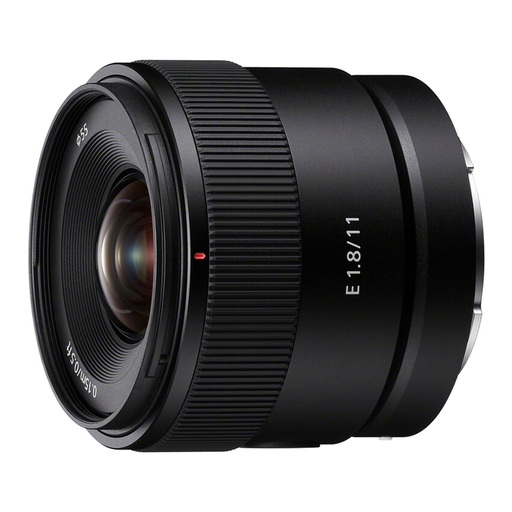
Sony E 11mm F1.8 APS-C Wide Angle Prime Lens (SEL11F18)

Sony E 11mm F1.8 APS-C Wide Angle Prime Lens (SEL11F18)

The product description mentions close-up photography, but check carefully whether this lens is suited to capturing small button details.

This is an 11mm ultra-wide-angle lens. Its stated magnification is 0.13× with autofocus and 0.20× with manual focus, both lower than 1:1.

Joybuy

Frequently asked questions

Does your macro lens need to offer 1:1 magnification to photograph a whole button?

No, not necessarily. First, check the framing you can achieve with your current lens. At 1:1, the subject is reproduced at life size on the sensor; a lens with ‘Macro’ in its name does not automatically offer 1:1 magnification.

Why isn’t a button with raised details sharp all over, even with a macro lens?

When you’re shooting close up, the depth of field may be too shallow to show all the raised details sharply. Keep the camera and button still, take shots at different focus points if needed, then combine them. Adobe explains focus stacking for macro and product photography, among other uses.

How can you reduce distracting reflections against a dark background?

First, try changing the angle of the camera or the light. Sony Netherlands points out that the camera and photographer can appear in reflective subjects, so a dark physical background is no substitute for controlling the light on the button.

Can you return a lens bought online in the Netherlands, and what should you do if it’s faulty?

For a distance purchase from a business, you generally have a 14-day cooling-off period; for example, this rule does not apply to an online purchase from a private individual. If a product is faulty, the seller must provide a solution. According to the Dutch government, the Netherlands does not have a fixed statutory two-year guarantee period for every product.
