
Maker with an existing camera
First, you want to make sure the lens mount matches your camera. Canon, Sony, Nikon, Sigma and OM SYSTEM offer models for different camera mounts, so check the exact version.


Start with the mount: the lens must fit your existing camera. A shorter macro lens can make it easier to frame an entire accessory, but when focusing close up, there may be little room left for lighting. With a longer focal length, you’ll need more space behind the camera to achieve the same framing. Compare the maximum magnification of the exact model, and test your camera, table and lighting setup together.
First, you want to make sure the lens mount matches your camera. Canon, Sony, Nikon, Sigma and OM SYSTEM offer models for different camera mounts, so check the exact version.
You want to capture seams, embellishments and other small features in close-up. To do that, compare the maximum magnification of the specific lens model, not just the Macro label.
You want to arrange the accessory, camera and lighting in a limited space. Allow for the working distance in front of the lens and the space the camera needs behind the table.
First, check the camera mount, then decide whether you mainly want to frame the entire accessory or a small detail. Finally, measure the space available on your table for the camera and lighting.
| What to consider | What should you check? | Who should pay particular attention? |
|---|---|---|
| Compatible camera mount | Compare the mount and the specific lens version with your camera model. | I want to keep using my existing camera and make sure the lens fits it first. Around 31% of consumers prioritise compatibility. |
| Framing and working space | Measure the space for your camera and lighting; check the working distance in front of the lens for your intended framing. | I photograph on a small table and want to leave room for lighting, whether I’m framing the entire accessory or a detail. Around 25% of consumers prioritise framing and working space. |
| Magnification for details | Compare the maximum magnification of the exact model with the size of the embellishments. Canon Netherlands lists a maximum of 1.4× for the RF 100mm F2.8 L Macro IS USM; Nikon Netherlands lists 1:1 for the Z MC 50mm f/2.8. | I want to capture small embellishments in close-up and would rather base my choice on the magnification ratio than on the Macro name alone. Around 25% of consumers prioritise magnification for details. |
| Repeatable focusing | Check the focusing features of the exact model and, if needed, plan a stable camera setup. | I want to photograph several accessories in a fixed setup and focus deliberately on the detail I want. Around 19% of consumers prioritise repeatable, sharp shots. |
The minimum focusing distance is not measured from the front of the lens. As a result, the lens or camera may come closer to the accessory than is practical for your lighting.
Check the working distance at the magnification you actually plan to use. Nikon USA distinguishes between focusing distance and the distance from the front of the lens to the subject.
The name alone doesn’t tell you how large the subject will appear on the sensor; Canon also describes macro-labelled lenses that do not achieve 1:1 magnification.
Check the maximum reproduction ratio of the full model.
A different focal length affects the framing. To achieve the same composition, you may need to position the camera further from the accessory.
Test the positions of the table, camera and lights for both a shot of the whole accessory and a close-up detail.
The RF 100mm F2.8 L Macro IS USM is an option for a compatible Canon RF camera.
The NIKKOR Z MC 50mm f/2.8 and Z MC 105mm f/2.8 VR S are options for compatible Nikon Z cameras.
The FE 90mm F2.8 Macro G OSS is a 90mm option for a compatible Sony E camera.
The 105mm F2.8 DG DN MACRO | Art is a 1:1 option available in versions for Sony E and L-Mount cameras.
The M.Zuiko Digital ED 60mm F2.8 Macro is an option for Micro Four Thirds cameras.
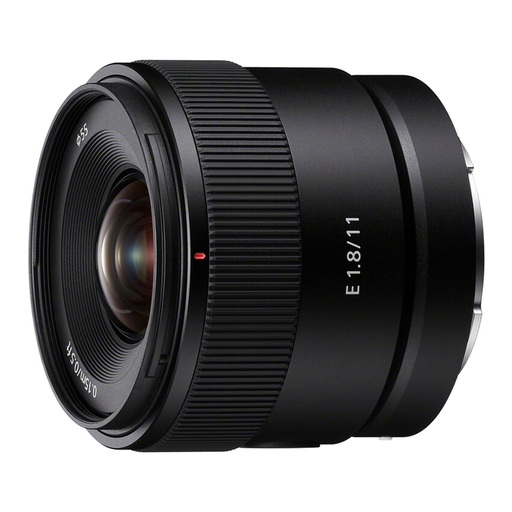
This product selection features a Sony E wide-angle lens for close-ups where high macro magnification isn’t needed.
 No image available
Based on its stated magnification, this lens is less suitable if you want to enlarge small embellishments significantly.
Sony E mount; APS-C; minimum focusing distance 0.15 m; maximum magnification 0.20× in MF and 0.13× in AF.
No, not if your existing lens already captures the whole accessory at a large enough size and in sufficient detail. For smaller embellishments, you can compare the maximum magnification of the exact lens model.
Keep the camera and accessory steady, and focus on the most important detail. Nikon USA points out that depth of field can be limited in macro photography and recommends using a tripod; whether you can stack focus shots depends on your camera and workflow.
For online consumer purchases, ACM ConsuWijzer says you generally have a statutory cooling-off period of up to 14 days after delivery, with some exceptions. You also have a statutory right to a product that works as expected for as long as you could reasonably expect it to; this is not a fixed, universal warranty period.
Not simply because it’s a macro lens. According to the European Commission, CE marking applies to products covered by specific, applicable EU rules; check which requirements apply to the particular version.