
Livraison le jour même et le lendemain

Qualité garantie

Débloquez vos offres de bienvenue: Livraison GRATUITE | Jusqu'à -80 % | 30 jours d'essai gratuits à JoyPlus
Téléchargez l'application
A lunchbox for meal prep may seem straightforward to choose, until you open your bag and find sauce has leaked, a lid no longer closes properly or containers turn out to be too large for your fridge. For work, school, sport, travel and camping, the closure, layout and ease of cleaning are usually more important than an eye-catching design.
Marketing terms such as “leak-proof”, “airtight” and “thermally insulated” do not say much on their own. Always check the product details, instructions and limitations. This helps prevent a bento lunchbox from turning out to be mainly suitable for dry snacks, or a food jar thermos from being less practical for a meal with several separate components.
A lunchbox may be described as leak-proof, but this only works when the lid, silicone ring and fastening clips work well together. A loose lid without a seal is usually less suitable for soup, dressing or yoghurt. A seal can also become misshapen over time due to grease, heat or incorrect cleaning.
Therefore, look for:
Always test a new lunchbox at home with water before putting it in a full work bag or schoolbag.
A compartmented lunchbox keeps ingredients separate, but small compartments are not practical for a large salad, pasta or a meal with sauce. A layout with five compartments is better suited to small portions, fruit, bread and snacks than to one generous main meal.
Think about your regular meal-prep routine in advance:
A stainless steel lunchbox is sturdy and generally absorbs fewer odours than some plastics, but stainless steel is not automatically suitable for the microwave. Plastic containers may be suitable for the microwave, freezer and dishwasher, but only within the stated temperature limits.
So do not just check whether a product is described as “durable” or “food-grade”. Look for specific information about the material, temperature range, dishwasher use and microwave use.
304 stainless steel is a common material choice for food containers. 316 stainless steel is often associated with greater corrosion resistance in product information. This makes the material specification relevant for regular use, acidic ingredients or outdoor activities. It is not a reason to overlook other product features, such as the closure or ease of cleaning.
Plastic can be practical when you want to use a container in the microwave. According to the product description, the Curver Fresh & Go containers are made from BPA-free plastic, with a temperature range of -40 °C to +100 °C. The lids must be removed before use in the microwave.
For a lunchbox for work and school, capacity is more important than a large-looking design. A container of around 600 to 1,000 ml is a manageable size for many lunches, while 1.4 or 1.5 litres is mainly suitable for larger portions, soup or meals to share.
Also consider the external dimensions. A wide box can be awkward to fit into a narrow cool bag or fridge drawer. For sets with several meal-prep containers, check whether they can be stacked and how much space they take up when empty.
An insulated food container or food jar thermos is suitable when you want to take hot or cold food with you separately. According to Maxcook’s product information, vacuum insulation helps retain the temperature for longer; the models mentioned have a stated guideline of 4 to 6 hours. This is a product claim, not a guarantee of a specific serving temperature. Preheating or pre-chilling may help, according to the description.
Also consider maintenance. A product that can only be washed by hand requires more time. With some models, only the stainless steel body is dishwasher-safe, while the lid must be cleaned by hand. Regularly check the silicone ring for dirt, cracks and deformation.
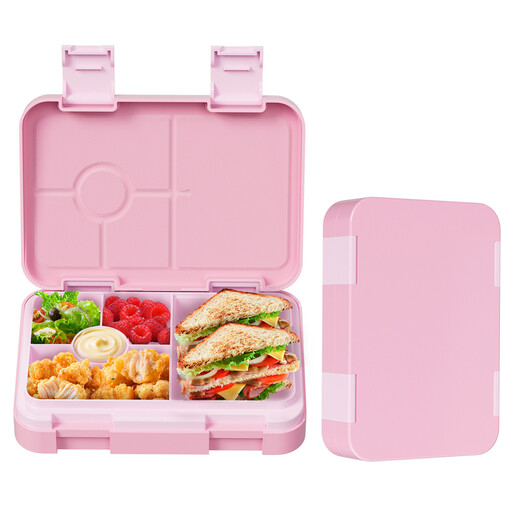
Why it suits this profile: The five compartments are useful for anyone who wants to keep lunch, fruit and snacks separate without immediately buying a complete set of food storage containers. The product name specifies double fastenings.
The layout prevents soft and dry ingredients from coming into direct contact. Before buying, however, check whether the product information provides sufficient detail about a leak-proof seal.
Five separate compartments and double fastenings, according to the product listing.
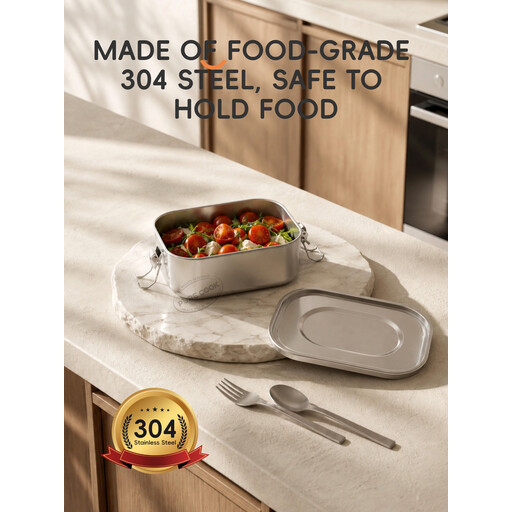
Why it suits this profile: A spacious stainless steel lunchbox with one compartment is suitable for complete meals such as pasta, rice dishes or salads for work, school and travel.
The product name mentions a silicone seal and locking clips. This provides more specific information than simply using the word “leak-proof”; check the lid after every cleaning.
304 stainless steel, one spacious compartment and, according to the product name, a dishwasher-safe design.

Why it suits this profile: This food jar thermos is designed for soup, stews and other meals that you want to take with you hot or cold, separately from other foods, to work, while camping or when travelling.
The wide opening makes filling and cleaning easier than with a narrow bottle-shaped design. According to the product description, the jar should not be turned upside down or tilted.
316 stainless steel, 1.5-litre capacity, vacuum insulation and a wide opening, according to the product information.
We have put together a complete, up-to-date list of products that fully meet these strict selection criteria and the applicable European safety regulations.
For a standard lunch, around 600 to 1,000 ml is often practical. If you take larger portions, soup or several separate components with you, it is better to choose a 1.4- to 1.5-litre model or a set with different sizes. Always check the external dimensions in relation to your bag and fridge.
Remove loose silicone rings from the lid when this is permitted according to the product information. Wash grooves, clips and the seal with warm water and mild washing-up liquid. Do not use an abrasive sponge if the manufacturer advises against it. Allow all parts to dry completely before closing and storing the lunchbox.
As a rule, stainless steel is not suitable for the microwave. Always follow the product’s specific instructions. For microwave use, choose a container whose manufacturer explicitly states that it is suitable, remove the lid when required and observe the specified temperature and time limits.
