
Baker making small lunchbox portions
You want to make a manageable amount of crumble occasionally or regularly, and are wondering whether a compact bowl is worth the extra washing-up.


For an occasional small batch, mixing by hand is a practical choice. A food processor is most useful if you make crumble topping regularly or also use the appliance for chopping and slicing. If you choose a processor, look for a blade and pulse function, and compare the usable capacity rather than just the bowl size. A larger bowl is better suited to bigger baking batches, but it also takes up more storage space. Bake crumble topping made with raw flour before eating.
You want to make a manageable amount of crumble occasionally or regularly, and are wondering whether a compact bowl is worth the extra washing-up.
You make a larger batch at a time and want to compare your recipe quantity with the appliance’s usable capacity and storage requirements.
You want to use the appliance for chopping or slicing as well as making crumble topping, so you’re comparing the included attachments and the cleaning involved.
| What to consider | What should you look for? | Who is this important for? |
|---|---|---|
| Crumble texture | Check whether the model has a chopping blade and pulse function; stop partway through to check the texture. | I want to stop as soon as the butter and dry ingredients form coarse crumbs. Around 36% of consumers prioritise control over the crumble texture. |
| Small portions | Compare your recipe with the usable capacity; the stated bowl size is not the same as the amount the appliance can process. | I usually make a small batch and want to avoid a bowl that’s awkwardly large for what I’m making. Around 29% of consumers prioritise a suitable capacity for small portions. |
| Other tasks and larger batches | Check which attachments come with the full model and compare your recipe with the stated dough limit. | I also want to chop other ingredients or make more crumble at once. Around 21% of consumers prioritise versatility or larger quantities. |
| Washing-up and storage | Check which parts are dishwasher-safe and measure the space where you plan to store the appliance. | I don’t make topping often and don’t want more washing-up or storage space taken up than necessary. Around 14% of consumers prioritise washing-up, storage or whether they need to buy an appliance at all. |
Bowl capacity and stated working capacity are two different things. For example, Kenwood lists a 1,3 l bowl and a working capacity of 0,75 l for dry ingredients for the FDP22.130RD; Bosch lists the bowl capacity and maximum dough quantity separately for the MCM3501M.
Compare your recipe ingredients with the specifications for the exact model. Don’t treat a general dough limit as a measured result for crumble topping.
Kenwood lists one reversible slicing and grating disc for the MultiPro Go FDP22.130RD, and two discs for the FDP22.140GY.
Check the full model number and what’s included in the box. For crumble topping, the key thing to check is whether the model comes with a chopping blade.
If you want a specific disc that isn’t included, you may need to buy it separately.
You can also make crumble dough by hand. A food processor is more useful if you also use it for other kitchen tasks.
Decide in advance which other tasks you’ll genuinely use it for. For an occasional small batch, you can rub cold butter into the dry ingredients by hand.
The Netherlands Nutrition Centre warns that raw flour can contain harmful bacteria.
Bake topping made with raw flour before eating; baking reduces the risk.
The MultiPro Go range is worth a look if you’re after a compact food processor with a chopping blade and pulse control.
The Mini Plus may suit you if you make different-sized portions and want to compare a large bowl with a separate mini bowl.
The MultiTalent 3 MCM3501M is worth comparing if you want to use your appliance for other kitchen tasks as well as making topping, and would like a larger bowl.
These Joybuy products are food processors for chopping and mixing, with options for smaller preparations and more bowl space. Compare the bowl capacity, controls and included attachments for each model.
 No image available
The product description mentions chopping and kneading; the 1,3 l bowl may be suitable for smaller preparations.
Bowl: 1,3 l. The description doesn’t mention a pulse function, so check the controls if short bursts are important to you.
 No image available
The product description mentions a pulse function, chopping and mixing. That may suit you if you want to work in short bursts and have more bowl space.
Bowl: 2,3 l. Power: 800 W.
 No image available
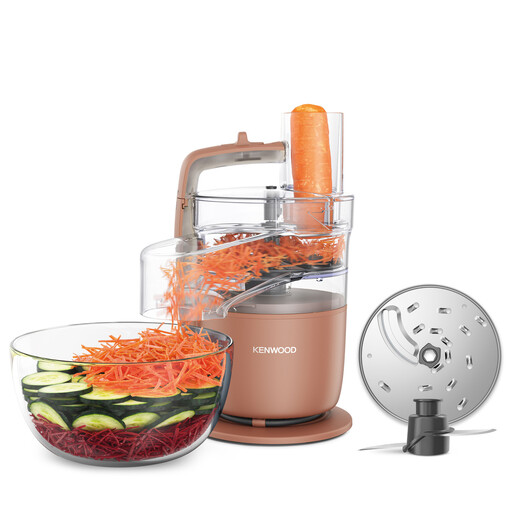
The product description mentions a pulse function and chopping blade, which may suit you if you want to chop ingredients in short bursts.
Bowl: 1,3 l. Check the full model number and the attachments included with this version.
Yes. For a small or occasional batch, you can rub cold butter into the dry ingredients with your fingers. Bake topping made with raw flour before eating.
Check the parts list and manual for the full model, and follow the instructions for assembly and cleaning. Manufacturers state whether parts are dishwasher-safe for each model or component; don’t assume this based on the brand name alone.
Consider your whole lunch: the Netherlands Nutrition Centre recommends using a small cool bag for food that can spoil quickly. It also advises setting your fridge to 4 °C and not leaving perishable food out of the fridge for more than 2 hours. These storage recommendations don’t automatically extend the shelf life of food.
When you buy online from a business, you usually have a 14-day cooling-off period, according to the Dutch Government. The seller must also offer a solution if the product proves faulty under normal use; there is no fixed statutory two-year guarantee period in the Netherlands.
According to the Netherlands Food and Consumer Product Safety Authority, CE marking is mandatory for these electrical consumer products. Parts that come into contact with food must also meet the applicable requirements for food contact materials; a CE marking alone doesn’t prove that an individual product meets every requirement.