What should you look for when choosing?
Start by deciding whether you want a familiar taste or specifically want a wholemeal option. Then decide whether the roll needs to be ready to take for lunch or can be baked at home.
Wholemeal roll
A good choice when: you specifically want a wholemeal roll for lunch.
Worth considering: the taste and texture may be less familiar to someone who usually eats white rolls.
Multigrain roll
A good choice when: you want to try something other than white without choosing a wholemeal roll straight away.
Worth considering: according to the Netherlands Nutrition Centre, ‘multigrain’ refers to the types of grain used; it does not automatically mean the grain ingredient is entirely wholemeal.
White roll
A good choice when: a familiar white bread option is the priority for this lunch.
Worth considering: according to the Netherlands Nutrition Centre, white grain products contain less fibre than wholemeal grain products.
| What to consider |
What to check when buying |
Who it matters to |
| Wholemeal and fibre |
Look for the description ‘wholemeal’. If it only says ‘multigrain’ or ‘brown’, check the ingredients and compare the fibre content per 100 g. |
I want to try something other than white, but the roll still needs to appeal to a fussy eater. This transition is the priority for around 46% of consumers. |
| Taste and ready-to-eat convenience |
Decide whether you want a roll that’s ready to eat or one that needs to be baked at home. |
If I buy a roll while I’m out, I don’t want to have to go home and bake it first, so I’d rather choose a familiar taste. Around 36% of consumers prioritise this ready-to-eat lunch option. |
| Packaging and storage |
Check the number of rolls and the storage instructions before choosing a pack for several lunches. |
If a pack contains several rolls, I want to be able to use the rest rather than leave them uneaten. This is the priority for around 18% of consumers. |
Brands to consider
The ranges below give you an idea of the types of products you may come across. Check the description and packaging of the roll you’re actually buying.
Albert Heijn
Albert Heijn lists fresh white and wholemeal rolls in its in-store range.
- The separate ‘white’ and ‘wholemeal’ descriptions make it clear which option you’re choosing.
- These rolls are listed as in-store products; check which varieties are available at your local shop.
Jumbo
Jumbo lists white and multiseed rolls, among other products in its roll range.
- The varieties offer a choice between white rolls and rolls topped with several types of seed.
- Wholemeal rolls in the wider bake-at-home range may not be shaped like rolls of this type.
Lidl
Lidl lists 700 g packs of wholemeal bake-at-home rolls as an in-store product.
- The product description makes it clear that these are wholemeal rolls for baking at home.
- If you’re specifically looking for rolls of this type, check the shape and packaging in store.
ALDI
ALDI lists an individual white roll, as well as white and wholemeal bake-at-home rolls in its wider range.
- The individual white roll is handy if you only want to take one with you.
- A wholemeal bake-at-home roll from the wider range is not necessarily a wholemeal roll of this type.
PLUS
PLUS lists white, multigrain and sourdough rolls as separate products.
- For PLUS Pistolets meergranen, PLUS lists 56% wholemeal wheat flour and 7 g of fibre per 100 g.
- Those ingredients and nutritional values apply to this multigrain variety, not to all PLUS rolls.
Dirk
Dirk lists 1 de Beste rolls in white and multigrain varieties.
- The multigrain variety is available in a pack of four rolls.
- Don’t take the description ‘multigrain’ as proof that these rolls are entirely wholemeal.
A white roll for lunch
This white roll is a good fit for a lunch where a familiar bread option comes first. Before buying, check whether the rolls are ready to eat or need baking.
 No image available
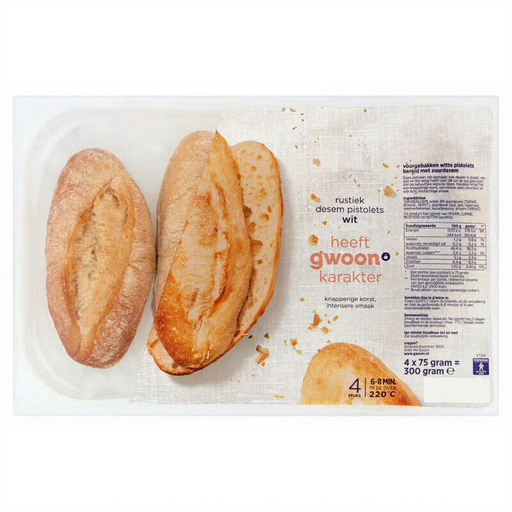
g'woon White Rustic roll, 4 pieces
A white roll for anyone looking for a familiar bread option at lunchtime. The pack contains 4 rolls.
If you specifically want wholemeal, choose a product labelled as such. Check the baking instructions for these rolls and, if relevant to you, the allergen information on the packaging.
View on Joybuy
Frequently asked questions
Is a multigrain roll automatically wholemeal?
No. According to the Netherlands Nutrition Centre, ‘multigrain’ means that at least three types of grain are used. The Netherlands Food and Consumer Product Safety Authority has a different requirement for the description ‘wholemeal’: the grain ingredient must consist entirely of wholemeal flour. So check the exact product description.
Does every Dutch roll contain iodised baker’s salt?
No. According to the Netherlands Nutrition Centre, bread does not have to be baked with baker’s salt. For packaged rolls, check the ingredients, or ask for product information if you’re buying one loose.
Where can I find allergen information for an individual roll?
If the information isn’t displayed, ask at the bakery counter before buying. According to the Netherlands Food and Consumer Product Safety Authority, allergen information must also be available for unpackaged foods.
How should I store leftover rolls?
For an unopened pack, first follow the storage advice and use-by date on the label. For brown rolls, the Netherlands Nutrition Centre’s Storage Guide recommends 2–4 days in a kitchen cupboard and 1–3 months in the freezer; always follow the storage instructions for your product.
Can you cook a bake-at-home roll in an air fryer?
Yes, if the packaging says that the roll can be cooked in an air fryer. Check the time and temperature for your product rather than using the same settings for every bake-at-home roll.


