Which roll is right for you?

Lunch shoppers looking for wholemeal

If you want a roll made entirely from wholemeal flour, don’t judge by its dark colour or seeds. Look for the ‘wholemeal’ label and compare the fibre per 100 g. The Netherlands Nutrition Centre defines wholemeal bread as bread made from 100% wholemeal flour.

Fussy eaters looking to try more wholemeal

A roll made with both wholemeal flour and white flour could be a good stepping stone if you’re not keen on fully wholemeal bread. Compare the ingredients for each product: the two PLUS multigrain rolls we looked at contain different proportions of wholemeal flour.

Lunch planners who bake rolls at home

Choose a bake-at-home or frozen roll with preparation and storage instructions that suit your plans. Also check the allergens on the packaging of the version you buy.

What should you look for when choosing?

Decide what matters most for your lunch: 100% wholemeal, a familiar taste with some wholemeal flour, or easy preparation and storage. Then compare the information for the specific rolls you’re considering.

What to consider What to look for Who it matters to
Wholemeal and fibre Look for the ‘wholemeal’ label and compare fibre per 100 g, not just per roll. If I want the roll itself to be 100% wholemeal, I want to be able to tell from the product label. For around 50% of consumers, choosing wholemeal is the top priority.
Taste and ingredients Check how much wholemeal flour and white flour are listed in the ingredients; ‘multigrain’ is not the same as ‘wholemeal’. I don’t always enjoy the texture of fully wholemeal bread, but I still want to know whether the roll contains wholemeal flour. Around 30% of consumers put this middle ground first.
Preparation and storage Check the baking instructions and, for frozen rolls, the storage temperature and instructions for after defrosting. On busy days, I want to know in advance when I can bake and use the rolls. For around 20% of consumers, this planning is the deciding factor.

Common mistakes when choosing rolls

  • Assuming ‘multigrain’ means 100% wholemeal

    A multigrain roll can contain white flour as well as wholemeal flour. For example, one PLUS multigrain product we looked at lists 34% wholemeal wheat flour and 21% wheat flour; according to the Netherlands Nutrition Centre, wholemeal bread is made from 100% wholemeal flour.

    Look for the ‘wholemeal’ label if you want a roll made entirely from wholemeal flour. If you choose a mix, check the proportion of wholemeal flour in the ingredients.

  • Looking at fibre alone

    A fibre figure without a stated measurement basis makes it difficult to compare rolls of different weights. Salt and allergens may also be relevant to your choice.

    Compare fibre and salt per 100 g, consider how much you eat in a serving, and check the allergen information on the current packaging.

  • Skipping the frozen storage instructions

    The Jumbo frozen rolls we looked at say to store at −18 °C and not to refreeze after defrosting. The white version we looked at must also be prepared and eaten within 24 hours of defrosting.

    Only defrost as many as you can use according to the instructions, and follow the storage guidance on the packaging you choose.

Brands to consider

Albert Heijn

Albert Heijn stocks, among other options, a wholemeal roll and a wholemeal sourdough roll.

  • The AH Wholemeal Roll lists 100% wholemeal flour and 7,1 g of fibre per 100 g.
  • Check the packaging when you buy, as ingredients and nutritional values can change.

Jumbo

Jumbo has a range of roll types, including white, brown and frozen varieties.

  • The white bake-at-home roll we looked at lists 2,1 g of fibre per 100 g; the brown frozen roll we looked at lists 5,1 g per 100 g.
  • These figures apply to these products, not all Jumbo rolls. For frozen varieties, check the storage instructions too.

PLUS

PLUS stocks multigrain rolls whose ingredients lists show the proportion of wholemeal flour.

  • Two products we looked at list 56% and 34% wholemeal wheat flour respectively.
  • These different ingredients show why the name ‘multigrain’ alone isn’t enough to tell you whether a product is 100% wholemeal.

Dirk

Dirk stocks, among other options, a pack of four multigrain rolls.

  • The product description says it contains a mix of grains.
  • Check the ingredients and nutritional information on the packaging if you want to compare the proportion of wholemeal flour or the values per 100 g.

ALDI

ALDI lists an individual white roll.

  • The product description makes it clear that this is a white roll.
  • Don’t use colour as a substitute for comparing ingredients, fibre and salt on the packaging.

Lidl

Lidl lists a wholemeal seeded bun as another lunch option.

  • The product name identifies this bun as wholemeal.
  • A wholemeal bun isn’t the same product as a roll. Check the specific product and its packaging if you’re looking for rolls in particular.

A white roll on Joybuy

This white roll is a good fit if you prefer a white bread roll. If you’re looking for a roll made with some wholemeal flour, check the ingredients to see whether a product suits your needs.
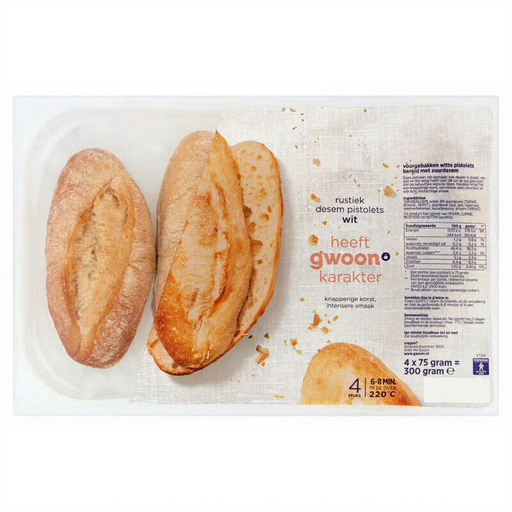
g'woon White Rustic Roll, pack of four

g'woon White Rustic Roll, 4 pack

For anyone who wants a white roll with their lunch. If you’re looking for a white and wholemeal flour mix, check the ingredients on the packaging; compare fibre and salt per 100 g as part of your decision too.

View on Joybuy

Frequently asked questions

Is a multigrain roll automatically wholemeal?

No. According to the Netherlands Nutrition Centre, wholemeal bread is made from 100% wholemeal flour, while a multigrain roll may also contain white flour. So if you’re looking for a 100% wholemeal product, check the product label and ingredients list.

How do I compare white, brown and wholemeal rolls?

Compare nutritional values on the same basis, such as fibre and salt per 100 g, and also check the ingredients, allergens and how much you eat. The AH wholemeal roll we looked at lists 7,1 g of fibre per 100 g; the brown and white Jumbo rolls we looked at list 5,1 g and 2,1 g per 100 g respectively. These figures apply to those specific products.

Where can I find allergen information for a roll?

Check the allergen information on the packaging of the roll you buy. The white, wholemeal and multigrain products we looked at contain wheat or other cereals containing gluten. For each variety, also check for information about other allergens and warnings, as ingredients can change.

How should I store and prepare frozen rolls?

Follow the instructions on the exact packaging, including after defrosting. The Jumbo frozen rolls we looked at say to store at −18 °C and not to refreeze after defrosting; the white version we looked at also says to prepare and eat it within 24 hours of defrosting.

Does bakers’ salt mean every roll contains iodine?

No, you can’t tell that from the product name for every roll. The Dutch Commodities Act Decree on the Addition of Micronutrients to Foodstuffs defines bakers’ salt as iodised table salt for bread and other bakery products. Check the ingredients list for the specific roll to see which salt is listed.
