Who is this guide for?

People with coeliac disease looking for a lower-fat option

You want a lower fat content, but first check the exact variant’s gluten-free information, ingredients and any relevant warnings. A corn base alone doesn’t tell you whether a product is suitable. The Dutch Coeliac Society offers practical advice on labels and cross-contamination warnings.

People who want to keep portions in check

Your main aim is to have less fat per snack, so you’re considering a measured portion of regular gluten-free tortilla chips. Compare the nutritional information per 100 g with the amount you actually eat. Albert Heijn’s product page lists a 25 g portion for AH Tortilla chips naturel.

People who shop at their usual supermarket

You want to pick up a suitable snack with your regular shopping and are considering price and convenience. Deloitte Netherlands identifies price and convenience as general factors in supermarket choices.

What should you look for when choosing?

What to consider What should you check? Who is this important for?
Gluten-free suitability Check the information for the exact variant, its ingredients and any relevant warnings on the packaging. When I’m buying for coeliac disease, I first want to be able to assess whether this exact variant is suitable and what warnings apply. Around 34% of consumers put confidence that a product is gluten-free first.
Fat content Compare grams of fat per 100 g and, if there’s a comparative claim, check which product is being used as the reference. According to the European Commission, a solid food must contain no more than 3 grams of fat per 100 grams to be labelled ‘low fat’. When I compare variants, I want to assess the fat content on the same basis, rather than relying only on the front of the pack. Around 33% of consumers prioritise fat per equal quantity.
Portion size and nutritional information Check the amount per portion and compare it with the weight you actually eat; keep per-100 g values separate from portion values. If my main aim is to eat less at one snack, measuring my portion can help; it doesn’t change the composition per 100 g. Around 20% of consumers prioritise portion control.
Price and convenience Compare packs containing the same amount and check that they’re exactly the same variant. I want to find a suitable variant during my usual shop, then consider the price and convenience. Around 13% of consumers give these practical preferences the most weight.

Common pitfalls

  • Assuming corn means a product is suitable for coeliac disease

    A corn base doesn’t automatically answer questions about ingredients or possible cross-contamination.

    Assess the exact variant by checking its ingredients, gluten-free information and any relevant warnings.

  • Treating ‘less fat’ and ‘low fat’ as the same thing

    A product can contain less fat than a similar product without meeting the separate ‘low fat’ claim.

    Check the values per 100 g and, if there’s a comparative claim, find out which product is being used for comparison. For solid foods, the European Commission’s limit for ‘low fat’ is no more than 3 grams of fat per 100 grams.

  • Applying claims from other countries to Dutch variants

    Information about a variant sold in another market doesn’t prove that a Dutch variant has the same composition or is suitable for a gluten-free diet.

    Check the packaging and product information for the exact variant you’re buying. PepsiCo SmartLabel’s Doritos information refers to a US Reduced Fat variant; Mission Foods Malaysia makes a comparison with potato crisps.

Brands to consider

Doritos

The Dutch brand page lists several flavours, including Naturel, Nacho Cheese, Sweet Chilli Pepper and Cool American.

  • The official Dutch range names can help you identify the flavour you’re looking for.
  • US Reduced Fat Nacho Cheese is a separate market variant; that information doesn’t show that Dutch variants are gluten-free or lower in fat.

Albert Heijn

AH Tortilla chips naturel 200 g is a standard Dutch reference variant.

  • Albert Heijn labels this variant gluten-free and lists 20 grams of fat per 100 grams.
  • This information doesn’t make the product a low-fat option and doesn’t automatically apply to other AH flavours.

Jumbo

Jumbo Tortilla Chips Paprika 170 g is a paprika-flavoured variant with nutritional information listed on the supermarket’s website.

  • Jumbo lists 21.3 grams of fat and 475 kcal per 100 grams for this variant.
  • These values don’t meet the threshold for a ‘low fat’ claim; the product information should also be checked separately for gluten-free suitability.

Lidl

Lidl Netherlands lists Tortilla chips sweet paprika in a 60 g pack.

  • The product name and pack size help you identify the variant.
  • The pack size alone doesn’t tell you anything about the fat content, a suitable portion or gluten-free suitability.

ALDI

ALDI Netherlands lists SUN SNACKS Tortillachips blauwe maïs as a product range.

  • The product name gives you a recognisable starting point for identifying this variant.
  • The description ‘blue corn’ isn’t evidence that the product is lower in fat or suitable for people with coeliac disease.

Mission

Mission Foods Europe describes tortilla chips in round and triangular shapes and a range of flavours.

  • The European product range description distinguishes between shapes and flavours.
  • A claim by Mission Foods Malaysia that its chips contain less oil than potato crisps isn’t evidence that Dutch Mission tortilla chips have a lower fat content.

Joybuy products

The plain tortilla chips below are a standard reference for assessing product information, not a confirmed lower-fat or coeliac-friendly choice.
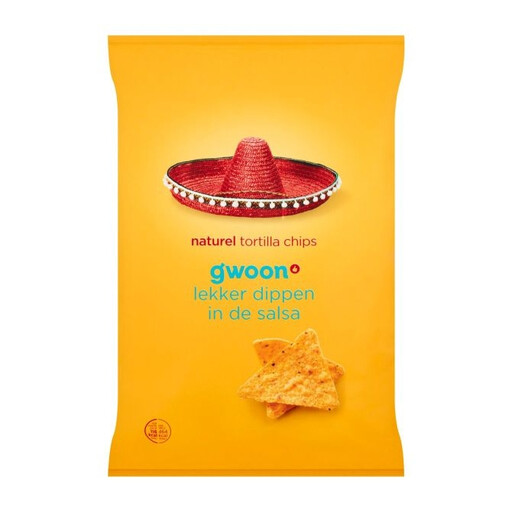
g'woon Tortilla Chips Natural, 165 g

g'woon Tortilla Chips Natural, 165 g

The product information says the chips may contain traces of gluten, so check the exact packaging before choosing them if you have coeliac disease.

The listed 22 grams of fat per 100 grams is above the limit of no more than 3 grams per 100 grams for a ‘low fat’ claim on solid foods, as explained by the European Commission.

View at Joybuy

Frequently asked questions

Is a gluten-free certification mark always essential?

A certification mark isn’t the only source of information. The Dutch Coeliac Society also advises reading the ingredients carefully; check the information about possible cross-contamination and the exact packaging too.

Does ‘less fat’ mean the same as ‘low fat’?

No. ‘Less fat’ describes a comparison with another product, while the ‘low fat’ claim for solid foods means no more than 3 grams of fat per 100 grams. The European Commission explains this limit; also compare the nutritional information and check which product a comparative claim refers to.

Does ‘may contain cereals containing gluten’ mean that every bag contains gluten?

No. The Dutch Coeliac Society describes this wording as indicating a possible cross-contamination risk, not as proof that every pack contains gluten. However, do take the warning into account when assessing a product for coeliac disease.

What Dutch rules on cross-contamination warnings apply from 2026?

The Netherlands Food and Consumer Product Safety Authority will oversee the new labelling rules from 1 January 2026. For pre-packed foods, a warning must be supported by a risk assessment; if the relevant reference values cannot be exceeded, the warning must not appear on the label. These are business requirements.

What should I do if the packaging differs from the online product information?

Read the packaging you received before eating the chips, and ask the retailer for clarification if there’s a relevant difference. Albert Heijn advises checking the packaging and contacting customer services if you have any questions.
