Who is this guide for?

Less fat per snack

You want to keep eating popcorn, but are mainly watching your total fat intake and portion size. Compare the label with your portion; the European Commission uses nutritional values per 100 g as a basis for comparison. Albert Heijn and Jumbo list nutritional values for various popcorn products.

More control over added ingredients

You want to decide how much oil, sugar or salt to add yourself, and don’t mind preparing it. Loose popcorn kernels give you control over the ingredients, but the nutritional values for dried kernels don’t automatically describe the finished recipe. Albert Heijn and Jumbo provide product information for loose kernels.

Convenience with the right balance

You’re looking for ready-to-eat or microwave popcorn and want to weigh convenience against the nutritional values of the exact variety. Total fat, saturated fat and sugar are different measures; the labels from Albert Heijn and Jumbo show why you should check them separately.

What should you look for in lower-fat popcorn?

First compare the product type and nutritional values per 100 g. Then consider how much you eat in one sitting.

What to consider What should you check? Who is this most relevant to?
Fat content and claims Compare total fat per 100 g and check exactly what a claim means. If I want to eat less fat, I compare the value with my portion and distinguish between an absolute claim and a comparison; around 36% of consumers give this the highest priority.
Preparation and oil Check whether the values are for dry kernels or prepared popcorn, and include any oil used. If I want to control what is added to the kernels, I also take preparation into account; around 22% of consumers prioritise this control.
Portion and energy Weigh your own portion and only compare portion values when the portions weigh the same. For each snack, I want to know how much I actually eat, not just what the figures say per 100 g; around 21% of consumers prioritise portion control.
Flavour and other nutritional values Alongside total fat, check sugar, saturated fat and salt per 100 g. If I choose a sweet or salty flavour, I want to consider the other nutritional values too; around 21% of consumers consider this the most important factor.

Pitfalls when choosing

  • Assuming ‘less fat’ means ‘low fat’

    A product can contain less fat than another product without meeting the threshold for a ‘low-fat’ claim. For solid foods, the European Commission sets a maximum of 3 g of fat per 100 g for this claim.

    Compare the absolute fat value per 100 g, and don’t treat a relative comparison as proof that a product is low in fat.

  • Using the nutritional values for dry kernels for the whole recipe

    The nutrition table for loose kernels doesn’t automatically include the ingredients you add during preparation. For example, Albert Heijn’s instructions for AH Biologisch Popcorn mais recommend 2 tbsp of vegetable oil.

    Include the ingredients you use yourself and assess the prepared portion, not just the dry kernels.

  • Assuming sweet popcorn is automatically a lighter choice

    Albert Heijn lists 4 g of fat, 45 g of sugars and 419 kcal per 100 g for AH Popcorn zoet. So total fat alone doesn’t tell you how much sugar or energy the product contains.

    Check each nutritional value separately and decide in advance how much you want to eat.

  • Looking only at total fat

    On the labels of the Jumbo products reviewed, the microwave variety has less total fat but more saturated fatty acids per 100 g than the ready-to-eat salted variety.

    Compare total fat and saturated fatty acids for the same quantity and exact product variety. The figures on these labels don’t represent all Jumbo popcorn products.

Popcorn brands to compare

Albert Heijn

The range reviewed includes loose organic popcorn kernels and ready-to-eat sweet popcorn: two different product types to assess separately.

  • Albert Heijn lists 4 g of fat per 100 g for AH Biologisch Popcorn mais and AH Popcorn zoet. For the sweet variety, the label also lists 45 g of sugars per 100 g.
  • The value for dried kernels doesn’t reflect the nutritional value of a prepared recipe made with oil. These products’ figures don’t prove that either variety meets the ‘low-fat’ claim.

Jumbo

The products reviewed are dried kernels, ready-to-eat salted popcorn and salted microwave popcorn.

  • Jumbo lists 4.5 g of fat per 100 g for dried kernels, 23.9 g for ready-to-eat salted popcorn and 12.4 g for the microwave variety.
  • On the labels of these two salted products, Jumbo lists 5.1 g of saturated fatty acids per 100 g for the microwave variety and 2.1 g for the ready-to-eat variety. This difference applies to the varieties reviewed, not the entire range.

Lidl

Lidl lists Snack Day Popcorn zeezout as ready-to-eat popcorn in a 200 g pack.

  • The product name and pack give you a specific variety to check on the label.
  • The sea salt flavour name doesn’t tell you the fat content; check the nutritional values on the exact pack.

ALDI

ALDI lists SUN SNACKS Zoute popcorn in a 100 g pack.

  • The range information gives you the product name and pack size, so you can check the exact pack.
  • The product name alone doesn’t tell you the fat content; check the nutrition table for the variety you buy.

Joybuy products for microwave popcorn

This product selection is for anyone looking for microwave popcorn. Before choosing it with the aim of eating less fat, check the nutrition table on the exact pack.
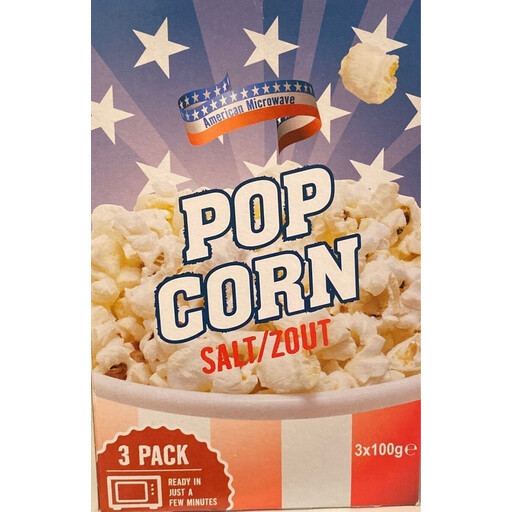
Pop Corn, 3 x 100 g

Pop Corn, 3 x 100 g

An option if you’re looking for microwave popcorn. If you want to eat less fat, compare the nutritional values on the exact pack with your own portion.

View at Joybuy

Frequently asked questions

When can popcorn be called ‘low fat’?

For solid foods, the European Commission sets a maximum of 3 g of fat per 100 g for a ‘low-fat’ claim. This is a condition for making a product claim, not a personal daily fat limit.

Does ‘less fat’ mean the same as ‘low fat’?

No. ‘Less fat’ describes a difference compared with another product, while ‘low fat’ has an absolute threshold. A product with less fat than another product doesn’t automatically meet the limit of 3 g per 100 g. For a comparative claim, check which products and measurement basis are being compared.

Should I include oil when I buy loose popcorn kernels?

Yes. For AH Biologisch Popcorn mais, the nutrition table describes dried kernels, while the preparation instructions recommend 2 tbsp of vegetable oil. So don’t use the values for the kernels as a complete calculation for your prepared recipe.

How do I compare popcorn portions?

First compare the nutritional values per 100 g, then weigh the amount you actually eat. You can only compare portion values directly when the portions weigh the same; the European Commission uses per 100 g as the basis for nutritional information.

What should I check if I have a gluten or soya allergy?

Check the information on the exact pack. For AH Biologisch Popcorn mais, Albert Heijn notes that it may contain cereals containing gluten, soya and wheat. Don’t assume the same information applies to another variety or to a label that has changed.
