
You want a demonstrably lower-fat option
You’re looking for coated peanuts whose nutrition information supports what you want, and you don’t want to mistake a claim for a different cooking method.


If you want less fat, compare the nutrition information for the exact coated peanut variety, using the same serving size. Being oven-baked or described as ‘made without added oil or fat’ does not prove that the product has a lower total fat content. Check energy, saturated fat and salt separately too, and choose a portion that suits what you want to eat while you’re away.
You’re looking for coated peanuts whose nutrition information supports what you want, and you don’t want to mistake a claim for a different cooking method.
You check the nutritional value of the amount you’ll actually eat, rather than just looking at the whole bag.
You check the storage instructions and allergen information for everyone who’ll be sharing them.
First decide whether you want to focus on the ingredients, the portion you eat, taking and sharing snacks, or the type of product.
Choose this option if: reducing total fat is your main priority and the exact variety has suitable nutrition information.
Bear in mind: check energy, saturated fat and salt separately too; a claim about one nutrient doesn’t automatically tell you anything about the others.
Choose this option if: you want to keep eating regular coated peanuts and mainly want to decide how much to have at each snack break.
Bear in mind: a smaller portion doesn’t change the nutritional value per 100 g.
Choose this option if: the cooking method matters to you and the exact variety matches the type of product you’re looking for.
Bear in mind: Duyvis describes Oven Baked Peanuts Original as roasted without added oil or fat. That doesn’t prove it has a lower total fat content, and it isn’t the same type of product as coated peanuts with a crunchy shell.
| What to consider | What to look for | Who it matters most to |
|---|---|---|
| Demonstrably lower total fat | Check the claim and compare the nutritional values of the exact variety, using the same serving size. | If I mainly want less total fat, I look for nutrition information I can check and don’t compare cooking methods as if they mean the same thing. Around 36% of consumers prioritise verifiable total fat content. |
| Energy in your portion | Check energy, fat and salt separately, and take into account how much you’ll have. | If I’m mainly thinking about the energy in my snack, I want to be able to match the nutritional values to my own portion. Around 29% of consumers prioritise energy and portion size. |
| Taking, storing and sharing | Read the storage instructions, pack size and allergen information on the exact product packaging. | For a holiday get-together, I want to know how to store the snack and whether it contains any allergens that matter to my group. Around 21% of consumers prioritise taking and sharing snacks. |
| Flavour and product type | Check the flavour and whether it’s coated peanuts with a crunchy shell or a different type of product. | If I’m specifically looking for the flavour and texture of coated peanuts, I don’t want to swap them for a different type of snack without realising. Around 14% of consumers prioritise flavour and product type. |
Duyvis describes Oven Baked Original as made without added oil or fat. This describes how it’s prepared; it doesn’t compare its total fat content with that of coated peanuts.
Read the nutrition table and compare products of the same type using the same serving size.
A claim may refer to one specific nutrient. Energy, fat, saturated fat and salt are listed as separate values in the nutrition information.
Decide what you mean by ‘a lighter snack’ and check the relevant values separately.
Albert Heijn warns that product information, including ingredients and allergen information, may change. For pre-packed products, the allergen information is on the label.
Check the current packaging, especially if you or someone in your group has a relevant allergy.
Useful for distinguishing coated peanuts from the separate Oven Baked Peanuts range.
AH Cocktail Coated Peanuts is a supermarket own-brand option whose exact packaging and ingredients you can check.
Jumbo Cocktail Coated Peanuts is a regular variety made with peanuts and a crunchy coating.
The Dutch product listing is for coated peanuts.
The shop page lists TRADER JOE’S coated peanuts in oriental, provençale or cocktail flavours.
PLUS Ham and Cheese Coated Peanuts is a specific flavour variety.
These product choices are regular coated peanuts; a product listing doesn’t prove that it’s a reduced-fat variety.
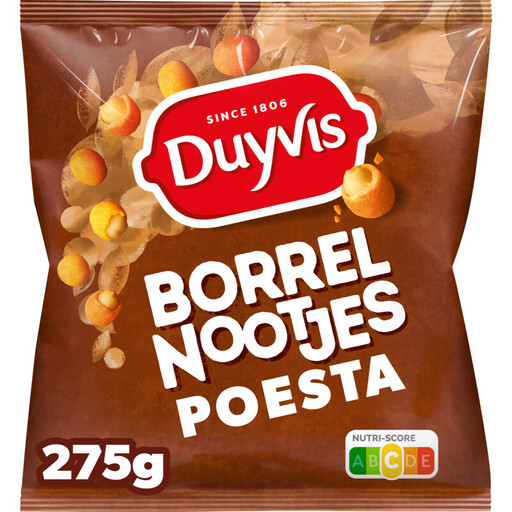 No image available
A good choice if you want regular coated peanuts and prefer to choose your own portion size.
The product description calls it a seasoned peanut snack with a crunchy coating; the title lists a pack size of 275 g.
According to the product information, this variety contains peanuts, milk, gluten (wheat) and celery. It may contain traces of soya, mustard and other nuts.
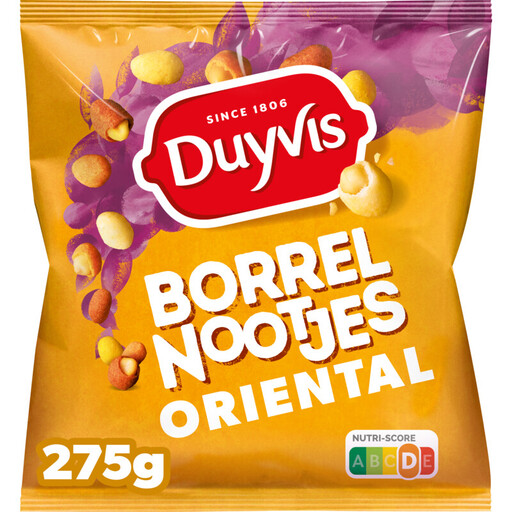 No image available
A good choice if you’re looking for regular coated peanuts with a crunchy shell and curry flavour.
The title lists a pack size of 275 g.
According to the product information, this variety contains peanuts, gluten (wheat and barley) and soya. It may contain traces of milk, nuts and mustard.
Compare the nutrition table for the exact variety, using the same serving size. Check energy, fat, saturated fat and salt separately.
The Netherlands Nutrition Centre lists 8,2 g of fat and 133 kcal per 25 g handful of generic coated peanuts. This is background information, not product-specific information for a particular variety from Duyvis, Albert Heijn, Jumbo, Lidl, ALDI or PLUS.
Follow the instructions on the packaging for your variety. Jumbo Cocktail Coated Peanuts 300 g and PLUS Ham and Cheese Coated Peanuts 300 g advise storing the products in a cool, dry, dark place; bear this in mind when choosing where to keep them.
Check for relevant allergies and read the information on the exact packaging before sharing the snack. The Netherlands Food and Consumer Product Safety Authority lists peanuts, cereals containing gluten, milk, soya and mustard among the allergens consumers must be informed about. This doesn’t mean every product contains all of these allergens.
No. Nutrition claims must meet the relevant EU requirements and must not be misleading. Consider the claim separately from the description of how the product is prepared, and check the nutrition information for the exact variety too.