
Stocking up with sugar in mind
You’re buying several packs and don’t want to mistake a standard kano biscuit for a lower-sugar option. Check the nutritional information per 100 g and the ingredients list for the product you’re actually buying.


If you want to stock up on lower-sugar kano biscuits, compare the sugar content per 100 g of the exact products; a claim on the front of the pack or a small serving size isn’t enough. The standard kano biscuits described by Albert Heijn and Jumbo contain 38 g and 37.9 g of sugars per 100 g respectively, but these figures don’t support choosing a lower-sugar kano biscuit. If reducing sugar matters more to you than the filled kano shape, you could also compare other types of biscuits, bearing in mind that they’re different products.
You’re buying several packs and don’t want to mistake a standard kano biscuit for a lower-sugar option. Check the nutritional information per 100 g and the ingredients list for the product you’re actually buying.
You’re specifically looking for a biscuit filled with almond paste. A biscuit or cereal bar with a sugar claim may be worth comparing, but it’s a different type of product.
You want to know how long the biscuits will keep and how to store an opened pack before buying several. Check the date and storage instructions on every pack.
First decide whether you want to stick with filled kano biscuits or consider other types too. Then compare like-for-like products per 100 g, and choose how much to buy based on the shelf life and storage advice.
| What to consider | What to check when buying | Who is this important to? |
|---|---|---|
| Sugar content | Compare ‘of which sugars’ per 100 g for similar biscuit products. Also read the exact claim and the ingredients list. | I want to choose biscuits with less sugar, but not rely on a claim that doesn’t tell me the total sugar content. This check comes first for around 38% of consumers. |
| Shelf life and storage | Check the best-before date on each pack and follow the storage advice, including after opening. | If I buy several packs, I want to use them before their quality deteriorates. This is the main consideration for around 37% of consumers. |
| Type and size of biscuit | Check whether it’s a kano biscuit filled with almond paste, how many are in the pack and which allergens are listed. | The familiar filled kano matters more to me than an alternative biscuit type; around 25% of consumers say this preference takes priority. |
‘Less sugar’, ‘no added sugars’ and ‘sugar-free’ don’t mean the same thing. The Netherlands Nutrition Centre points out that a product with no added sugars may still contain sugars.
Read the exact wording and also compare ‘of which sugars’ per 100 g with a suitable product.
Serving sizes can vary from one product to another. So figures per serving don’t necessarily tell you which comparable product contains less sugar for the same amount.
Use the nutritional information per 100 g as your basis for comparison, and check the net weight and number of biscuits separately when planning your stock.
The AH BASIC Kano biscuits described were listed as discontinued, and Jumbo’s online listing for Mini Kano biscuits said that variant was no longer available. So an earlier product description doesn’t tell you which pack you can buy now.
Check the current product just before buying, and read the nutritional information and best-before date on the pack you receive.
A biscuit or cereal bar with a sugar claim isn’t automatically a filled kano biscuit. You’re changing the type of product, not just the information about its sugar content.
If the kano shape and almond-paste filling matter to you, check the biscuit type before buying several packs of an alternative.
The AH BASIC Kano biscuits described are standard filled kano biscuits, not a substantiated lower-sugar option.
The Jumbo butter Mini Kano biscuits described are a smaller kano variant filled with almond paste.
PLUS listed Aviateur Kano biscuits in a 230 g pack in its everyday biscuit category.
Verkade San Francisco Zero is a biscuit for anyone looking beyond the kano category too.
This cereal bar is worth considering if sugar content matters more to you than the shape and filling of a kano. Compare the current nutritional information with that of the biscuit product you’d otherwise buy; the words ‘Less Sugar’ in the name don’t prove anything on their own.
 No image available
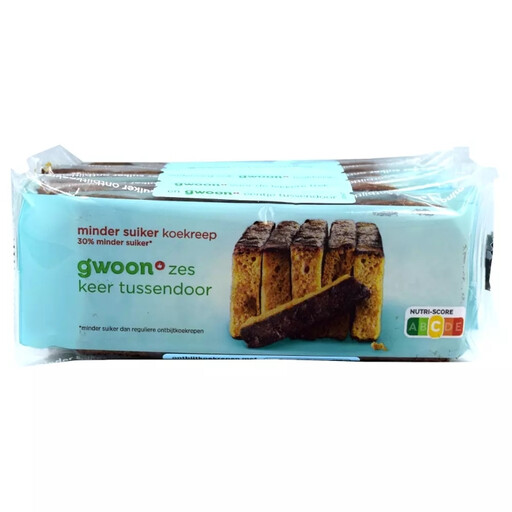
A cereal bar to compare if you’re considering other types of biscuits as well as kano biscuits. The product name says there are 6 bars in the pack; before stocking up, check the current pack for sugars per 100 g, net weight, best-before date and storage advice. A cereal bar isn’t a filled kano, and the name ‘Less Sugar’ doesn’t confirm a reduction in sugar without a suitable product to compare it with.
For similar kano biscuits, compare the ‘of which sugars’ figure per 100 g. The Netherlands Nutrition Centre recommends this basis because serving sizes can vary; also check the ingredients and the exact product variant.
No. According to the Netherlands Nutrition Centre, a product may still contain sugars even if none have been added. So check the nutrition table and compare the total sugar content per 100 g.
Follow the storage advice on the pack and check the best-before date on each one. For the AH BASIC Kano biscuits described, Albert Heijn advised storing them in a cool, dark and dry place and keeping them in a sealed tin after opening. Don’t assume the same advice applies to other variants without checking.
Check the ingredients, allergens, net quantity, best-before date, any storage instructions and the nutritional information. This helps you decide whether a particular pack suits your preferences, and how many packs you can reasonably store and use.