
If you’re keeping an eye on sugar
You want to keep ordering kano biscuits, but first compare the sugars listed per 100 g and per portion. To you, a small difference between standard kano biscuits isn’t the same as a substantiated ‘less sugar’ claim.


If you’re looking for a lower-sugar kano biscuit online, compare the ‘of which sugars’ values per 100 g and per portion. A lower figure than that of one other kano biscuit doesn’t automatically make a product low in sugar. Jumbo lists 36,8 g of sugars per 100 g for its butter kano biscuits, while Albert Heijn lists 39 g per 100 g for AH Butter Kano biscuits. These standard kano biscuits therefore don’t offer a substantiated choice if you’re specifically looking for a product with a ‘less sugar’ claim. In that case, choosing a defined portion or a different type of snack is another option.
You want to keep ordering kano biscuits, but first compare the sugars listed per 100 g and per portion. To you, a small difference between standard kano biscuits isn’t the same as a substantiated ‘less sugar’ claim.
You’re looking for a defined eating occasion and want to know how much a biscuit weighs, how much sugar that portion contains and how many portions are in the pack.
Before ordering online, you need to be able to check the ingredients, allergens and possible traces listed for your chosen kano biscuit. Check the packaging too when your product arrives.
If you’re considering ordering kano biscuits online and want to reduce your sugar intake, start by comparing like-for-like nutritional values. Then check whether the ingredients, portion and ordering options suit your needs.
| What to consider | What should you check? | Who is this most important for? |
|---|---|---|
| Demonstrably less sugar | Compare ‘of which sugars’ per 100 g and assess any ‘less sugar’ claim by comparing it with a similar product. | If I’m choosing my kano biscuit mainly by its sugar content, I don’t want a small difference between standard biscuits to be presented as a sugar claim. Around 42% of these consumers prioritise demonstrably less sugar. |
| Ingredients and allergens | Read the full ingredients list, allergen information and warnings about possible traces. | If I need to avoid certain ingredients, a lower sugar figure isn’t enough to make me choose the biscuit. For around 33% of these consumers, ingredients and allergens matter most. |
| Portion and availability to order | Check the weight and sugars per portion, and whether the kano biscuit can be ordered for delivery to your area. | I want to know in advance what one eating occasion involves and whether the pack I’ve chosen can be included with my shopping. For around 25% of these consumers, portion size and availability to order come first. |
Jumbo lists 36,8 g of sugars per 100 g for its butter kano biscuits, compared with 39 g per 100 g for AH Butter Kano biscuits, according to Albert Heijn. That difference alone doesn’t substantiate a ‘less sugar’ claim.
Compare the same quantity of product and decide whether you’re looking for a standard kano biscuit with a different label value, or a product with a substantiated sugar claim.
The amount you consume on each occasion also depends on the portion size. Jumbo lists 20,2 g of sugars per 55 g portion for its butter kano biscuits.
As well as the value per 100 g, check the portion size and sugars per portion on the label.
On the Jumbo page consulted, Aviateur Filled Kano Biscuits were no longer listed in the online range; Lidl listed Sondey Kano Biscuits as available in store only.
When putting together your order, check whether you can add your chosen kano biscuit to your basket for delivery to your area.
The AH and Jumbo kano biscuits described list several allergens. Some ingredients lists also include sorbitol; according to the Netherlands Nutrition Centre, consuming large amounts of polyols can cause flatulence and diarrhoea.
Before buying, read the current ingredients, allergen information and possible traces, even if sugar is your first selection criterion.
Albert Heijn describes AH Butter Kano biscuits as a 270 g pack containing six portions.
Jumbo describes its butter kano biscuits as a 275 g pack containing five portions.
Lidl describes Sondey Kano Biscuits as butter biscuits filled with almond paste, in a 325 g pack.
The Aviateur Filled Kano Biscuits described by Jumbo come in a pack of seven, weighing 325 g.
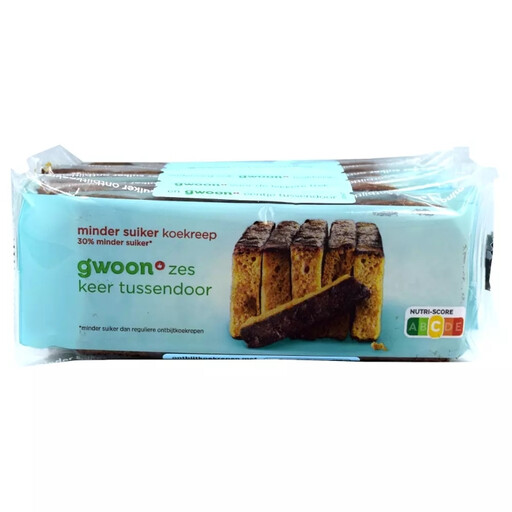
If you’re not set on having a kano biscuit, you could consider a biscuit bar as a different snack. Compare the nutritional information for the product you choose; the words ‘Less Sugar’ in the name don’t, on their own, prove a substantiated ‘less sugar’ claim.
 No image available
This biscuit bar is only an alternative if you’re happy to choose something other than a kano biscuit. The pack contains six bars; before buying, check the sugars per 100 g and per bar, the ingredients and the allergens. Don’t treat ‘Less Sugar’ in the product name as a confirmed sugar claim without a substantiated comparison.
A difference between the kano biscuits described doesn’t prove that any of these products is low in sugar. Jumbo lists 36,8 g of sugars per 100 g for its butter kano biscuits, while Albert Heijn lists 39 g per 100 g for AH Butter Kano biscuits. If you’re choosing between these biscuits, compare the portions too.
There are conditions for using the ‘less sugar’ claim in the EU; a lower figure than on one randomly chosen label isn’t enough to assess the claim. According to the European Union, among other requirements, the energy value of the product carrying the claim must be equal to or lower than that of a similar product. So check the nutritional values and the basis for the comparison too.
Yes. The AH and Jumbo kano biscuits described list several allergens, including cereals containing gluten, milk, soya and egg. Check the current product information before ordering and read the packaging when your order arrives, including details about almonds, other nuts and possible traces.
No. The presence of sweeteners alone doesn’t tell you how much sugar a biscuit bar contains or how it compares with a similar product. Compare the nutritional information and ingredients for each product; according to the Netherlands Nutrition Centre, consuming large amounts of polyols can cause flatulence and diarrhoea.