
People who keep an eye on sugar
If you fancy a sweet snack after exercise, compare the sugars per 100 g and per portion. A claim such as ‘less sugar’ doesn’t tell you how much sugar you’ll actually eat.


A lower-sugar biscuit can be a convenient snack after exercise, but don’t judge it by its sugar claim alone. The Voedingscentrum highlights both carbohydrates and protein after exercise, so compare the nutritional information per portion too, and consider whether the biscuit fits in with what else you eat and drink. If you’re choosing a low-sugar option, check for polyols and allergens as well.
If you fancy a sweet snack after exercise, compare the sugars per 100 g and per portion. A claim such as ‘less sugar’ doesn’t tell you how much sugar you’ll actually eat.
If you’re looking for something to eat after a workout, don’t just check the carbohydrates in a biscuit. The Voedingscentrum also highlights protein as something to consider after exercise.
If polyols or allergens matter to you, read the ingredients list and allergen information on the packaging. Some of the products reviewed warn that excessive consumption may have a laxative effect.
First decide whether you’re mainly looking for less sugar or a snack that fits in with what else you eat after exercise. Then check the portion size and ingredients.
| What to consider | What to check before buying | Who it matters to |
|---|---|---|
| Sugar content | Compare the sugars per 100 g and per portion. If the claim says ‘less sugar’, check what the product is being compared with too. | I want to take a sweet biscuit with me, but limit how much sugar I eat. Around 36% of consumers put reducing sugar first. |
| Food after exercise | Check the carbohydrates and protein, and take into account what else you eat and drink. | After exercise, I want my snack to fit in with the rest of what I eat and drink. This is the main consideration for around 29% of consumers. |
| Fibre and portion size | Check the fibre per portion and see how the pack is divided up. | When I’m out and about, I want to be able to grab a single portion easily and compare the fibre content too. Portability and fibre are the main considerations for around 21% of consumers. |
| Polyols and allergens | Read the latest ingredients and allergen information, particularly for products containing sweeteners. | If I need to avoid certain ingredients, I want to know what’s in the biscuit before I buy it. Around 14% of consumers give this the highest priority. |
A low sugar figure alone tells you little about the rest of the nutritional information. Albert Heijn lists AH Digestive 0% suiker as containing 0.3 g of sugars, but also 465 kcal and 20 g of fat per 100 g.
Compare the nutritional information per 100 g and for the portion you’ll actually eat.
According to the product information from Albert Heijn, Sultana Fruitbiscuit banaan contains at least 30% less sugar than the regular Fruitbiscuit, but still has 23 g of sugars per 100 g.
Check both the product used for comparison and the actual amount of sugars.
The product information for Céréal sesame and vanilla biscuits lists 17 g of polyols per 100 g and warns that excessive consumption may have a laxative effect.
Check which sweeteners and polyols the product contains. Keep products containing xylitol out of reach of pets.
A lower-sugar biscuit won’t necessarily provide enough protein too. The Voedingscentrum highlights both carbohydrates and protein as things to consider after exercise.
Check the protein content and consider how the biscuit fits in with what else you eat and drink.
The own-label products reviewed show the difference between a biscuit with a very low sugar content and a cookie bar with a relative reduction in sugar.
The Fruitbiscuit banaan reviewed is a portioned fruit biscuit with a sugar-reduction claim.
The sesame and vanilla biscuit reviewed is aimed at shoppers looking for a biscuit without sugars.
The wholegrain breakfast cake without added sugars reviewed is a different type of product from a biscuit.
Lotus Bakeries describes Biscoff as a crunchy, caramelised biscuit. It’s a flavour benchmark, not an example of a biscuit with a substantiated less-sugar claim.
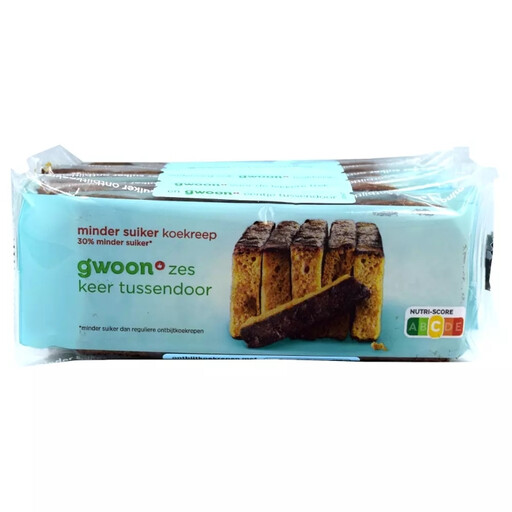
This cookie bar may suit you if you’re looking for a post-workout snack with a less-sugar claim. Check the stated sugar content and the rest of the nutritional information before choosing.
 No image available
A cookie bar for anyone looking for a less-sugar claim, but not necessarily a product with no sugars. The product description lists, per 100 g, 22.8 g of sugars, 62 g of carbohydrates, 9 g of fibre and 3.7 g of protein. If you have an allergy, check the latest packaging: the description mentions rye and the possible presence of other allergens.
Not necessarily. The Voedingscentrum highlights both carbohydrates and protein after exercise, so check the biscuit’s nutritional information and consider what else you eat and drink.
These claims don’t mean the same thing. ‘Less sugar’ compares a product with another product; ‘no added sugars’ doesn’t rule out sugars that are naturally present. Even with a ‘sugar-free’ claim, check the nutritional information and ingredients, including any sweeteners or polyols.
Check which polyols the biscuit contains and how much you eat. The product information reviewed warns that excessive consumption may have a laxative effect. The packaging provides the information for the specific variety you buy.
No. That claim says nothing about allergens. Check the ingredients and allergen information on the latest packaging for the specific product.