Who is this choice for?

Consumers looking for a strictly low-fat option

For you, simply choosing something with relatively less fat isn't enough: you want to know whether the crisps meet the threshold for the ‘low fat’ nutrition claim. According to EUR-Lex, solid foods must contain no more than 3 g of fat per 100 g to meet this threshold. The lower-fat Original varieties discussed here are above it.

Crisp lovers comparing fat content

You want to keep buying crisps, but would rather check the fat content per 100 g than rely on wording on the front of the pack. Compare the rest of the nutritional information too, and think about how much you actually serve.

Households planning portions

You share crisps between people or snack times. In that case, the size of a large bag, the stated number of portions and individual packs all matter, alongside the nutritional values per 100 g.

What should you look for when choosing?

First decide whether you want a strictly low-fat product or simply crisps with less fat than a similar standard variety. Then choose between a sharing bag and individual packs based on how much you want to serve.

What to consider What to check before buying Who it's important for
Fat content and claims Compare the fat content per 100 g of similar crisps. For solid foods, check ‘low fat’ against the EUR-Lex threshold of no more than 3 g of fat per 100 g. If I want to keep a strict eye on fat, I need to understand the difference between ‘less fat’ and ‘low fat’. This is the main consideration for around 42% of consumers.
Relatively less fat Check the fat and energy per 100 g, and find out which product a claim such as ‘less fat’ is being compared with. I still want to eat crisps, but I'm looking for a variety with demonstrably less fat than a comparable standard crisp. This is the main consideration for around 33% of consumers.
Pack size and portion Check the pack size, the stated number of portions and the amount per portion. Before buying, also consider which pack is best for sharing. When I divide crisps between several occasions, I want to decide in advance how much to put out. Portion planning is the top priority for around 25% of consumers.

Common mistakes

  • Reading ‘less fat’ as ‘low fat’

    These are different claims. Albert Heijn lists 13 g of fat per 100 g for Lay's Oven Baked Original and 20 g for AH Ridged Crisps Original Less Fat. Both values are above the maximum of 3 g per 100 g for a ‘low fat’ claim on solid foods, as set out by EUR-Lex.

    Check the fat value per 100 g and decide whether you're looking for a relative reduction or specifically a product that meets the ‘low fat’ threshold.

  • Thinking a large bag will help you manage portions

    According to Albert Heijn, the 300 g Lay's Original value pack contains ten portions, but it still has 30 g of fat per 100 g. A larger bag doesn't change the fat content of the crisps.

    Decide how much you want to serve and set it aside in advance. If individual portions are more convenient, compare multipacks too and check the weight of each pack.

  • Looking only at the fat content

    A difference in fat doesn't mean that energy and salt will differ by the same amount. Voedingscentrum notes that light crisps show a smaller difference in calories than in fat.

    Compare the nutritional information per 100 g, then consider what your chosen portion means for your snack.

  • Buying a multipack without checking the label

    Individual packs make it easier to see how much you're having at a time, but they don't tell you whether the ingredients are suitable for everyone in your household.

    Before buying crisps for several people, check the current allergen information for your chosen flavour and pack.

Brands and product ranges to consider

Lay's

The products compared here are a 300 g Original value pack and 150 g Oven Baked Original, both listed by Albert Heijn.

  • Albert Heijn lists 13 g of fat per 100 g for Oven Baked Original, compared with 30 g for the Original value pack.
  • The larger Original bag is designed for sharing, not a variety with less fat per 100 g. The Oven Baked Original mentioned here also doesn't meet the threshold for a ‘low fat’ claim.

Albert Heijn

AH Ridged Crisps Original Less Fat comes in a 150 g bag. Albert Heijn states that it contains 35% less fat than AH Ridged Crisps Original.

  • The product information lists 20 g of fat per 100 g and names the specific product used for comparison.
  • This comparison doesn't apply to all Albert Heijn crisps. At 20 g of fat per 100 g, this variety doesn't meet the threshold for a ‘low fat’ claim.

Jumbo

Jumbo Original Crisps come in a standard 250 g bag, which Jumbo says contains ten portions.

  • The stated portions can help you divide up a sharing bag in advance.
  • Jumbo lists 30.7 g of fat per 100 g for this variety. The portion information doesn't make it a lower-fat option per 100 g.

Pringles

Pringles Original is also available as a multipack of 12 individual 40 g packs.

  • The individual packs give you a set amount for each snack occasion.
  • Joybuy's product information lists 31 g of fat per 100 g for this multipack. Check the allergen information for the specific pack before buying too.

Crisps on Joybuy

This selection on Joybuy is a 150 g bag of oven-baked Barbecue crisps. If you're mainly comparing fat content, check the nutritional values for this flavour itself: the values for Oven Baked Original don't automatically apply to Barbecue.
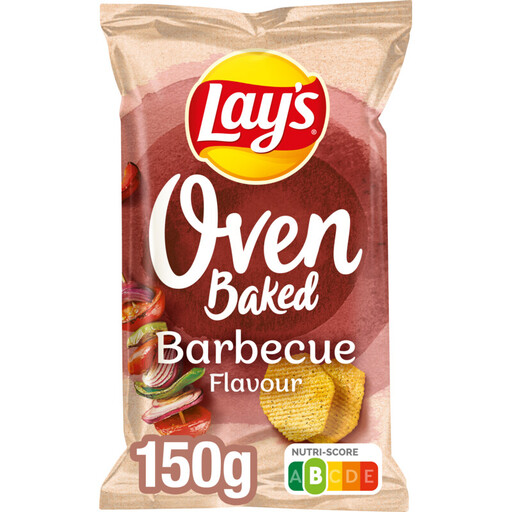
Lay's Oven Baked Barbecue, 150 g bag

Lay's Oven Baked Barbecue 150 g

An oven-baked Barbecue variety for anyone who wants to divide a single bag between snack occasions.

The bag contains 150 g. Check the current label for the fat content per 100 g before comparing this flavour with other crisps. Check the portion and allergen information there too.

View on Joybuy

Frequently asked questions

Does ‘less fat’ mean the same as ‘low fat’?

No. According to EUR-Lex, solid foods can use the ‘low fat’ nutrition claim when they contain no more than 3 g of fat per 100 g. For the Oven Baked Original and AH Ridged Crisps Original Less Fat discussed here, Albert Heijn lists 13 g and 20 g of fat per 100 g respectively. So ‘less fat’ doesn't make these varieties ‘low fat’.

How do I compare bags with different portion sizes?

First compare the nutritional values per 100 g, as recommended by Voedingscentrum when comparing products. Then check how many grams the manufacturer lists as a portion and how much you want to serve yourself.

Are light or oven-baked crisps automatically a better fit for my overall diet?

No. A lower fat content doesn't tell you the whole story about a product's nutritional value. Voedingscentrum notes that with light crisps, the difference in calories can be smaller than the difference in fat. So compare the energy and other nutritional information per 100 g as well.

Does a multipack help you manage portions?

A multipack gives you a set amount in each individual pack: the Pringles Original multipack listed here contains 12 packs of 40 g. That doesn't change the fat content per 100 g; Joybuy lists 31 g of fat per 100 g for this variety. Check the allergen information on the label too.

Should I compare salt as well as fat?

Yes, if salt matters to your choice. Voedingscentrum lists 0.45 g of salt for a 40 g bowl of Original crisps. To compare different packs, check the salt value per 100 g for the products you're considering.
