
Parents who look at the fat claim
You’re looking for paprika crisps for a snack during the school holidays and want to choose a product that states how much less fat it contains compared with regular potato crisps.


For a snack during the school holidays, you can compare paprika crisps with a clear reduced-fat claim: Hoogvliet states that Chio Oven Chips Paprika contains 60% less fat, Lay’s Benelux says Lay’s Oven Baked Roasted Paprika contains 50% less, and Jumbo says Lay’s Light Paprika contains 30% less, each compared with regular potato crisps. A greater reduction in fat doesn’t automatically tell you anything about salt, serving size or allergens, so check the current packaging too.
You’re looking for paprika crisps for a snack during the school holidays and want to choose a product that states how much less fat it contains compared with regular potato crisps.
You want to do more than compare products: you also want to decide how many crisps to serve at snack time. The nutritional information per serving is just as relevant as the information per 100 g.
You need to read the ingredients and allergen warnings before serving. For example, Chio says that Chio Oven Chips Paprika may contain wheat, sesame, milk and soya.
Start with why you’re looking for a different paprika crisp: a specific fat claim, keeping an eye on salt and portions, setting a defined snack time, or checking ingredients and allergens.
| What to consider | What to check when buying | Most relevant to |
|---|---|---|
| Fat claim | Check that the claim applies to this specific paprika flavour and find out what its fat content is being compared with. | I mainly want to choose paprika crisps with a clear comparison against regular potato crisps. For around 36% of consumers, this fat claim is the top priority. |
| Salt and portion size | Compare the amount of salt per 100 g and, if listed, per serving; decide how much you’ll actually serve. | If I’m serving a bowl of crisps, I want to know how much salt it contains. Around 29% of consumers focus most on salt and portion size. |
| Snack time | Choose a pack and serving size that suit the planned snack break. | During the school holidays, I want to avoid the children picking at crisps all day. Setting specific snack times is the main priority for around 21% of consumers. |
| Ingredients and allergens | Read the ingredients list and any warnings about possible allergens on the current packaging. | If an ingredient or allergen needs to be avoided, I need to be able to check the packaging before offering crisps. For around 14% of consumers, this check comes first. |
A reduced-fat claim compares crisps with regular potato crisps; it doesn’t assess portion size or how often children eat them. The Netherlands Nutrition Centre recommends setting regular snack times for children.
Use the claim to compare products, then decide separately how many crisps to serve at the planned snack time.
Jumbo lists 1.6 g of salt per 100 g for Lay’s Light Paprika and 0.5 g per 30 g serving. The value per 100 g helps you compare products; the value per serving helps you work out how much salt is in the bowl.
Check both figures and decide how much to serve before putting the bag on the table.
Lentils as an ingredient don’t prove that a product contains less fat. For Properchips Paprika, Jumbo lists 19 g of fat and 2.71 g of salt per 100 g.
Compare the nutritional information for the specific flavour, and look for an explicit reduced-fat claim if less fat is your main reason for buying.
Ingredient information can change. The Netherlands Food and Consumer Product Safety Authority highlights the importance of clear allergen labelling; Chio says its Oven Chips Paprika may contain wheat, sesame, milk and soya.
Check the packaging again before serving if you need to avoid a particular allergen.
Chio Oven Chips Paprika is an oven-baked paprika snack in a 125 g pack, as listed by Jumbo.
Lay’s has separate paprika flavours called Oven Baked Roasted Paprika and Light Paprika.
According to Jumbo, Properchips Paprika contains ingredients including lentil flour, making it a different type of product from potato crisps.
This selection is suited to anyone looking for an oven-baked paprika flavour for a snack during the school holidays. Check the packaging for the fat claim, nutritional information and allergens for the flavour on offer.
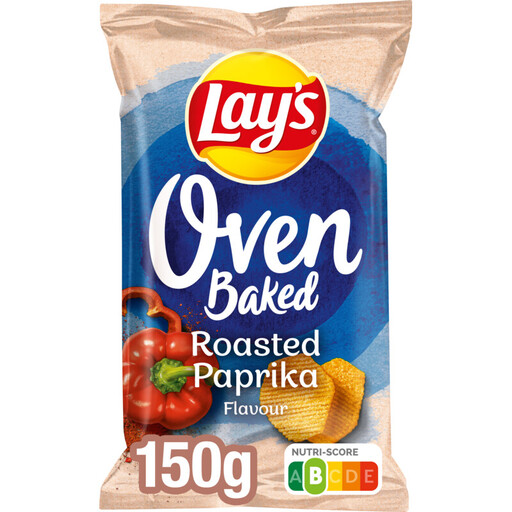 Image unavailable
For anyone looking for oven-baked paprika crisps and wanting to decide on a portion in advance for snack time.
Pack size: 150 g. Compare the current nutritional information per 100 g and per serving, and read the allergen information on the packaging.
A reduced-fat claim doesn’t automatically make paprika crisps suitable as an everyday snack for children. The Netherlands Nutrition Centre recommends setting regular snack times for children, so also decide when and how much to offer.
The percentages compare the fat content with regular potato crisps, not with one another: Hoogvliet says Chio Oven Chips Paprika contains 60% less fat, Lay’s Benelux says Lay’s Oven Baked Roasted Paprika contains 50% less, and Jumbo says Lay’s Light Paprika contains 30% less. Check the label of each individual flavour for other nutritional values.
Yes. A fat claim doesn’t tell you how much salt a product contains. Jumbo lists 1.6 g of salt per 100 g for Lay’s Light Paprika and 0.5 g per 30 g serving; compare both figures with the amount you plan to serve.
Read the allergen information on the current packaging before serving the crisps. Chio says Oven Chips Paprika may contain wheat, sesame, milk and soya; a warning for one product doesn’t automatically apply to other paprika flavours.
Use a retailer’s website to compare products in advance, but also check the packaging you receive. Albert Heijn points out that ingredients, nutritional values and allergen information can change.