
Office buyer keeping an eye on fat
You’re looking for paprika crisps to share and want to compare their fat content with that of regular crisps. A stated fat reduction is a good starting point, but check the salt and allergens too.


When choosing crisps for a shared office snack tin, first compare the fat reduction claimed for each product, then check the fat and salt per 100 g and the allergens listed on the packaging. A 125 or 150 g bag can be added to the tin in small amounts; a 25 g pack is better suited to an individual portion than to sharing. Less fat does not automatically mean less salt.
You’re looking for paprika crisps to share and want to compare their fat content with that of regular crisps. A stated fat reduction is a good starting point, but check the salt and allergens too.
You’d rather have an individual pack than take crisps from a shared tin. A 25 g pack gives you a defined portion, but check the ingredients too if allergens are a concern for you.
You need to check which ingredients are suitable for the people sharing the crisps. The Netherlands Food and Consumer Product Safety Authority points out that allergens must be listed on the label of prepacked foods. Keep this information available when you put crisps in a tin too.
Start with why you’re looking for different paprika crisps: a fat reduction, a defined portion or an option whose ingredients you can check for colleagues. Then compare products per 100 g, even when the bags are different sizes.
| What to look for | What to check when buying | Who it matters to |
|---|---|---|
| Less fat | Check what the fat reduction is compared with and look at the fat per 100 g. | If I’m buying paprika crisps for the office to limit fat, I don’t want to rely on the wording on the front of the pack alone. For around 42% of consumers, this fat comparison is the main priority. |
| Portions and sharing | Compare an individual 25 g pack with 125 or 150 g bags, and decide how much to put in the tin at a time. | For a shared tin, I want to be able to top it up without leaving the whole bag open, while I’d prefer a set portion for myself. Portion size and ease of sharing are the main consideration for around 33% of consumers. |
| Salt and allergens | Check the salt per 100 g and read the ingredients and allergens on the current packaging. | If several colleagues are sharing, I want to know whether the crisps meet their allergen requirements and how much salt the product contains. For around 25% of consumers, these checks take priority. |
The stated fat reductions are not all based on the same comparison. A fat claim also tells you nothing about the salt content of the crisps.
Alongside the claim, check the nutrition information for fat, saturates and salt per 100 g.
An opened bag can lose its crunch. The Netherlands Nutrition Centre recommends storing opened crisps in a kitchen cupboard for 2 to 5 days.
Put a small amount in the tin each time and store the rest somewhere cool, dry and dark, in a tightly sealed bag.
The product information for the crisps discussed here lists milk, soya and barley, among other ingredients, and warns that other allergens may be present. Without the packaging, colleagues may find it difficult to check this information.
Check the current label and keep the packaging or allergen information by the shared tin.
A 25 g pack is designed as a defined individual portion; a 125 or 150 g bag is easier to share in a tin a little at a time.
Choose the size based on who’ll be helping themselves, and don’t put the whole contents of a larger bag in the tin at once.
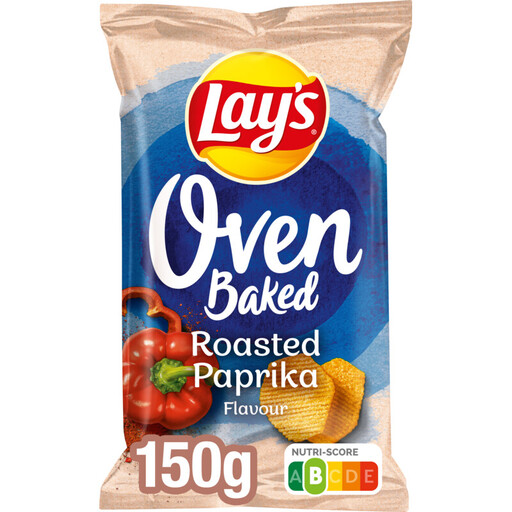
Alongside its regular paprika crisps, Lay's offers a 150 g pack of Oven Baked Roasted Paprika crisps.
Chio Oven Chips Paprika is an oven-baked paprika variety sold in a 125 g bag.
WeCare Paprika Flavour Chips comes in an individual 25 g pack for anyone looking for a set portion.
If you’re looking for a bag of oven-baked paprika crisps to share in small amounts, this 150 g pack could be a good fit. Check the nutrition information and allergens for this product too before buying it for colleagues.
 No image available
A bag to add to a shared office snack tin a little at a time.
According to Joybuy product information, this oven-baked variety contains 50% less fat than regular crisps. Per 100 g, the information lists 13 g of fat and 0.81 g of salt; milk is listed as an allergen. Check the current packaging before sharing with colleagues.
No, a fat reduction claim doesn’t tell you how much salt the crisps contain. The product information lists 0.81 g of salt per 100 g for Lay's Oven Baked Paprika, 1.6 g for Chio Oven Chips Paprika and 2.5 g for WeCare Paprika Flavour Chips. So compare both values on the current packaging.
It’s best to put a small amount in the tin at a time and seal the remaining bag tightly. The Netherlands Nutrition Centre recommends storing opened crisps somewhere cool, dry and dark, in a tightly sealed bag, and gives 2 to 5 days in a kitchen cupboard as a storage guideline.
Always check the current packaging of the product you choose. The available product information lists milk for Lay's Oven Baked; barley and the possible presence of wheat, sesame, milk and soya for Chio; and soya and the possible presence of gluten for WeCare. Keep the allergen information by the tin.
Nutri-Score can offer an additional comparison within the same product group, according to the Netherlands Nutrition Centre. Also check the nutrition information per 100 g and the ingredients and allergens; the score alone won’t tell you which crisps suit your colleagues’ needs.