
If you’re looking for organic crisps with less fat
You want to be able to check both qualities in the same snack. An organic label alone doesn’t tell you how much fat the crisps contain.


If organic is a must for you, only choose crisps when you can check both the organic label and a specific comparison showing they contain less fat on the packaging. If you’re mainly looking for less fat than in standard potato crisps, Lay’s Oven Baked Naturel is another option: according to Albert Heijn, this variety contains 50% less fat than standard potato crisps. For both options, also compare the nutritional information per 100 g, especially the salt content.
You want to be able to check both qualities in the same snack. An organic label alone doesn’t tell you how much fat the crisps contain.
You want to compare a potato crisp with a specific lower-fat claim against standard potato crisps, and organic isn’t an absolute requirement.
You’re open to different snack bases and compare energy, as well as fat and salt, per 100 g. The Netherlands Nutrition Centre recommends using this consistent basis for comparison because serving sizes can vary.
First decide whether organic is a requirement or whether the lower-fat claim takes priority. Then compare the nutritional information of the varieties that meet your first preference.
| What to consider | What should you check? | Who is this important to? |
|---|---|---|
| Organic and lower-fat | Check the organic label and see which crisps the lower-fat claim is compared with. | I want to see both qualities on the same pack before I choose; this dual requirement comes first for around 46% of consumers. |
| Less fat in potato crisps | Read the reference for the claim and compare the fat content per 100 g. | If I mainly want less fat than in standard potato crisps, organic doesn’t have to be the deciding factor. Around 27% of consumers say that reducing fat takes priority. |
| Nutritional information | Compare energy, fat, saturated fat and salt per 100 g; check the ingredients list if it’s relevant to your choice. | When comparing different types of crisps, I don’t want to rely only on the front of the pack; comparing nutritional values matters most to around 18% of consumers. |
| Availability and pack size | Check the current range status and the weight in grams. | I’m looking for a pack I can actually buy that suits the occasion. This practical consideration comes first for around 9% of consumers. |
An organic label and a lower fat content describe different qualities. A product can have one without the other.
Check each separately: look for the organic label, then check the fat content per 100 g and the reference used for any lower-fat claim.
A lower-fat claim doesn’t tell you how much salt or energy a variety contains. For example, Albert Heijn lists 1.7 g of salt per 100 g for BioToday sea salt lentil crisps, despite the claim that they contain 30% less fat than standard potato crisps.
Compare the nutritional information per 100 g and check the ingredients and allergens on the packaging if they’re important to you.
A product description that fits your needs doesn’t mean the crisps are still available to buy. Albert Heijn marks De Kleine Keuken Tekkels as discontinued; Joybuy listed Leev Biologisch Yes Peas Paprika as unavailable.
Check the current product page just before buying and make sure any alternative still meets your requirements.
Sea salt lentil crisps for anyone looking to combine organic with an explicit lower-fat claim.
Oven Baked Naturel is a potato crisp for anyone mainly looking for a specific reduction in fat.
According to Albert Heijn’s product information, Tekkels combined an organic label with a lower-fat claim.
Biologisch Yes Peas Paprika is a chickpea snack, not a potato crisp with a stated lower-fat claim.
These oven-baked potato crisps suit anyone prioritising less fat, with organic not being an absolute requirement. If you only want to buy organic crisps, check the packaging yourself.
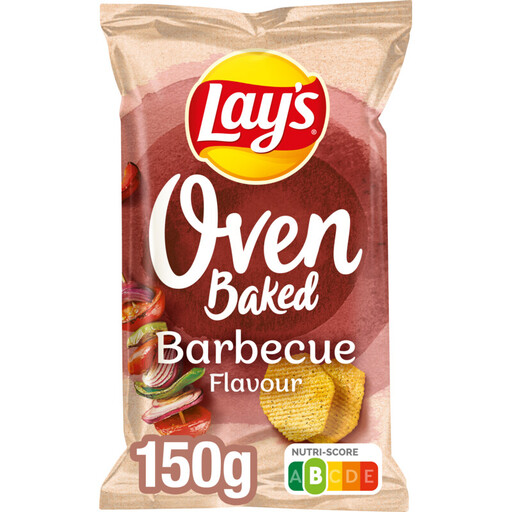 Image unavailable
For anyone looking for oven-baked potato crisps with a barbecue flavour, who doesn’t have an absolute requirement for organic.
150 g bag. Check the organic label, nutritional information and ingredients on the packaging if they’re important to your choice.
No. An organic label alone says nothing about fat content. Also check the fat content per 100 g and, for a lower-fat claim, find out which product the crisps are being compared with.
Look for the organic label and the EU organic logo on the packaging. According to the European Commission, the logo may only be used on products certified as organic by an authorised control authority or control body.
Yes. A lower-fat claim says nothing about the salt content. Albert Heijn lists 0.85 g of salt per 100 g for Lay’s Oven Baked Naturel and 1.7 g per 100 g for BioToday sea salt lentil crisps; compare the varieties you’re considering on the same basis.
Start by comparing the nutritional information per 100 g. The Netherlands Nutrition Centre points out that serving sizes can distort a comparison; then consider how much you want to eat.