
Shoppers comparing total fat
You want to compare total fat per snack occasion without confusing it with saturated fat or energy. The Netherlands Nutrition Centre’s category data shows why it’s worth looking at these nutritional values separately.


If you want to reduce your total fat intake, compare the nutritional values for equal quantities. Reducing saturated fat, energy intake or portion size are different goals. The European Commission defines a ‘low fat’ claim for solid foods as no more than 3 g of fat per 100 g; ‘unsalted’ or ‘no added oil’ does not prove that a product meets this claim. Choose a pack size that suits your planned snack occasions and weigh out each portion separately.
You want to compare total fat per snack occasion without confusing it with saturated fat or energy. The Netherlands Nutrition Centre’s category data shows why it’s worth looking at these nutritional values separately.
You’re looking for a pack size that suits the number of snack occasions you have planned. The Netherlands Nutrition Centre recommends storing nuts in a tightly sealed container in a dry place; the weight of a bag alone tells you nothing about its fat content.
You pay attention to how the nuts are prepared. Duyvis describes Cashews Original as oven-roasted with no added oil, but this doesn’t prove that they have a lower total fat content.
| What to consider | What should you check? | Who is this important to? |
|---|---|---|
| What does ‘less fat’ mean? | Decide what your goal is and compare total fat, saturated fat and energy using the same quantity as your basis. | If you mainly want to compare total fat per snack occasion, check saturated fat and energy too. Around 36% of consumers use total fat as their first selection criterion. |
| Portion per snack occasion | Weigh your portion and use the label on the exact pack to calculate its nutritional values. | If your main aim is to manage how much you eat at each snack occasion, weighing your portion matters more than a claim on the pack. Around 29% of consumers prioritise portion size and energy. |
| Pack size for the week | Check the net weight and how many planned portions it provides; follow the storage instructions on the pack. | If you’re shopping for several days, you’ll want a quantity that matches how much you plan to use. Around 21% of consumers prioritise planning their supplies. |
| Preparation and flavour | Read the preparation description and ingredients, and assess fat and energy separately. | If you’re mainly looking for roasted nuts or want to avoid added oil, check exactly what the product description says. Around 14% of consumers give preparation and flavour top priority. |
For solid foods, the European Commission sets the threshold for a ‘low fat’ claim at no more than 3 g of fat per 100 g. This claim is different from ‘no added oil’. As an example of category data, the Netherlands Nutrition Centre lists 12.2 g of fat, 2.1 g of saturated fat and 154 kcal per 25 g of unsalted cashews. For the category of unsalted nuts, the figures are 14.9 g of fat, 1.6 g of saturated fat and 164 kcal. These are general category figures, not nutritional values for every individual pack.
A description of how a product is prepared doesn’t tell you its total fat content on its own, nor does it substantiate a ‘low fat’ claim.
Read the nutrition table alongside the preparation description. Treat ‘no added oil’ and ‘low fat’ as two separate properties.
According to the Netherlands Nutrition Centre’s category data, unsalted cashews contain less total fat per 25 g than the general category of unsalted nuts, but more saturated fat.
Decide which factor matters most to you, and compare saturated fat and energy using the same basis too.
A 500 g pack is a stock-up size, not a portion for one snack occasion. You’ll also need to store its contents properly.
Work out how much you need for the week ahead and weigh out each portion separately.
A bag that’s larger than you plan to use may leave you with leftovers.
The listing for Duyvis Sweet Paprika compares a specific product with regular peanuts in a crunchy coating and says it is no longer available. This isn’t current evidence for plain nuts or other products.
Assess a comparative claim using the exact pack and the product category it compares against.
Worth considering for roasted snacks, including Cashews Original.
AH Unsalted Cashews are a good fit if you’re looking for an unsalted option.
Jumbo Unsalted Cashews Value Pack 500 g is a larger pack option for several snack occasions.
The product listing for unsalted cashews specifies a 500 g pack.
The product listing for Trader Joe’s roasted, unsalted cashews specifies a 250 g pack.
PLUS Unsalted, Unroasted Cashews 200 g is an option if you’re looking for this variety.
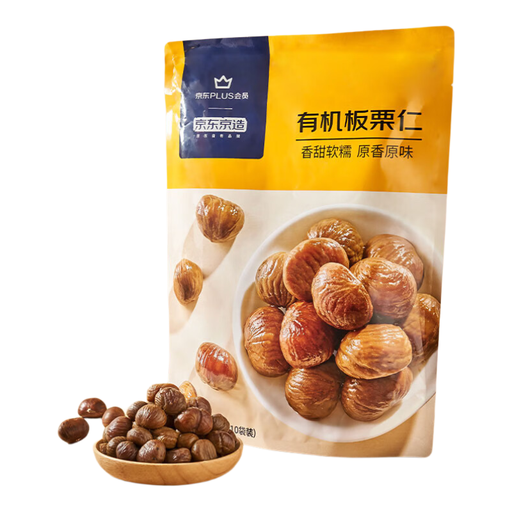
If you’re looking for a ready-to-eat, low-fat chestnut snack for your weekly shop, bear in mind that each sachet contains 100 g when planning your supplies.
 No image available
A good fit if you’re looking for a ready-to-eat chestnut snack. Each sachet contains 100 g, so the pack size won’t necessarily be right for a single snack portion.
The product information lists 1.7 g of fat and 191 kcal per 100 g. This fat content is below the 3 g per 100 g threshold the European Commission uses for a ‘low fat’ claim on solid foods.
The pack contains 1,000 g, divided into 10 sachets of 100 g each.
No. For solid foods, the European Commission sets the threshold for a ‘low fat’ claim at no more than 3 g of fat per 100 g. ‘No added oil’ describes how a product is prepared; check its total fat content separately.
Multiply your chosen portion weight by the number of planned snack occasions and the number of people. At 25 g per portion and seven snack occasions for one person, you’d need 175 g. This is a calculation example, not personalised nutritional advice.
Store nuts in a tightly sealed container in a dry, preferably cool place. The Netherlands Nutrition Centre gives 10–15 °C as an example. Follow the storage instructions on the pack too.
The NVWA lists peanuts and nuts separately as allergens. Prepacked products must show allergen information on the label. If you have an allergy, check the exact pack and its warnings, not just the product name.
Check the warnings on the exact pack and bear in mind the risk of choking. The Jumbo pack reviewed warns that young children may choke on nuts; this isn’t a general age limit.
Do not eat the affected batch: Trader Joe’s unsalted cashews, 170 g, barcode 2003020120930 and best-before date 23-09-2026. On 20 May 2026, the NVWA reported that it may contain metal fragments. The warning applies to that specific batch, not automatically to other packs.