
Fans of savoury coated nuts looking for less fat
You want to keep serving a crunchy, seasoned snack while understanding which products are used as the basis for a lower-fat claim.


If your main priority is reducing total fat, check which products are being compared. If you want to control how much you snack on, choose a measured portion. Unsalted and made without added cooking oil are separate product characteristics, and don’t automatically mean a lower total fat content.
You want to keep serving a crunchy, seasoned snack while understanding which products are used as the basis for a lower-fat claim.
You want to know how much energy is in the amount you actually serve yourself, rather than looking only at the nutritional values per 100 g.
You’re looking for a suitable snack and want to take your guests’ ingredients and allergens into account.
Historical Albert Heijn listings for Duyvis Oven Baked Smoked Paprika and Sundried Tomato and Herbs feature a brand claim of 30% less fat than regular Duyvis Borrelnootjes and Tijgernootjes. Albert Heijn lists both varieties as discontinued. This comparison applies to the products mentioned and doesn’t confirm they’re currently available to buy.
| What to consider | What should you check? | Who is this important for? |
|---|---|---|
| Lower total fat | Compare the same quantity and check which products are used as the reference. For solid foods, the European Commission sets a maximum of 3 g of fat per 100 g for a ‘low fat’ claim. | When choosing coated nuts, you’ll want to know how much less fat they contain and what they’re being compared with. Around 31% of consumers prioritise lower total fat when shopping. |
| Energy per portion | Compare the nutritional values per 100 g as well as the weight of your own portion. The Voedingscentrum gives 164 kcal for a 25 g handful of unsalted nuts; the Jumbo label for Duyvis Oven Baked Pinda’s Original lists a 30 g portion. | When filling a bowl for drinks and nibbles, you’ll want to measure the amount you serve. Around 25% of consumers give portion control top priority. |
| Unsalted and preparation method | Read the ingredients: AH Ongezouten cashewnoten contains sunflower oil, while PLUS Cashewnoten ongezouten lists unroasted cashews as an ingredient. Being unsalted doesn’t in itself tell you whether cooking oil has been added. | If you’re looking for an unsalted snack, you’ll also want to know how it’s prepared. Around 19% of consumers prioritise an unsalted product. |
| Suitable for guests | Check the allergen information on the exact product label. PLUS states that its unroasted cashews may contain peanuts; the NVWA treats peanuts and tree nuts as separate allergens. | When serving guests, their known allergies may determine which products are suitable. Around 13% of consumers consider suitability for guests the most important factor. |
| Pack size and storage | Check whether the pack size suits what you’re serving and can store. The Voedingscentrum recommends storing nuts in a tightly sealed container in a dry place, preferably somewhere cool. | For a small get-together, you’ll want to choose an amount that suits the occasion and can be stored properly. Around 12% of consumers prioritise a suitable pack size. |
Duyvis describes Oven Baked Peanuts Original as roasted without added fat. Even so, the Jumbo label lists 50 g of fat per 100 g. The preparation method and total fat content therefore tell you different things.
Read both the preparation description and the nutrition table, and compare the fat content per 100 g.
The ingredients for AH Ongezouten cashewnoten include sunflower oil. So the product name doesn’t mean that no oil has been added.
Check the ingredients if you want to choose a product made without added cooking oil.
A larger bag can leave you with leftovers if you’re only serving a small amount.
Choose an amount to suit the occasion and think in advance about how you’ll store an opened pack.
The product ranges vary: coated nuts for drinks and nibbles aren’t the same as dry-roasted peanuts.
The listing for AH Ongezouten cashewnoten provides a specific example of the ingredients in an own-brand product.
Jumbo describes Oriëntaals Borrel Noten as coated nuts for drinks and nibbles, with a seasoned coating.
Lidl Netherlands has a product listing for cashew nuts.
ALDI describes a range that includes cashews, almonds, walnuts and Brazil nuts, both salted and unsalted.
PLUS Cashewnoten ongezouten ongebrand is an example of unroasted cashew nuts.
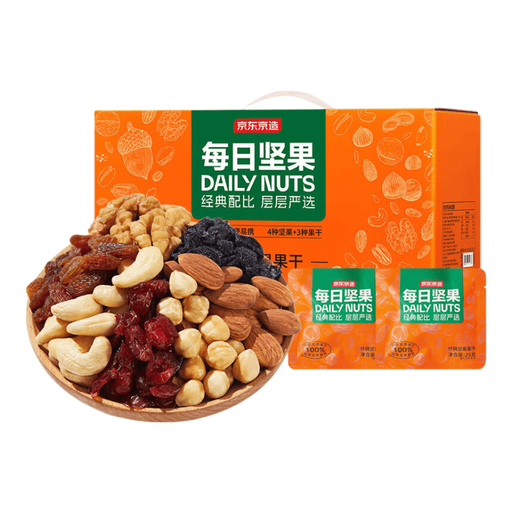
A Joybuy product selection for drinks and film nights, where measured portions matter.
 No image available
The individual 25 g sachets give you a measured portion for drinks or a film night.
The mix contains nuts and dried fruit. The stated nutritional information lists 40.7 g of fat per 100 g, so don’t choose this product if your aim is to reduce your total fat intake. The nuts listed are walnuts, almonds, cashews and hazelnuts; check the packaging for allergen information.
For solid foods, the European Commission sets a maximum of 3 g of fat per 100 g for a ‘low fat’ claim. So a product containing less fat than another doesn’t automatically meet this threshold.
Use the weight of the portion you’ll serve: multiply the kcal per 100 g by the portion weight in grams, then divide by 100. The Voedingscentrum gives 164 kcal for a 25 g handful of unsalted nuts; treat this as an example for the category, not as the nutritional value of every product.
Check the allergen information on the exact product packaging, including warnings about possible traces. The NVWA treats peanuts and tree nuts as separate allergens and states that allergen information must appear on the labels of pre-packed products.
Follow the storage instructions on the packaging. The Jumbo label for Duyvis Oven Baked Pinda’s Original recommends storing the product in a cool, dry place and, once opened, keeping it in a light- and airtight container.
The labels for the Duyvis peanuts and PLUS cashew nuts mentioned warn that young children can choke on nuts. So don’t assume that whole nuts are suitable for this age group.