Choose lower-fat crisps for on the go based on what matters most to you: a clearly stated reduction in fat, a different texture in a potato crisp, or a lentil-based crisp. Compare the fat and salt per 100 g, then decide how much you’ll actually take with you. A reduced-fat claim doesn’t tell you the whole story about nutritional value.
Who is this choice for?
Snackers mainly looking for less fat
You want to take crisps with you for lunch, but you’re looking for an option with a clearly defined reduction in fat. Check what the manufacturer is comparing them with and how much fat the product contains per 100 g.
Label checkers who also consider salt and energy
You don’t want to rely on the wording on the front of the pack alone. As well as fat, compare salt, energy and saturated fat, and consider what those figures mean for the portion you eat.
Snackers who want to take a portion with them
You’re looking for something crunchy to enjoy on the go, without automatically taking a whole multi-portion bag. The pack size and stated portion size can help you decide in advance how much to take.
What should you look for when choosing?
When comparing lower-fat crisps for lunch on the go, start by checking the reduced-fat claim against the figure per 100 g. Then look at the rest of the nutritional information and how much you want to take with you.
| What to consider | What to check when buying | Who is this important for? |
|---|
| Less fat |
Check what the reduced-fat claim is comparing the product with, and look at the amount of fat per 100 g. |
I want to keep eating potato crisps, but choose an option with a demonstrably lower fat content. Around 36% of consumers prioritise this reduction in fat. |
| A portion for on the go |
Check the pack size and stated portion size, then decide how much you’ll take with you. |
When I take crisps with me for lunch, I want to be able to decide on my portion in advance. This is the main priority for around 29% of consumers. |
| Salt and energy |
Compare salt, energy and saturated fat per 100 g, then factor in your own portion. |
A lower fat content isn’t enough for me to choose a product: I also want to know how much salt and energy the crisps provide. This broader comparison is the main priority for around 21% of consumers. |
| Ingredients and protein |
Check the ingredients, protein, salt content and allergens for the specific variety. |
I’m specifically looking for lentil-based crisps, or I’m focusing on protein when making this choice. Around 14% of consumers give this the highest priority. |
Common mistakes
-
Taking ‘less fat’ as a complete guide to nutritional value
A reduced-fat claim on its own tells you nothing about the salt content or energy in the portion you eat. For example, Albert Heijn lists 1.7 g of salt per 100 g for BioToday Linzenchips zeezout, alongside its reduced-fat claim.
Read the nutritional information per 100 g, then compare it with the amount you plan to take with you.
-
Treating a multi-portion bag as a single portion
According to Albert Heijn, a 150 g bag of Lay’s Oven Baked Naturel contains five stated portions of 30 g. Taking the whole bag makes it harder to stick to the amount you chose in advance.
Put your chosen portion in a resealable container at home and keep the rest of the bag for later.
-
Looking only at protein in lentil crisps
Albert Heijn lists 12 g of protein and 1.7 g of salt per 100 g for BioToday Linzenchips zeezout. The product information also mentions possible traces of allergens.
Check the salt content and the latest allergen information on the specific pack before choosing this variety.
-
Relying on out-of-date product information
Ingredients and nutritional values can change, so information you saw online previously may not match the pack you buy.
Check the ingredients, allergens and nutrition table on the current packaging.
Brands to consider
Lay's
The Oven Baked range is worth considering if you’re looking for oven-baked potato crisps with a reduced-fat claim.
- For Lay's Oven Baked Naturel, Albert Heijn states 50% less fat than regular potato crisps and 13 g of fat per 100 g.
- The Naturel pack reviewed contains 150 g and five stated portions of 30 g. Also compare the salt content and decide on your own portion size.
AH
AH Ribbelchips naturel minder vet is an own-brand option for anyone comparing plain ridged crisps.
- According to Albert Heijn, this variety has 35% less fat than AH Ribbelchips naturel and contains 20 g of fat per 100 g.
- Albert Heijn also lists 0.9 g of salt per 100 g. The reduced-fat claim is specifically based on a comparison with AH Ribbelchips naturel.
BioToday
The Linzenchips zeezout variety reviewed here has a different base ingredient from the potato crisps mentioned above.
- Albert Heijn lists 43% lentil flour, 12 g of protein per 100 g and 30% less fat than regular potato crisps for this variety.
- The product information lists 1.7 g of salt per 100 g and possible traces of allergens. Check the current packaging if this information is important to you.
Pringles
Pringles Original is worth considering if you’re mainly looking for compact packaging for on the go, rather than a well-supported lower-fat option.
- Pringles Netherlands lists a 40 g pack of Original, among other sizes.
- Pringles Netherlands lists 31 g of fat and 1.0 g of salt per 100 g for Original. The product information does not include a reduced-fat claim.
Oven-baked crisps on Joybuy
These two oven-baked crisp varieties come in pack sizes you can compare for lunch on the go. To compare nutritional value and portion size, check the label for the specific flavour.
 No image available
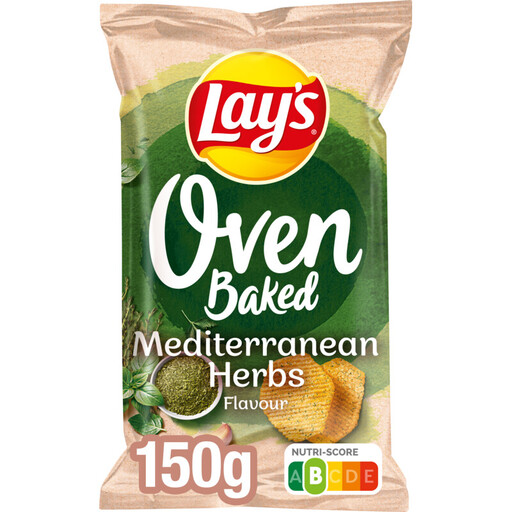
Lay's Oven Baked Mediterranean Herbs, 150 g
If you’re looking to take oven-baked crisps with you for lunch, this is a 150 g bag. Check the pack for the nutritional values per 100 g, portion size and allergens for this flavour.
View on Joybuy
 No image available
Chio Oven Chips Sea Salt, 125 g
If you’re looking for oven-baked crisps in a 125 g bag, you can compare this Sea Salt variety. Check the nutritional values per 100 g and decide how much you want to take with you.
View on Joybuy
Frequently asked questions
Is less fat enough reason to choose crisps for my lunch?
No. The reduced-fat claim alone doesn’t give you the full nutritional picture. Compare energy, saturated fat and salt per 100 g as well, and consider how many crisps you actually eat. The Netherlands Nutrition Centre points out that snacks can be high in energy or salt.
How can I compare lower-fat crisps fairly?
Start with the amount of fat and salt per 100 g, then check what the reduced-fat claim is comparing the product with. Albert Heijn lists 13 g of fat and 0.85 g of salt per 100 g for Lay's Oven Baked Naturel; for AH Ribbelchips naturel minder vet, it lists 20 g of fat and 0.9 g of salt per 100 g. These are different products, and their reduced-fat claims are based on different comparisons.
How can I take a measured portion of crisps with me?
Decide in advance how many grams you want to take and put that amount in a resealable container. Albert Heijn lists portions of 30 g for Lay's Oven Baked Naturel and 25 g for AH Ribbelchips naturel minder vet. These stated portions may not match the amount you eat yourself.
Should I still check allergens and nutritional values on the pack?
Yes. Check the label on the specific pack you’re buying. Ingredients, allergen information and nutritional values can change, so check the details again if you choose a different flavour or variety.


