
Health-conscious hosts
You want to eat less fat and are checking whether that’s down to the product’s ingredients or simply a smaller portion. The way a product is prepared doesn’t automatically tell you how much fat it contains.


If you want to consume less fat, first decide whether you’re looking for a lower fat content per 100 g or simply want to serve a smaller portion. Unsalted and made without added oil are separate product characteristics. For a product to be labelled ‘low fat’, solid foods must contain no more than 3 g of fat per 100 g, according to the European Commission. The Duyvis variant without added oil that we looked at lists 43 g of fat per 100 g.
You want to eat less fat and are checking whether that’s down to the product’s ingredients or simply a smaller portion. The way a product is prepared doesn’t automatically tell you how much fat it contains.
You’re looking for cashews with no added oil, no added salt, or neither. Check the ingredients and salt content separately: for example, unsalted cashews may still be prepared in oil.
You’re working out how much to serve and taking allergens and leftover storage into account. If you’re serving food commercially, allergen information is also important.
First decide whether you’re mainly assessing the product’s fat content, your portion size, how it’s prepared or whether it’s suitable for your guests.
| What to consider | What should you check? | Who is this important for? |
|---|---|---|
| Is it genuinely lower in fat? | Check the fat content per 100 g and look closely at the exact claim and the basis for comparison. | I want to know whether the product itself contains less fat, not just whether it’s prepared differently. Around 31% of consumers prioritise a demonstrable reduction in fat. |
| Fat per portion | Compare products per 100 g first, then work out the figures for the same serving size. | If my main aim is to serve less fat, weighing the portion can help; it doesn’t change the product’s composition per 100 g. Around 25% of consumers prioritise portion control. |
| Salt and preparation | Check the ingredients, salt content per 100 g and description of how the product is prepared. | I’d rather focus on salt or added oil than a fat claim. Around 19% of consumers prioritise salt and preparation. |
| Suitable for guests | Check the allergen information and warnings on the packaging. | If I’m serving cashews to guests, I check the label first and take warnings for young children into account. Around 13% of consumers prioritise guest safety. |
| Quantity and storage | Choose a net weight that suits the portions you’re planning and check the storage instructions. | I want to choose a pack whose contents I can use and whose leftovers I can store properly. Around 12% of consumers prioritise quantity and minimising leftovers. |
These terms describe the salt content or how the cashews are prepared, not necessarily their fat content. For solid foods to be labelled ‘low fat’, the European Commission sets a limit of 3 g of fat per 100 g; the Duyvis variant without added oil that we looked at lists 43 g per 100 g.
Check the nutrition information and ingredients separately. Don’t treat a preparation or salt claim as proof of reduced fat.
A smaller portion may show less fat per serving even if the fat content per 100 g is no lower. Serving sizes shown in product information can also vary.
Compare the figures per 100 g first, then work them out for the same portion size.
A fat or salt claim doesn’t tell you which allergens may be present. The PLUS variant we looked at lists cashews and may contain peanuts; product pages from AH, Duyvis and PLUS, among others, also warn about choking hazards for young children.
Check the latest allergen information and warnings on the packaging before serving the nuts.
The pack size should suit what you want to serve, and the contents should be easy to store properly. The Netherlands Nutrition Centre recommends keeping nuts in a dry, airtight container.
Work out how much you need in advance and follow the pack’s storage instructions for any leftovers.
The variants we looked at differ in how they’re prepared and in their oil and salt content. These characteristics alone don’t prove that a product is lower in fat.
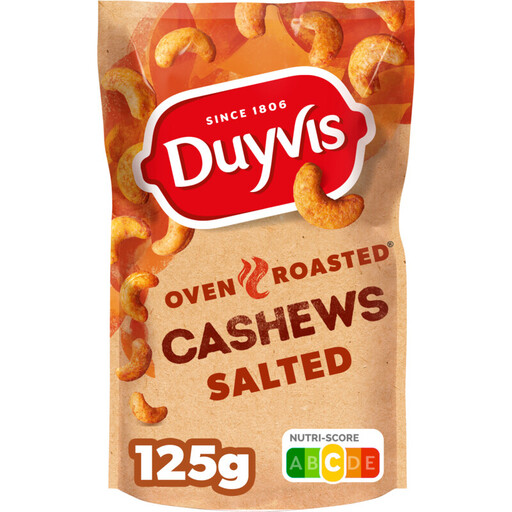
Duyvis describes Cashews Original as oven-roasted cashews made without added oil, intended, among other occasions, to serve with drinks.
AH Cashewnoten ongezouten 170 g is a baked variant for anyone looking to avoid added salt.
Jumbo Cashewnoten Ongezouten 200 g is an own-brand unsalted variant with published ingredients and nutrition information.
Lidl describes cashews in unsalted and spicy roasted varieties, including options to serve with drinks.
The Trader Joe’s Cashewnoten geroosterd en ongezouten variant we looked at comes in a 250 g pack.
PLUS Cashewnoten ongezouten ongebrand 200 g may suit you if you’re looking for a product with only cashews on the ingredients list.
This selection is for anyone looking for cashews without added oil to serve with drinks; it isn’t a selection based on proven fat reduction.
 No image available
A good choice to serve with drinks if you’re looking for cashews without added oil; the product information describes them as oven-roasted.
The nutrition information lists 43 g of fat and 0.92 g of salt per 100 g. This isn’t low fat under the limit of no more than 3 g of fat per 100 g for solid foods.
The product description says there are 4–5 servings per pack.
No. For solid foods to be labelled ‘low fat’, the European Commission sets a limit of no more than 3 g of fat per 100 g. No added oil describes how the product is prepared; the Duyvis variant we looked at still lists 43 g of fat per 100 g.
First compare the fat content per 100 g, then work it out for the same portion size. The Netherlands Nutrition Centre gives 12.2 g of fat for a 25 g handful of unsalted cashews; this is general nutrition information, not a measurement of a specific shop-bought product.
Store nuts in a dry, airtight container. The Netherlands Nutrition Centre recommends keeping them somewhere cool, for example at 10–15 °C. Also follow the storage instructions and use-by information on your own pack.
As a business, you must inform consumers about any allergens present. According to the NVWA, this information appears on the label of pre-packed products; for unpackaged food, it can be provided in writing or verbally. If you provide it verbally, you must make it clear that customers can ask for the information. This applies to commercial food service, not as a general record-keeping requirement for a private gathering.
Do not eat the 170 g pack of Trader Joe’s Cashewnoten ongezouten with barcode 2003020120930 and best-before date 23-09-2026. On 20 May 2026, the NVWA warned that this specific pack may contain metal fragments; the warning doesn’t automatically apply to other packs.