
Breakfast eaters keeping an eye on sugars
You want to know how much sugar the toast contains, so you compare the nutritional values per 100 g rather than just per serving size of your choice.


Choose toast for a savoury breakfast by comparing the sugars per 100 g first: according to the Netherlands Nutrition Centre, the ‘low-sugar’ claim applies to products containing no more than 5 g of sugars per 100 g. Then check fibre, salt and allergens separately. The Van der Meulen varieties listed by Jumbo each contain 3.2 g of sugars per 100 g, but differ in these other respects.
You want to know how much sugar the toast contains, so you compare the nutritional values per 100 g rather than just per serving size of your choice.
You enjoy toast with savoury toppings and, alongside a low sugar figure, are looking for a fibre content that suits you. You also compare the salt content of each variety separately.
You check the exact variety for gluten-containing grains, soya, sesame and possible traces. Toast with a similar sugar content may differ in these respects.
Start with ‘of which sugars’ per 100 g. Then decide whether fibre, salt, allergens or the type of toast is the deciding factor for your breakfast.
| What to consider | What to check when buying | Who it matters to |
|---|---|---|
| Sugars | Check ‘of which sugars’ per 100 g. According to the Netherlands Nutrition Centre, ‘low-sugar’ means no more than 5 g per 100 g. | If I’m mainly keeping an eye on sugars, I want to see whether the toast I choose suits my goal. Around 40% of consumers put checking sugar first. |
| Fibre and salt | Compare both values per 100 g; the figures vary between the Van der Meulen varieties listed by Jumbo. | For savoury toppings, I look for toast whose fibre content matters more to me, but I don’t want to overlook the salt. Fibre is the first consideration for around 30% of consumers. |
| Ingredients and allergens | Check the current packaging for allergens, and compare the salt content if it matters to your choice. | If I need to avoid certain ingredients, the information for that exact variety determines whether I can choose it. Ingredients, allergens or salt come first for around 20% of consumers. |
| Type and taste | Choose between Melba toast and rice toast; a cracker is a different type of product. | With savoury toppings, I mainly want a neutral, crunchy base that works for my breakfast. Around 10% of consumers give the type of product top priority. |
The Netherlands Nutrition Centre sets the limit for ‘low-sugar’ at 5 g of sugars per 100 g, and the limit for ‘sugar-free’ at 0.5 g per 100 g. ‘Less sugar’ requires a comparison with a suitable alternative product.
Check ‘of which sugars’ per 100 g, and don’t assume that a low figure on its own means there has been a reduction compared with another product.
According to Jumbo, Van der Meulen Melba Wholemeal Toast contains 9.7 g of fibre and 1.9 g of salt per 100 g; the plain variety contains 3.9 g of fibre and 1.3 g of salt per 100 g.
Compare both values and decide which matters more for your breakfast.
Plain, multigrain and wholemeal Melba toast differ in their ingredients and allergen information. Information on an online product page may also be inconsistent.
If you have an allergy or intolerance, check the current packaging of the exact variety and ask the manufacturer or retailer for clarification if in doubt.
The Netherlands Food and Consumer Product Safety Authority outlines the conditions under which iodine may be present in bakery products through baker’s salt. This does not tell you which salt has been used in a particular toast.
If iodine matters to your choice, check the label or ask the manufacturer.
The plain, multigrain and wholemeal varieties listed by Jumbo are separate types of Melba toast, with nutritional values you can compare.
ALDI lists Sun Snacks Melba Toast Natural as Melba toast in a 240 g pack.
Bolletje Proteïn & Low Carb Crackers are an alternative if you’d prefer a cracker rather than toast for your savoury breakfast.
Joybuy lists Delverde Classic Melba Toast in a 100 g pack.
These options include Melba toast and rice toast for anyone looking for a base to serve with savoury toppings. They are different types of product, so compare the nutritional information and ingredients for each variety separately.
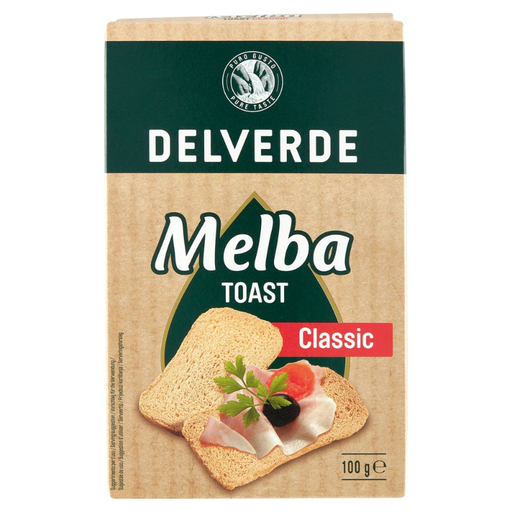 Image unavailable
Melba toast to compare if you’re looking for a base to serve with savoury toppings.
Joybuy lists 4.1 g of sugars and 1.25 g of salt per 100 g. The allergen information lists wheat and barley; check the current packaging if allergens or fibre matter to your choice.
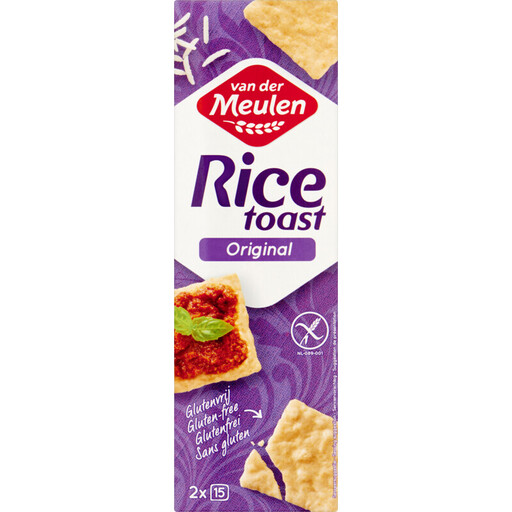 Image unavailable
This rice toast is a different type of product from Melba toast, for anyone who wants toast with savoury toppings.
Check the current packaging for the nutritional values per 100 g and the allergens: the available product descriptions don’t provide consistent information on these.
According to the Netherlands Nutrition Centre, ‘low-sugar’ means no more than 5 g of sugars per 100 g. Check ‘of which sugars’ in the nutrition table for the specific toast.
No, that doesn’t follow from the term ‘low-sugar’. The Netherlands Nutrition Centre sets the limit for ‘sugar-free’ at 0.5 g of sugars per 100 g, compared with a maximum of 5 g per 100 g for ‘low-sugar’.
Not for the Van der Meulen varieties compared here: according to Jumbo, both the wholemeal and plain varieties contain 3.2 g of sugars per 100 g. The wholemeal variety lists more fibre, but also more salt per 100 g.
Read the allergen information on the current packaging for the exact variety you’re buying. The Melba toasts reviewed differ in their grains and other ingredients, including soya and sesame, so don’t rely on terms such as ‘plain’ or ‘wholemeal’ alone.
You can’t tell from the type of product alone. The Netherlands Food and Consumer Product Safety Authority explains when iodine may be present in bakery products through baker’s salt. For a specific toast, check the label or ask the manufacturer.