
Hosts looking for low-sugar taaitaai biscuits
You want to know whether taaitaai biscuits genuinely meet the ‘low sugar’ claim. To check, compare the packaging with the nutrition information per 100 g, rather than looking only at a smaller portion.


If you’re looking for low-sugar taaitaai biscuits for drinks, check both the claim on the packaging and the sugar content per 100 g. The Netherlands Nutrition Centre defines ‘low sugar’ for solid foods as no more than 5 g of sugars per 100 g. According to their product information, the standard taaitaai biscuits mentioned from Albert Heijn, Jumbo and PLUS contain between 38.594 and 39 g of sugars per 100 g. Choosing smaller portions doesn’t change that figure.
You want to know whether taaitaai biscuits genuinely meet the ‘low sugar’ claim. To check, compare the packaging with the nutrition information per 100 g, rather than looking only at a smaller portion.
You want to decide in advance how many taaitaai biscuits to serve. Albert Heijn and Jumbo list a 14 g serving for the products mentioned, which you can use as a guide when serving them.
You’re taking account of guests for whom cereals containing gluten or milk are a concern. Information can vary by product, so check the allergen information on the packaging of the product you’re serving.
First decide whether ‘low sugar’ is a must, or whether you simply want to limit how much standard taaitaai you serve. If taaitaai itself isn’t essential, you could also compare another type of biscuit by its sugars per 100 g and its allergen information.
| What to consider | What to check when buying | Who is this most important for? |
|---|---|---|
| Sugar content | Compare the sugars per 100 g and read the claim on the packaging. The Netherlands Nutrition Centre defines ‘low sugar’ for solid foods as no more than 5 g per 100 g. | I want to serve taaitaai that can genuinely be described as low sugar, not just a smaller biscuit. This is the top priority for around 50% of consumers considering taaitaai for drinks. |
| Allergens | Read the allergen information on the packaging you buy, paying particular attention to cereals containing gluten, milk and any statements about possible traces. | If guests need to avoid certain ingredients, I want to know which biscuit I can offer them. Allergen suitability takes priority for roughly 30% of these consumers. |
| Portions | Check the portion size and pack weight. Albert Heijn and Jumbo list a 14 g portion for the taaitaai biscuits mentioned. | I want to decide in advance how many taaitaai biscuits to put out, without describing a small portion as low sugar. Planning portions is the main concern for around 20% of these consumers. |
A biscuit may contain less sugar than another product without meeting the ‘low sugar’ criteria. For solid foods, the Netherlands Nutrition Centre sets the limit at no more than 5 g of sugars per 100 g.
Read the claim on the packaging, then compare the sugars per 100 g in the nutrition information.
A smaller portion doesn’t change the nutritional value per 100 g. According to their product information, the standard taaitaai biscuits mentioned from Albert Heijn, Jumbo and PLUS contain between 38.594 and 39 g of sugars per 100 g.
Compare products per 100 g first. Then use the per-portion information to work out how much to serve.
The taaitaai products mentioned list cereals containing gluten and milk, among other ingredients. Jumbo also states that its Sint Taai Taai Figuurtjes may contain almonds and hazelnuts, among other allergens.
Keep the packaging handy so guests can read the information for the product being served. If someone has a relevant allergy, only offer them an alternative whose ingredients and allergen information you’ve checked.
The information below relates to the specific taaitaai products mentioned, not the full range from these brands. Always check the current packaging when you buy.
AH Taai taai in a 350 g bag.
Jumbo Sint Taai Taai Figuurtjes in a 500 g pack.
PLUS Taai taai sint en piet, 500 g, and PLUS Ambachtelijke taai taai koeken, 250 g.
This is a different type of biscuit for anyone who doesn’t necessarily want to serve taaitaai. If you choose an alternative, check its sugars per 100 g before calling it low sugar.
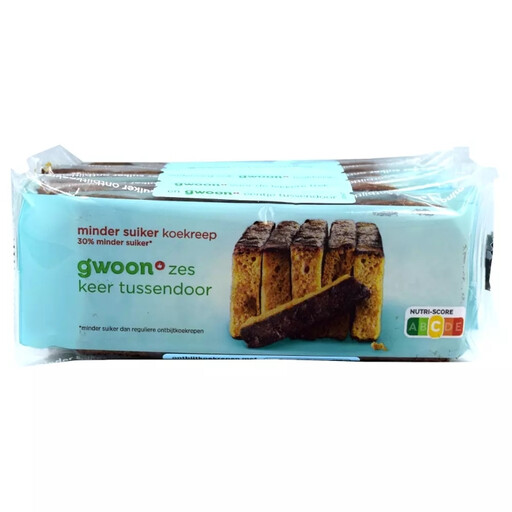 Image unavailable
This pack of six Cookie Bars is an option if you’re considering serving a different biscuit alongside drinks instead of taaitaai.
‘Less Sugar’ in the product name doesn’t by itself mean that the biscuits are low sugar. Compare the sugars per 100 g and check the ingredients and allergens on the packaging.
For solid foods, the Netherlands Nutrition Centre defines ‘low sugar’ as no more than 5 g of sugars per 100 g. Check both the claim and the nutrition information on the packaging; a name such as ‘Less Sugar’ doesn’t by itself prove that a biscuit meets this criterion.
No. Their stated sugar content is above the limit the Netherlands Nutrition Centre sets for ‘low sugar’. Albert Heijn lists 39 g of sugars per 100 g for AH Taai taai, Jumbo lists 38.6 g for Sint Taai Taai Figuurtjes, and PLUS lists 38.594 g for the two products mentioned.
For the products mentioned, check at least the information about cereals containing gluten and milk. Some packs also mention the possible presence of other allergens, so read the packaging of the product you’re actually serving.
Follow the storage instructions on the packaging. For the taaitaai mentioned, Albert Heijn recommends storing it in a sealed tin after opening; PLUS says to store its products in a cool, dry and dark place.