If you have coeliac disease, first choose toast or crackers explicitly labelled gluten-free on the packaging. Then compare the stated sugars per 100 g: Albert Heijn lists 0.9 g for Laurieri Scrocchi Sea Salt, but it contains soya and also lists 3 g of salt per 100 g. A low sugar value alone does not prove that a product can carry a reduced-sugar claim.
Who is this choice relevant to?
Shoppers with coeliac disease
You’re looking for a crisp product labelled gluten-free, and you check the current packaging before eating it. The Netherlands Nutrition Centre identifies the word ‘gluten-free’ and the Crossed Grain Trademark as signs to look for.
Shoppers comparing sugars
You want to compare the stated amount of sugars per 100 g in gluten-free toast or crackers. You keep a difference in nutritional values separate from a reduced-sugar claim.
Shoppers with other dietary considerations
As well as gluten, you may need to consider soya, egg, possible traces of other allergens or the amount of salt. In that case, the lowest sugar value won’t be the only factor in deciding which pack is right for you.
What should you look for when choosing?
Start with the gluten-free label. Then compare sugars per 100 g and check which other ingredients or nutritional values matter for your choice.
| What to look for | What to check when buying | Who it matters to |
|---|
| Gluten-free label |
Look for ‘gluten-free’ or the Crossed Grain Trademark on the current packaging, and read the ingredients list. |
If I have coeliac disease, I don’t want to judge by the product type; I want to see on the packaging that the toast is gluten-free. This is the top priority for around 46% of consumers. |
| Stated sugars |
Compare sugars per 100 g across products of a similar type; don’t treat a low value as proof of a reduction claim. |
When choosing between gluten-free toast products, I want to know how much sugar each lists on the same basis. This is the most important comparison for around 36% of consumers. |
| Other ingredients and nutritional values |
Read the allergen information and compare salt per 100 g; consider sources of iodine as part of your overall diet if you eat little bread. |
I want my choice to suit any additional allergy I have and take account of my salt intake. This is the deciding factor for around 18% of consumers. |
Common mistakes
-
Assuming gluten-free means lower in sugar
A gluten-free label tells you nothing about the amount of sugars. A low value per 100 g also doesn’t prove that the sugar content has been reduced compared with a similar product.
Check the gluten-free label first, then look at the sugars listed in the nutritional information. Assess any reduced-sugar claim separately.
-
Comparing sugars alone
Albert Heijn lists 0.9 g of sugars and 3 g of salt per 100 g for Laurieri Scrocchi Sea Salt. Jumbo lists 1.7 g of sugars and 6.6 g of salt per 100 g for Gluten Free Bakery Holland Italian Herb Toast. So the lower sugar value doesn’t tell the whole story.
Compare both values per 100 g, and also consider the portion you plan to eat.
-
Overlooking other allergens
A gluten-free product may still contain soya or egg, or state that it may contain traces of other allergens. The gluten-free label doesn’t replace this information.
Check the current ingredients list and the ‘contains’ and ‘may contain’ statements each time you buy, especially if you need to consider more than one allergen.
-
Using toast as a straightforward replacement for bread
Toast doesn’t automatically provide the same contribution to your iodine intake as bread made with iodised baker’s salt. The Netherlands Nutrition Centre highlights iodine intake as something to consider if you eat little bread or choose bread without iodised salt.
Don’t assume toast contains iodised salt just from its name. Check the ingredients and consider your sources of iodine as part of your overall diet.
Brands with relevant products
Laurieri
Scrocchi Sea Salt is a crisp, gluten-free snack to enjoy with drinks.
- Albert Heijn lists 0.9 g of sugars per 100 g for this variety.
- This variety also contains soya and has 3 g of salt per 100 g.
Gluten Free Bakery Holland
Italian Herb Toast offers a seasoned, gluten-free toast option.
- Jumbo lists 1.7 g of sugars per 100 g for this toast.
- The product information also lists 6.6 g of salt per 100 g, egg, gluten-free oats and possible traces of nuts and sesame.
Wasa
Gluten Free & Lactose Free Classic is a cracker, not a small party toast.
- For this variety, Albert Heijn lists 2 g of sugars, 1.1 g of salt and 7 g of fibre per 100 g.
- The product information notes that it may contain milk, soya, sesame and mustard. If you have an additional allergy, check the current packaging.
Schär
Gluten-Free Crackers are one cracker option in the gluten-free range.
- Jumbo lists 5.2 g of sugars per 100 g for these crackers.
- This variety contains soya. Compare the nutritional information if the amount of sugars is your main criterion.
AH Glutenvrij
Albert Heijn’s own-brand range includes gluten-free crackers and snacks to enjoy with drinks.
- You can explore a range of crisp product types across the range.
- Compare sugars and allergens for each individual product; the range name doesn’t tell you those values.
Gluten-free rice toast on Joybuy
If you have coeliac disease and are looking for crisp rice toast, this is a product to assess for its gluten-free label, sugars and any additional allergens.
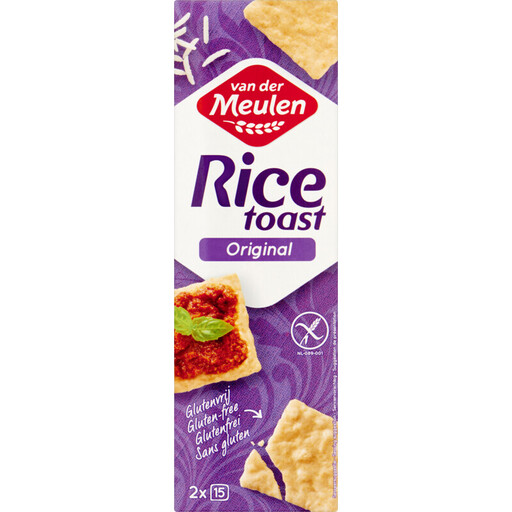 Image unavailable
Van Der Meulen Rice Toast Natural, 65 g
This rice toast is labelled gluten-free and may suit someone with coeliac disease looking for a crisp toast; check the label on the current packaging.
If you have an additional soya or sesame allergy, read the allergen information on the packaging before choosing. Don’t assess a reduced-sugar claim based only on the stated amount of sugars.
View on Joybuy
Frequently asked questions
Is ordinary toast suitable if you have coeliac disease?
Don’t assume ordinary toast is gluten-free. Choose a pack explicitly labelled gluten-free or bearing the Crossed Grain Trademark, as recommended by the Netherlands Nutrition Centre, and check the current ingredients information.
Does a low amount of sugars mean the sugar content has been reduced?
No. A low sugar value per 100 g doesn’t prove that the sugar content has been reduced compared with a similar product. You can compare the nutritional values of gluten-free toast, but don’t treat that comparison as evidence for a reduction claim.
Are gluten-free toast products also suitable if you have another allergy?
Not automatically: gluten-free toast may contain other allergens or state that it may contain traces of them. Check the current ingredients and allergen information for the specific product; the Netherlands Food and Consumer Product Safety Authority explains which allergens must be listed on food labels.
Why does iodine matter if I eat little bread?
Bread made with iodised salt can contribute to your iodine intake, but you can’t assume the same of toast. The Netherlands Nutrition Centre points out that eating little bread or choosing bread without iodised salt means you should consider sources of iodine across your overall diet.


