For a work meeting, first decide what matters most: a low sugar value on the label, a familiar biscuit to have with coffee, or biscuits that are easy to hand out. Then compare similar products per 100 g and check the portion size, ingredients, polyols and allergens too. ‘Less sugar’ on its own doesn’t tell you how much sugar a biscuit contains.
Who is this choice relevant to?
Organisers keeping an eye on sugar
If standard sweet biscuits shouldn’t be the only option, it helps to compare the nutritional information per 100 g and then check how much sugar is in one biscuit. A claim on the front of the pack isn’t a substitute for this comparison.
Organisers of meetings with lots of attendees
When lots of people will be helping themselves, individually wrapped biscuit bites may be more convenient than a shared pack of biscuits. Check how many pieces there are and whether they really are individually wrapped.
Teams with ingredient or allergen requirements
For this group, the information for the exact product variant matters. Before serving, check the current label for any allergens relevant to those attending.
What should you look for when buying?
The Netherlands Nutrition Centre advises comparing similar products per 100 g. For your meeting, also decide whether ingredient information or ease of handing them out will affect your choice.
| What to consider |
What to check when buying |
Who is this important for? |
| Sugars in the biscuit |
Check ‘of which sugars’ per 100 g and look at the portion size. If the product says ‘less sugar’, check what it is being compared with. |
If I’m putting out biscuits because I want to keep an eye on sugar, I don’t want to rely on ‘zero’ or ‘less sugar’ alone. For around 36% of consumers, the sugar value comes first. |
| Ingredients and allergens |
Check the label of the variant you buy for relevant allergens, and see which sweeteners or polyols it contains. |
If colleagues need to avoid certain ingredients, I need to be able to check what I’m offering them. For around 29% of consumers, this check matters most. |
| Handing out and portion sizes |
Check the number of pieces and whether they are individually wrapped. A statement that there are six portions doesn’t confirm that each piece has its own wrapper. |
For a short meeting, I want to hand out biscuits without having to pass around a shared pack. For around 21% of consumers, ease of handing them out is the main priority. |
| Taste and other nutritional information |
As well as sugars, compare energy, fat, fibre and salt per 100 g. If the meeting is a regular one, you could try a pack first. |
If I’m putting something out for colleagues with different preferences, I want to make a choice based on more than a sugar claim. Around 14% of consumers mainly take this broader consideration into account. |
Pitfalls when choosing biscuits for a meeting
-
Looking only at ‘zero’ or ‘sugar-free’
A low sugar value doesn’t tell you how much energy or fat a biscuit contains. For example, Albert Heijn lists AH Digestive 0% sugar as containing 0.3 g of sugars, but also 465 kcal and 20 g of fat per 100 g.
Following the Netherlands Nutrition Centre’s advice, compare similar products per 100 g and then check the portion size.
-
Overlooking sweeteners and polyols
Product information for several biscuits with no sugar or no added sugar lists polyols and a warning that excessive consumption may have a laxative effect.
Read the ingredients and warnings on the packaging. Keep the pack available when serving so that attendees can make their own choice.
-
Guessing allergens from the brand name
Allergen information can vary between biscuits and product variants. So a suitable choice for one attendee won’t necessarily be suitable for someone else.
Check the exact packaging before the meeting and keep the information available alongside the biscuits. If you’re unsure about a relevant allergy, don’t rely on a general description of the brand.
Brands and product ranges to consider
Céréal
Biscuits in sugar-free varieties, including chocolate chip and coconut.
- Albert Heijn lists Céréal Chocolate Chip Cookie without sugar as containing 0 g of sugars per 100 g.
- For the variant you choose, check the polyols, the warning about excessive consumption and the allergens on the label.
Albert Heijn
Own-brand products include AH Digestive 0% sugar.
- Albert Heijn lists this digestive biscuit as containing 0.3 g of sugars per 100 g.
- The same product also contains 465 kcal and 20 g of fat per 100 g, so consider more than just the sugar value.
Verkade
San Francisco Naturel Zero is a biscuit with no added sugar to enjoy with coffee or tea.
- Jumbo lists this biscuit as containing 1.7 g of sugars per 100 g.
- The product information lists maltitols and the allergens milk, soya and wheat; check the current packaging.
Goud Gebakken
ALDI own-brand range, with a lower-sugar version of biscuit bites for anyone who values being able to hand them out individually.
- ALDI Netherlands describes its biscuit bites as six individually wrapped pieces, with a claim of 30% less sugar.
- Before serving, read the nutritional information and allergens for the variant you’ve chosen on the packaging.
Lower-sugar-claim cookie bars at Joybuy
These cookie bars may suit a meeting where you’re looking for a pack of six. Check the ‘Less Sugar’ claim against the label, and separately confirm whether the bars are individually wrapped.
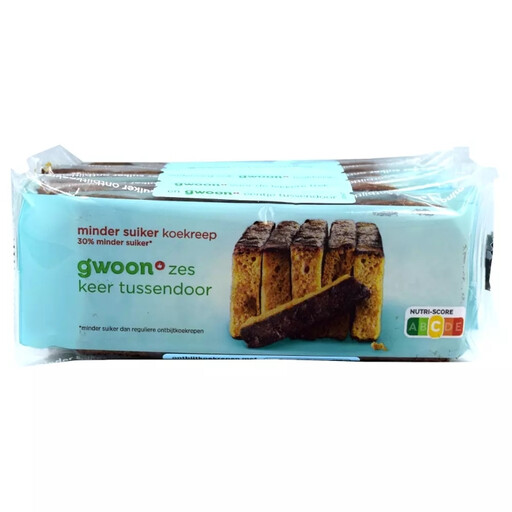 Image unavailable
g'woon Cookie Bars Less Sugar, 6 pieces
An option if you’re looking for cookie bars in a pack of six for your meeting.
Check the packaging to see what ‘Less Sugar’ is being compared with and whether the pieces are individually wrapped. Also read the current allergen information before handing them out.
View at Joybuy
Frequently asked questions
Does ‘less sugar’ mean a biscuit contains little sugar?
No, the claim compares the product with another product. So check ‘of which sugars’ per 100 g and find out which product it is being compared with. Jumbo says its Ontbijtkoek Minder Suiker contains 30% less sugar than its plain ontbijtkoek bar, but it still contains 22.7 g of sugars per 100 g. Ontbijtkoek is also different from a biscuit.
Are sugar-free biscuits automatically a lighter choice?
No, the sugar value doesn’t tell you everything about the nutritional value. As well as 0.3 g of sugars, Albert Heijn lists AH Digestive 0% sugar as containing 465 kcal and 20 g of fat per 100 g. Check the portion size and ingredients too.
What should I do if colleagues have allergies?
Before serving, check the label on the exact pack for any allergens relevant to them. Keep the packaging with the biscuits so attendees can read the information themselves; don’t rely on the details for another variant from the same brand.
How should I store biscuits left over after the meeting?
Follow the storage instructions on the packaging, including after opening. For AH Digestive 0% sugar, Albert Heijn advises storing it in a sealed tin once opened. If the biscuits were handed out individually, check that any leftovers are still wrapped.


