Choose sugar-free biscuits if the amount of sugars on the label is your main priority, or compare biscuits with a ‘less sugar’ claim if you want to stick with a particular type. In either case, check the nutritional information per 100 g as well as what you’ll take for each snack; if you’re sharing, check the ingredients, allergens and packaging too.
Which option is right for you?
Festival-goers keeping an eye on sugar
If you want to take a low-sugar biscuit with you, look beyond the wording on the front of the pack. The nutritional information shows how many sugars the product contains per 100 g, while the ingredients list tells you which sweeteners, if any, have been used.
Groups catering for people with allergies
If you’re sharing biscuits with others, the ingredients list is just as important as the sugar claim. Check the allergens on the current packaging before you take a pack for the group.
Festival-goers taking biscuits with them
For a day at a festival, the number of portions, the packaging and the storage instructions all matter too. Individually wrapped portions or an airtight tin make it easier to keep biscuits dry and intact.
What should you look for when choosing?
First decide whether your main concern is sugars, ingredients, or taking biscuits with you and sharing them. Then compare like with like: according to the Netherlands Nutrition Centre, nutritional information per 100 g makes products easier to compare than portion information alone.
| What to consider |
What to check before buying |
Who it matters to |
| Amount of sugars |
For the same type of biscuit, compare ‘of which sugars’ and energy per 100 g, then check the weight of a portion. If a product claims ‘less sugar’, check what it is being compared with. |
If I want to eat less sugar, I want to compare the amount on the label rather than relying on ‘zero’ or ‘less sugar’ alone. For around 45% of consumers, sugar content is the top priority. |
| Sweeteners and allergens |
Read the ingredients list, allergen information and any warning about polyols. If you’re sharing, check the packaging of each variety. |
When I share biscuits, I want to know whether the ingredients are suitable for everyone I’m taking them for. Ingredients and allergens are the main concern for around 33% of consumers. |
| Portions and packaging |
Check the number of biscuits, how they’re packed and the storage instructions; make sure you can reseal an opened pack securely. |
When I’m out and about, I want to be able to take biscuits with me and share them without leaving an open pack loose in my bag. For around 22% of consumers, practical use is the deciding factor. |
Which common mistakes can you avoid?
-
Reading ‘less sugar’ as ‘sugar-free’
Albert Heijn says that AH Roomboter minder suiker stroopwafels contain 32% less sugar than its standard AH Roomboter stroopwafels. According to Albert Heijn, the less-sugar variety still contains 23 g of sugars per 100 g.
Use the claim as a reason to compare: check the amount of sugars per 100 g and consider the portion you’ll take with you.
-
Overlooking the ingredients in ‘zero’ products
A biscuit low in sugars may still contain ingredients you need to consider when sharing. Jumbo lists almonds, barley, egg, milk, nuts, soya and wheat among the ingredients in Céréal Speculoos met amandel.
Check the current allergen information before you set off, and keep different products separate if you’re taking biscuits for several people.
-
Not accounting for polyols
Albert Heijn says that AH Digestive 0% suiker contains 14 g of polyols per 100 g. Products containing polyols may carry a warning about a laxative effect; the amount and warning vary by product.
Check the label of the variety you choose and decide in advance how many biscuits you’ll take for each snack.
-
Putting an opened pack loose in your bag
According to the Netherlands Nutrition Centre, sugar-free biscuits can become soft or stale as their quality deteriorates.
Follow the storage instructions on the packaging. The Netherlands Nutrition Centre recommends storing sugar-free biscuits in a cool, dry, dark place in a tightly sealed container.
Brands and varieties compared
Albert Heijn
The AH range includes a digestive biscuit labelled ‘0% sugar’ and a butter waffle with a ‘less sugar’ claim. They’re different types of biscuit, so don’t compare them as if the claims mean the same thing.
- According to Albert Heijn, AH Digestive 0% suiker contains 0.3 g of sugars per 100 g, while AH Roomboter minder suiker stroopwafels contain 23 g of sugars per 100 g.
- AH Digestive contains sweeteners. Check the current ingredients, allergens and nutritional information on the packaging for each variety.
Céréal
Céréal offers, among other products, coconut and speculoos biscuits labelled as sugar-free. The pack format may be useful if you want to divide them up over a festival day.
- Jumbo lists Céréal Kokos as a pack of 3 × 4 biscuits, with 0 g of sugars per 100 g.
- The coconut variety listed by Jumbo contains polyols. The speculoos variety with almonds lists several allergens; check the ingredients and packaging for the variety you choose.
Verkade
Albert Heijn lists Verkade San Francisco zero as a variety to compare with other biscuits.
- This variety gives you a specific biscuit to compare using the nutritional information.
- Don’t judge the ‘zero’ label on its own: check the current ingredients list, amount of sugars per 100 g, allergens and portion size too.
Less-sugar snack bars on Joybuy
This snack bar carries a ‘Less Sugar’ claim and contains six bars. For your festival day, check the amount of sugars separately and think about how you want to take them with you.
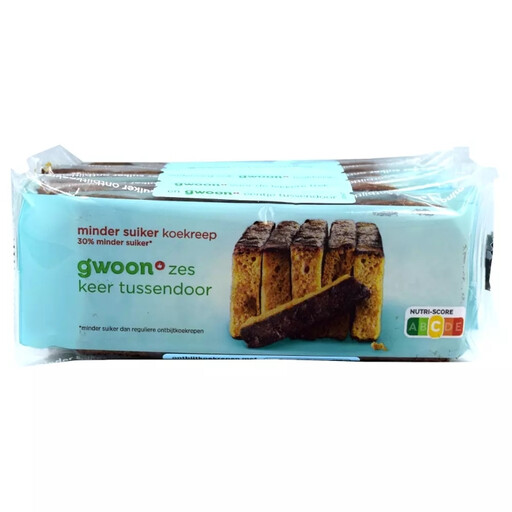 Image unavailable
g'woon Cookie Bars Less Sugar, 6 bars
A good option if you want to take a snack bar with a less-sugar claim and compare the nutritional information for yourself.
The product description lists 22.8 g of sugars per 100 g. The ‘Less Sugar’ claim alone doesn’t tell you how much less sugar the bars contain than a comparable variety.
Before you set off, check the allergens on the current packaging and make sure the six bars are packed in a way that suits your needs.
View on Joybuy
Frequently asked questions
Does ‘less sugar’ mean a biscuit is almost sugar-free?
No: ‘less sugar’ compares a product with another one; it doesn’t mean it contains no sugars. Albert Heijn compares AH Roomboter minder suiker stroopwafels with its standard butter waffles and lists 23 g of sugars per 100 g for the less-sugar variety. So be sure to check the nutritional information for the biscuit itself.
Can I avoid polyols by choosing sugar-free biscuits?
Not without checking the ingredients and nutritional information. Albert Heijn lists 14 g of polyols per 100 g for AH Digestive 0% suiker, while Jumbo lists 18 g per 100 g for Céréal Kokos. Check for any warning on the packaging you choose too.
How can I check for allergens when sharing biscuits?
Read the allergen information on the current packaging of every product you plan to hand out. According to the Netherlands Food and Consumer Product Safety Authority, any allergens from the 14 specified groups that are present must be listed on the label. Don’t rely on the sugar claim or product name alone.
How should I take biscuits with me for a festival day?
Choose packaging that will stay intact while you’re travelling, or use a tightly sealed tin once opened. The Netherlands Nutrition Centre recommends storing sugar-free biscuits in a cool, dry, dark place in a tightly sealed container. Check the storage instructions and best-before date on your own pack too, and make sure you’re allowed to take your own food into the festival before you set off.


