
Salt-conscious remote worker
You want to make a quick, hot lunch and compare the salt content of the oat base. You also consider the liquid, toppings and other parts of your lunch.


For a quick work-from-home lunch with as little salt as possible from the oat base, first compare the salt content per 100 g of dry oats, then check the ingredients and your own portion size. A plain single-serve sachet can be quick to prepare and low in salt, but convenience, extra protein or a gluten-free label do not tell you how much salt it contains. Check allergen information separately if it’s relevant to you.
You want to make a quick, hot lunch and compare the salt content of the oat base. You also consider the liquid, toppings and other parts of your lunch.
You’re looking for a portion that’s quick to prepare with water or milk. A plain variety could be a good fit if you don’t want to automatically opt for a flavoured mix.
Check more than just the word ‘oats’ on the packaging. According to the Voedingscentrum, regular oats can come into contact with gluten during processing. If you have coeliac disease, look for the official Crossed Grain symbol on the packaging.
Start by comparing the salt content per 100 g of dry oats, so differences in portion size don’t skew the comparison. Then check whether the preparation time suits your lunch break and which ingredients and allergens matter for your choice.
| What to consider | What to check when buying | Who it matters to |
|---|---|---|
| Salt content | Compare the salt per 100 g of dry oats, then check your portion size and the ingredients. | If I want to put together a lunch with little salt from the oat base, I don’t want to rely on the size of a sachet. Around 36% of consumers put limiting salt at the top of their list. |
| Preparation time | Check the preparation time, the amount of liquid needed and the instructions for the hob or microwave. | Between work meetings, I want to know whether preparing the meal and washing up will fit into my break. Speed is the top priority for around 29% of consumers. |
| What’s in your lunch | Compare fibre and protein per 100 g, and check the sugars, preparation base and added ingredients. | For my lunch, I want to know what the oats and the rest of the meal provide together, not just what’s on the front of the pack. For around 21% of consumers, what’s in their lunch is their main concern. |
| Gluten and allergens | Read the latest allergen information; if you have coeliac disease, check for the official Crossed Grain symbol. | If I need to avoid gluten or take an allergy into account, the packaging needs to give me a clear answer before I use the oats. For around 14% of consumers, this check comes first. |
According to the Voedingscentrum, portion sizes on labels can vary. That means the figure per sachet isn’t a reliable direct comparison with the figure for a larger portion.
First compare salt per 100 g for products in the same form, then check how many grams you’ll prepare.
Quaker’s product information lists 0 g salt per 100 g for Oats Express Naturel; Albert Heijn lists 1 g per 100 g for Elovena Natural Instant Oatmeal. A gluten-free label and the salt content answer two different questions.
Check both separately on the packaging. If you have coeliac disease, also look for the official Crossed Grain symbol.
Jumbo lists both 24 g of protein and 0.48 g of salt per 100 g for Upfront Instant Oatmeal with Chocolate Flavour. The protein content doesn’t tell you how much salt the product contains.
Compare the nutritional values per 100 g and read the ingredients and allergen information before choosing a flavoured or high-protein variety.
The liquid and any additions are part of the lunch you’ll actually eat. The salt content of dry oats doesn’t automatically reflect the prepared bowl.
Also check the nutritional information for things like your drink, nut butter or ready-made topping, and adjust the amounts to suit your portion.
These examples relate to specific oatmeal products, not every product from each brand. Always compare the variety you’re actually considering buying.
Oats Express Naturel comes in individual portions and is designed for anyone who wants to prepare plain oatmeal quickly. Albert Heijn gives a preparation time of around two minutes.
Fijne Vlokken are an option if you prefer to measure out your own portion rather than use an instant sachet.
Natural Instant Oatmeal comes in individual portions and is marketed as gluten-free.
According to Albert Heijn, Brinta Havermout is made from 100% oat flakes. The extra-fine flakes are designed for quick preparation without individual instant sachets.
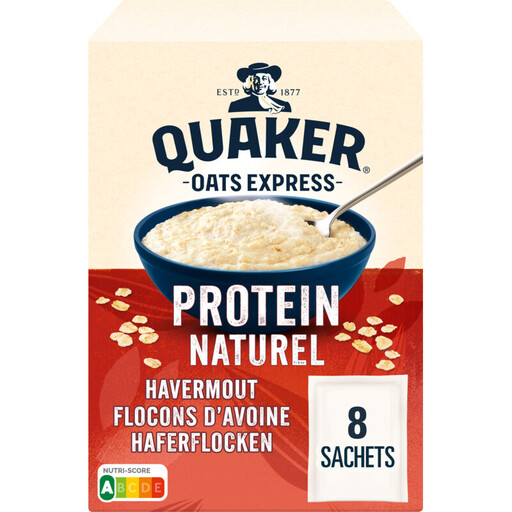
This high-protein variety is worth considering if quick preparation is important for your work-from-home lunch. If your main aim is to limit salt, check the salt content per 100 g on the packaging before comparing it with plain oatmeal.
 No image available
For a short work-from-home break, the Joybuy product description gives a preparation time of two minutes.
If you’re watching your salt intake, check the nutritional information per 100 g on the packaging. If you have allergies, also read the latest information about soya and cereals containing gluten.
Compare the salt content per 100 g of products in the same form, then check how much you’ll actually use. The Voedingscentrum points out that portion sizes on labels can vary. Also take the preparation liquid and any additions into account when assessing your lunch.
If you have coeliac disease, don’t rely on the word ‘oats’ alone. According to the Voedingscentrum, oats can come into contact with gluten during processing. Look for the official Crossed Grain symbol on the packaging and read the latest allergen information.
Yes, the Voedingscentrum lists oatmeal as a lunch option. What you end up eating also depends on the portion size, the preparation liquid and any additions. Vary your lunch choices rather than focusing only on the oat base.
Pay particular attention to salt per 100 g, the ingredients, allergens and preparation instructions. Only use the nutritional values per portion after checking how large that portion is and whether the figures apply to the dry or prepared product.