
Vandaag of morgen in huis

Kwaliteit gegarandeerd

Welkomstaanbiedingen ontgrendelen: GRATIS bezorging | Tot 80% korting | Gratis 30 dagen JoyPlus-proefperiode
Download de app
Choosing a living room table might seem straightforward, until you factor in walking space, storage, materials and assembly. An oversized coffee table can make a flat feel cramped. A narrow table that lacks stability can soon start to wobble. And a lift-top that looks smooth in product photos still needs to be assembled correctly and used with care.
When comparing living room tables, these are the three main pitfalls to watch out for:
First, measure the space between your sofa, armchairs and television. Allow enough room to move around, and check not just the length but also the width and height.
A low coffee table usually sits in front of a sofa, while a sofa table or console table is designed to go behind the sofa or against a wall. For a hallway or narrow entrance, a narrow hallway table with a shallow depth is more practical than a wide coffee table.
Also consider how the table will sit alongside your sofa:
Many living room tables combine engineered wood, such as MDF or chipboard, with a metal frame. This can be a practical combination, but check the thickness of the top, the construction of the legs and the stated maximum load.
A 4 cm-thick top is listed for several models. This is a verifiable product specification, but it doesn’t tell you how much weight the table can support on its own. Always check the recommended maximum load for each component. For example, the Tribesigns console table is listed as supporting up to 150 kg. The LANTINE console table has a stated load capacity of up to 100 lb, equivalent to around 45 kg.
These points also matter for everyday use:
A coffee table with storage helps stop loose items from spreading around the living room. Open shelves are suitable for books, baskets and ornaments. A hidden compartment keeps smaller items out of sight.
A lift-top coffee table also provides a raised surface for working or eating. If you’re considering one, check:
A table with shelves can often be used in different ways, as a console table, TV stand, plant stand or storage table. Choose a multi-purpose model only if its dimensions also suit the way you’ll use it most.
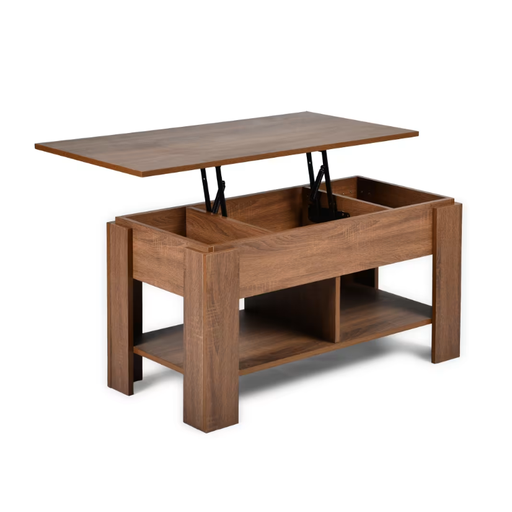
Why it suits this buyer: For a flat or small living room, this model combines a coffee table, work surface and storage in one piece of furniture.
It measures 96 × 50 cm and the height adjusts from 48 to 63 cm. Before buying, check that there’s enough space around the lift mechanism.
Two open shelves and one hidden storage compartment; MDF construction with metal hinges and assembly instructions included.
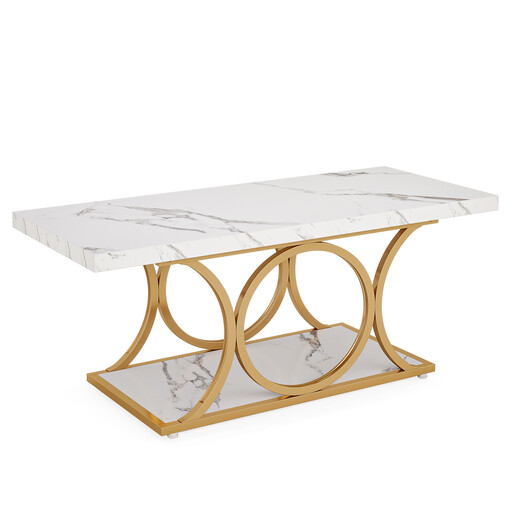
Why it suits this buyer: This modern coffee table is a good choice if you want to pair a striking design with a spacious top and an extra shelf.
The product specifications list a 4 cm-thick E1 chipboard top, a metal base and a melamine finish. Check the maximum load before use.
Measures approximately 118 × 56,5 × 48 cm; two tiers and a white faux-marble top with gold-coloured geometric legs.
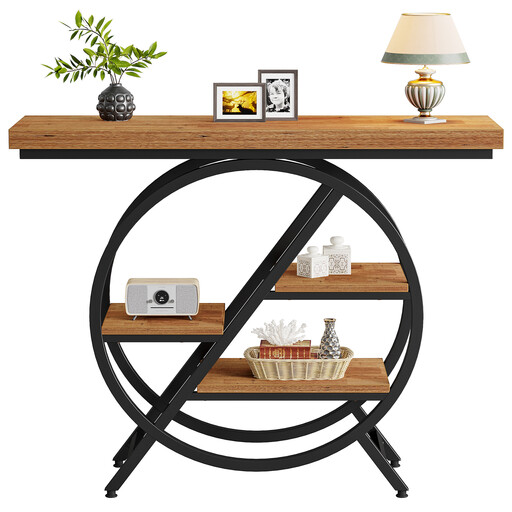
Why it suits this buyer: This model is designed for anyone looking for an industrial-style table for a hallway or living room, to place behind a sofa or use as open storage.
The table has four adjustable feet and an open design. This lets you compensate for minor unevenness in the floor and keep items organised in plain sight.
A 4 cm-thick top, round metal frame, three staggered shelves and a stated load capacity of up to 150 kg.
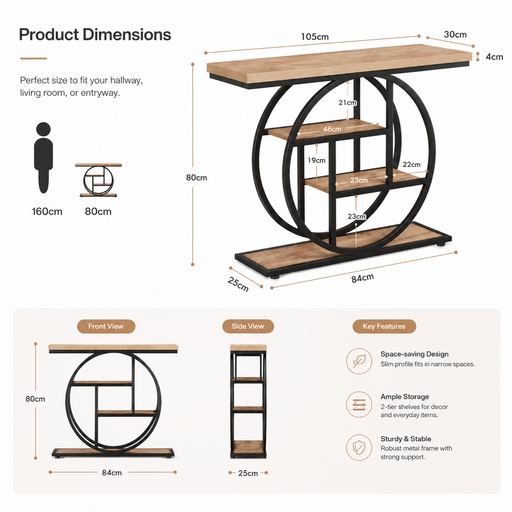
Why it suits this buyer: Its shallow depth of 30 cm makes this model suitable as a console table, hallway table or sofa table behind a sofa.
Its fixed dimensions of 30D × 105W × 80H cm make it easy to measure up beforehand. Adjustable foot pads are designed to help reduce wobbling on uneven floors.
Four staggered tiers, a 4 cm-thick table top and a circular metal frame with a light brown wood-effect finish.
Almost all models require self-assembly. Before you start, lay out all the parts alongside the instructions and initially tighten the screws loosely. Fully secure the frame only once the top is correctly aligned. Then check that the table doesn’t wobble and that all the legs sit evenly on the floor.
Take extra care with the mechanism on a lift-top table. Test it without heavy items on the top, and keep your fingers away from hinges and moving parts. Use a soft, damp cloth for cleaning and avoid abrasive cleaners. You may also want to place protective pads under ornaments or appliances.
We’ve put together a complete, up-to-date list of products that meet these strict selection criteria and the applicable European safety regulations.
Look for a table designed for small spaces, with a shallow depth and enough room to move around it. A model with shelves makes use of vertical space without taking up extra floor area. Measure the space between your sofa and television before ordering a coffee table.
It can be, if its height and dimensions suit the way you sit. A lift-top that adjusts from 48 to 63 cm offers several positions, but check the maximum load and make sure the mechanism is assembled correctly. For longer periods of work, a suitable desk is usually a better fit.
Its lifespan depends on the material, assembly, load and care. A metal frame and a thick top can contribute to stability, but never exceed the stated maximum load. Protect the surface from prolonged exposure to moisture, heat and abrasive objects.
