If you only have a few linen scarves to press and limited storage space, a standard steam iron is usually a better choice than a steam generator. A steam generator is mainly worth considering if you also regularly iron large loads of laundry. Choose the temperature and whether to use steam according to the scarf’s care label, rather than relying on the fibre name alone. A handheld steamer may suit you if quick de-wrinkling matters more than a crisp, pressed finish.
Who is this advice for?
If you have limited space and only a few scarves to iron
You want to smooth out a few scarves before your move and need an appliance that won’t take up much storage space afterwards. Consumentenbond lists small amounts of ironing and limited storage space as reasons to consider a standard steam iron.
If you take care with your textiles
You want to know which temperature and treatment your scarf’s care label allows. GINETEX advises checking the care label to determine the maximum ironing temperature, rather than relying on the fibre composition alone.
If you regularly iron larger loads
You often have more laundry to iron as well as your scarves, so refilling, how heavy the appliance feels in your hand and stubborn creases may matter more. Consumentenbond describes a steam generator as an option to compare for larger ironing loads.
What should you look for when choosing?
Start with the care label and the finish you want. Then choose between a standard steam iron for a small job, a steam generator for regular, larger loads, or a handheld steamer if you mainly want to de-wrinkle your scarf quickly.
Standard steam iron
A good fit if: you want to press a few scarves flat and have limited storage space.
Bear in mind: a smaller water tank may need refilling sooner than a steam generator during a longer ironing session.
Steam generator
A good fit if: you regularly iron larger loads and have space for a separate base unit.
Bear in mind: the base takes up extra space and is less convenient to move and store.
Handheld steamer
A good fit if: you want to quickly de-wrinkle a hanging scarf without an ironing board and don’t need a crisp, pressed finish.
Bear in mind: Philips describes a handheld steamer as a different solution from an iron, particularly for thick linen; the results aren’t the same.
Check the symbol on the scarf before ironing. GINETEX states that the care label determines the maximum treatment allowed. If the label says not to iron, an iron isn’t suitable for that scarf.
| What to consider |
What should you look for? |
Who is this important for? |
| Care label and finish |
Check the permitted temperature and whether steam is allowed; choose your desired pressed finish accordingly. |
I want to set the iron according to my scarf’s care instructions, rather than making assumptions based on the word linen. Around 36% of consumers prioritise the permitted treatment and finish. |
| Compactness |
Compare the appliance’s dimensions and weight; check that the tank and cord will suit your ironing space. |
I don’t want to store a large appliance just for a few scarves before a move. Around 29% of consumers prioritise compactness for a small ironing job. |
| Maintenance and storage |
Check the care instructions and confirm features such as automatic shut-off for the exact model; switch the appliance off, unplug it and let it cool before storing it. |
If I’m ironing while packing, I want to know what maintenance is needed and how to put the appliance away after use. Around 21% of consumers prioritise maintenance and storage. |
| Capacity |
Compare continuous steam output in g/min with the steam boost and check the tank capacity; if you’re considering a generator, allow for space for the base unit too. |
If you often iron large loads as well as your scarves, you may want to refill less often. Around 14% of consumers prioritise capacity for larger ironing loads. |
Common buying mistakes
-
Relying on the word linen alone
The fibre name doesn’t determine which treatment the finished item can withstand. The care label sets out the maximum ironing treatment; a low setting may also mean that steam isn’t allowed.
Check the ironing symbol before setting the temperature or steam, and follow the instructions for your specific scarf.
The wrong treatment can permanently damage your scarf.
-
Expecting a handheld steamer to give the same results as an iron
Philips says a garment steamer isn’t equivalent to an iron; according to Philips, the difference is particularly relevant for thick linen.
Choose according to the finish you want: quickly de-wrinkle without an ironing board, or press the scarf flat with an iron. Follow the care label when steaming too.
-
Assuming every model in a product range has the same features
Features can vary between models. Tefal states that the FV2838E0 doesn’t have automatic shut-off; Braun lists TexStyle 3 models both with and without this feature.
Check the full model number against the manufacturer’s specifications, especially if automatic shut-off matters to you.
Brands to compare
Philips
Philips offers standard steam irons and handheld steamers. The 3000 Series DST3031/20 is one example to consider for smaller loads of laundry.
- Philips lists a ceramic soleplate and a 300 ml water tank for the DST3031/20.
- Philips describes a handheld steamer as a different solution from an iron, particularly for thick linen. This is the manufacturer’s description, not an independent assessment of how it performs on linen scarves.
Tefal
Tefal offers standard steam irons and steam generators. The Express Steam FV2838E0 is one example of a standard steam iron.
- According to Tefal, the FV2838E0 has a continuous steam output of 40 g/min, a 270 ml water tank and an anti-drip system.
- Tefal doesn’t list automatic shut-off for this model. These specifications don’t automatically apply to other models.
Braun
The TexStyle 3 range includes several standard steam irons. Check the full model number if a particular feature matters to you.
- Braun lists a precision tip and self-cleaning for the SI 3030.
- Braun lists automatic shut-off on some other SI 30xx models. Don’t assume that every TexStyle 3 has this feature.
Rowenta
The Autosteam DW4020D1 is a standard iron to compare if automatic control of the steam output is important to you.
- Rowenta lists a 130 g steam boost and a precision tip for this model.
- These specifications come from the manufacturer’s description; assess whether the exact model is suitable for your scarf separately.
Irons for a small ironing job
These Joybuy products are standard steam irons to compare for pressing scarves flat. Always check the care label and the settings on your chosen model before use.
 No image available
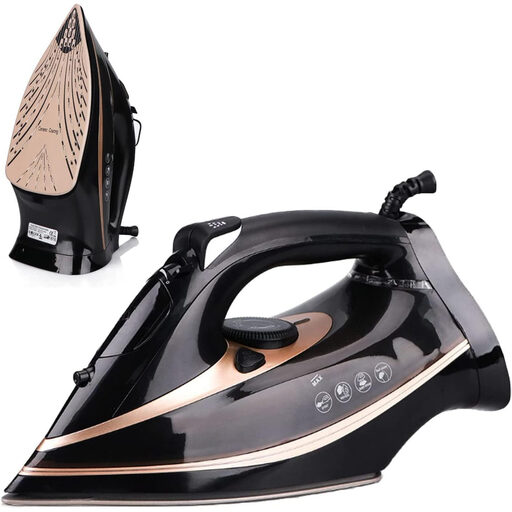
Steam iron with ceramic soleplate
A standard steam iron to compare if you want to press your scarf flat.
2600 W; 70 g/min continuous steam; 120 g steam boost; 300 ml water tank; ceramic soleplate; self-cleaning function.
Joybuy
 No image available
2400 W handheld steam iron
A steam iron with a soleplate, so you can adjust the heat and steam to suit the treatment allowed for your scarf.
Five temperature settings; adjustable steam and dry ironing; spray function; non-stick soleplate; self-cleaning; anti-drip function.
Joybuy
 No image available
Philips 3000 Series DST3031/20
Consider this model if you want to adjust the steam output and spray function to suit what the care label allows.
180 g steam boost; 40 g/min; 300 ml water tank; adjustable steam; spray function; automatic shut-off.
Joybuy
 No image available
Philips 1000 Series DST1030/20
A standard iron with a temperature dial and separate steam control, so you can adjust the settings to suit the care label.
2000 W; 1.6 m cord; spray function; steam boost; Calc-Clean maintenance function; suitable for dry ironing.
Joybuy
 No image available
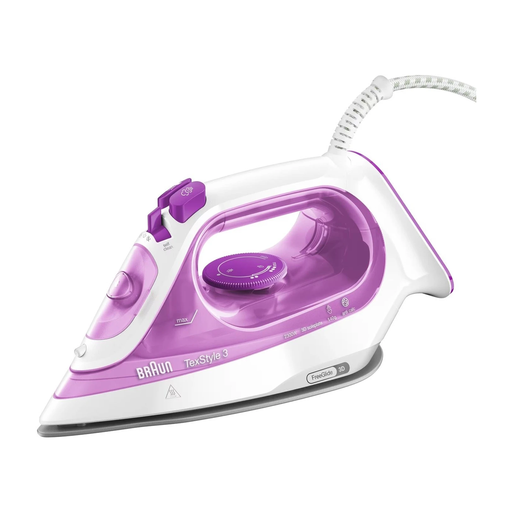
Braun TexStyle 3 SI3030, purple
A standard steam iron to compare if a precision tip and maintenance function are important to you.
270 ml water tank; 35-second heat-up time; self-cleaning function; precision tip.
Check automatic shut-off for this exact model; features can vary across the range.
Joybuy
Frequently asked questions
Can I use the hottest setting on every linen scarf?
No. The individual scarf’s ironing instructions determine the maximum treatment allowed, not just the fibre name. GINETEX distinguishes between ironing symbols with maximum soleplate temperatures of 200 °C, 150 °C and 110 °C; the 110 °C symbol means you shouldn’t use steam.
How can I iron a linen scarf?
Check the care label first. Studio Anneloes advises ironing linen clothes while the fabric is still slightly damp, using a steam iron and ironing on the reverse; only follow this advice if your scarf’s care instructions allow it. Let the scarf and appliance cool and dry before putting them away.
What maintenance does a steam iron need?
Follow the care and descaling instructions for the exact model. Consumentenbond explains that limescale can block the steam channels over time; a self-cleaning function doesn’t replace the model-specific maintenance instructions.
Do I always get exactly two years’ warranty in the Netherlands, and what applies to online orders?
No. Rijksoverheid states that the Netherlands has no fixed statutory warranty period; you’re entitled to a product that works as it should, and the retailer is your point of contact if there’s a problem. ACM ConsuWijzer says that with an online purchase, you generally have up to 14 days after delivery to change your mind. The right to change your mind and your warranty are different rights.


