
Short on time
You want to remove a few creases from an iron-safe linen scarf before visiting family, and need an appliance that’s suitable for a small ironing job.


For one or a few linen scarves, a compact steam iron is usually a practical choice: you can press the fabric flat without needing a large setup. Always check the care label on the specific scarf first. A garment steamer or 2-in-1 appliance may suit a scarf you want to freshen up while hanging; consider a steam generator mainly if you also regularly tackle larger loads of laundry or stubborn creases.
You want to remove a few creases from an iron-safe linen scarf before visiting family, and need an appliance that’s suitable for a small ironing job.
Your scarf may have a special finish, lining or fibre blend. The care label tells you whether and how to use heat or steam.
You iron other laundry as well as scarves. Tank capacity, steam output and storage space will all factor into your choice of appliance.
| What to consider | What should you look for? | Who is this important for? |
|---|---|---|
| Smoothing out creases precisely | Check that the scarf is suitable for ironing. Compare the steam settings, soleplate and how easy it is to reach narrow sections; don’t judge performance on wattage alone. | If I want to tackle visible creases precisely, I look at the soleplate and steam controls. Around 36% of consumers put precise crease removal at the top of their list. |
| A quick job and limited storage space | Compare the type of appliance and tank capacity. Check the model’s dimensions and think about how much room you have for it. | For a single scarf, I don’t want to have to set up or store a large appliance. Around 29% of consumers value a compact solution for a quick ironing job most. |
| Protecting the scarf from damage | Read the ironing symbol and check whether steam is allowed. Only choose a setting that complies with the care instructions for that scarf. | If I’m not sure about the finish or fibre blend of my scarf, I follow the label rather than relying on the word linen alone. Around 21% of consumers prioritise preventing fabric damage. |
| Ironing larger loads too | Compare tank capacity, continuous steam output and the weight of the iron. Also consider how much room you have for the generator and ironing board. | If I regularly iron large loads of laundry, extra capacity could be useful, even if the setup takes up more space. Around 14% of consumers mainly prioritise longer ironing sessions. |
The maximum temperature depends on the care label for the finished scarf, not just the name of the fibre.
Before ironing, check the ironing symbol, temperature limit and any restrictions on using steam.
A larger tank and more steam are most useful if you regularly iron a lot of laundry or tackle stubborn creases. For a couple of scarves, that extra capacity may go unused.
Think about how often you use the appliance for larger ironing sessions and whether you have room for the setup.
Product specifications and manufacturer claims apply to a particular model; they are not an independent comparison test. Business.gov.nl explains that CE marking is not a quality mark for a product.
Keep model specifications, conformity information and independent test results separate when comparing products.
Philips offers both a traditional steam iron and a steam generator; these models are suited to different types of ironing session.
The models mentioned include a traditional steam iron and a 2-in-1 appliance for horizontal ironing and vertical steaming.
The TexStyle 7 Pro SI 7181 is a traditional steam iron with manual temperature control and a precision tip.
This selection includes standard steam irons for pressing fabric flat, handheld steamers for vertical touch-ups and a steam generator for larger ironing sessions.
 No image available
A standard steam iron for pressing a scarf flat; the product description mentions adjustable steam and temperature and steam controls.
Continuous steam output: 45 g/min. Water tank: 200 ml.
Always follow the scarf’s care label for the temperature and use of steam.
 No image available
The product description says it can be used both to iron flat and steam vertically, for a scarf whose care label allows this treatment.
Water tank: 0,15 l. Steam output: 22 g/min. Weight: 0,77 kg.
The temperature and steam can be adjusted manually. Follow the scarf’s care label.
 No image available
A standard steam iron for pressing fabric flat; the product description mentions a precision tip for hard-to-reach areas.
Steam output: 50 g/min. Water tank: 300 ml.
Always follow the scarf’s care label for the temperature and use of steam.
 No image available
This steam generator is better suited to someone who regularly irons larger loads as well as scarves than to someone who only needs it for a quick scarf job.
Water tank: 1,3 l. Continuous steam output: 120 g/min.
The product description mentions OptimalTEMP, with no manual temperature setting. Follow the fabric’s care label.
 No image available
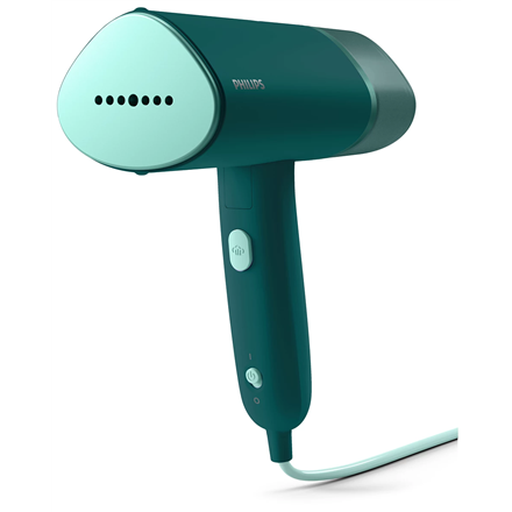
A handheld steamer for a hanging scarf, if the care label allows vertical steaming; the product description says no ironing board is needed.
Water tank: 120 ml. Steam output: 20 g/min. Heat-up time: 30 seconds.
The description lists one heat setting and no adjustable steam output. Only use the appliance if this treatment is suitable according to the scarf’s care label.
No. Choose the maximum temperature based on the care label for the specific scarf, not just the name of the fibre. The label may specify a lower temperature or ironing without steam.
Only use steam if the care label allows it. Follow the appliance instructions too, and don’t set a temperature higher than the label recommends.
Limescale can reduce steam output over time. Follow the descaling procedure for your specific model; Consumentenbond takes maintenance and the preservation of steam output into account in its tests.
When you buy from a business online, you usually have a 14-day cooling-off period, according to the Dutch Government. You are also entitled to a product that meets reasonable expectations. The Netherlands has no fixed statutory guarantee period; if something is wrong, contact the seller.
For an electric iron sold on the Dutch market under the applicable EU rules, the manufacturer must apply the required CE marking and draw up an EU declaration of conformity. CE marking is not a quality mark for ironing performance or overall product quality; the conformity of an individual item must be established separately.