
Scarf presser
You want to give your linen scarves a neat, flat finish. Choose an appliance based on the care label and its temperature and steam settings.


For a few linen scarves in a top-floor flat, a standard steam iron is a sensible place to start if you want to press them flat and store the appliance compactly; always check the care label first. A handheld garment steamer is better suited to freshening up scarves on a hanger for a soft finish, while a steam generator is more suitable for larger, frequent ironing sessions if you have room for the whole set-up. The Consumentenbond says a standard steam iron is a good choice for occasional ironing and limited storage space.
You want to give your linen scarves a neat, flat finish. Choose an appliance based on the care label and its temperature and steam settings.
You iron small loads in a top-floor flat and want an appliance that’s easy to move and store. The Consumentenbond highlights size and storage space as factors to consider when choosing between an iron and a steam generator.
Your scarves have different finishes or fabric compositions, and you want to follow the care instructions for each one. GINETEX advises using the care symbol to determine the maximum temperature, rather than relying on the fibre name alone.
Best for: pressing a few iron-safe scarves flat and storing the appliance compactly after use.
Trade-off: the water tank is built into the hand-held appliance and is smaller than the one on a steam generator.
Best for: freshening up a hanging scarf when a soft finish is all you need and the care label allows steaming.
Trade-off: steaming won’t press fabric as firmly as an iron soleplate, so you won’t get the same crisp, flat finish.
Best for: frequent, larger ironing sessions and stubborn creases, if you have room for the base unit and a suitable ironing board.
Trade-off: the complete set-up is bulkier and harder to move than a standard steam iron; the Consumentenbond also says steam generators are noisier.
| What to consider | What should you check? | Who is this important for? |
|---|---|---|
| Pressing flat | Check whether the appliance has a soleplate, whether the steam is adjustable and whether the tip is suitable for narrow edges. Follow the care label. | If I want to give a scarf a flat finish, I need contact with an iron soleplate; around 36% of consumers mainly want a flat, pressed finish. |
| Moving and storage | Compare the dimensions and weight of the complete appliance with your storage space and ironing board. | In a top-floor flat, I want to be able to move and store the appliance easily after a small ironing session; this is a priority for around 29% of consumers. |
| Care label and fabric treatment | Check that the temperature and steam settings match the instructions on the scarf. | When my scarves have different care labels, I want to be able to follow the permitted treatment for each one; around 21% of consumers put fabric protection first. |
| Steam maintenance | Read the model-specific instructions for water use and descaling; check that any limescale collector is easy to reach. | If I use the appliance regularly, I want to know what maintenance it needs; around 14% of consumers put ease of maintenance first. |
A handheld steamer is compact and handy for freshening up clothes, but it won’t press fabric down like an iron. Before you buy, decide whether you want a soft finish or a flat, pressed one.
For a crisp, pressed finish, you may still need an iron and an ironing surface.
The separate base unit makes the complete steam generator bulkier and harder to move. So compare the whole set-up with your storage space and ironing board.
The base unit needs extra storage space and may require a suitable, sturdy ironing board.
The care label determines which treatment is suitable; too much steam can leave the fabric and ironing board overly wet. Read the label and choose settings that match its instructions.
Using the wrong treatment could damage the scarf or leave it shiny.
The Express Steam FV2838E0 and Ultragliss Anti-Calc Plus FV6840E0 are examples of steam irons with different controls and maintenance features.
The Azur 8000 DST8050/20 is an example of a steam iron with a single temperature setting for fabrics that the care label says can be ironed.
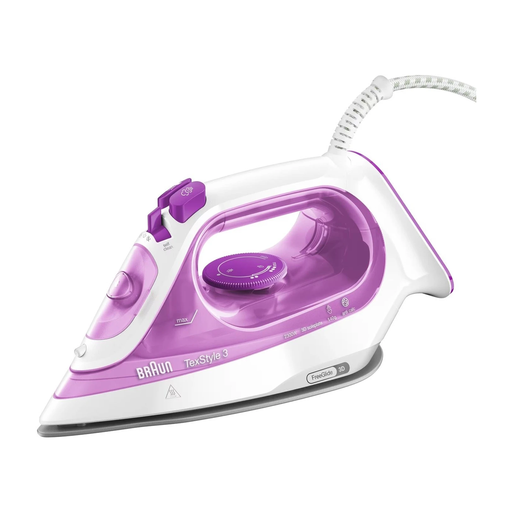
The TexStyle 7 Pro range includes the SI 7160 in blue and the SI 7181 in purple; these are separate models.
These steam irons are for anyone who wants to press a scarf with a soleplate; check that the settings on each model suit the care label.
 No image available
A steam iron to compare if you want to press a scarf with a soleplate.
 No image available
A handheld steam iron to compare if you’re looking for a compact appliance that makes contact with the fabric.
The product name describes a compact, lightweight design and dual voltage.
 No image available
A steam iron to compare if you want to press a scarf with a soleplate.
The product name lists the colour as blue and white and the power as 2000 W. The product description says steam isn’t available on the synthetic setting and warns that water may splutter if you use steam on that setting.
 No image available
A steam iron to compare if you want to press a scarf with a soleplate.
The product name specifies the purple version.
 No image available
A steam iron to compare if you want to press a scarf with a soleplate.
The product name specifies the violet version.
No. Choose the temperature based on the care label on that scarf, not just the fibre name. Follow any lower maximum temperature or instruction not to iron.
Use steam only if the care label allows it. The Consumentenbond advises ironing fabric when it’s slightly damp; leave a little time between extra bursts of steam and finish without steam if needed.
Limescale can affect how well the steam works. Follow the instructions for your chosen model on water use and descaling; having a limescale collector or self-cleaning function doesn’t mean you can skip maintenance.
When you buy online from a business, you generally have a 14-day cooling-off period, according to the Rijksoverheid. You’re also entitled to a product that works as it should. There is no set statutory guarantee period in the Netherlands, and if something goes wrong, you should contact the seller.
Electrical equipment within the scope of the European low-voltage rules must meet the applicable safety requirements. According to Ondernemersplein, once the manufacturer has established conformity, they must affix a CE mark and draw up and sign an EU declaration of conformity; a general product listing does not prove that a specific model meets these requirements.