
If you want to smooth out creases from packing
You want to get a crisp fold in a linen scarf properly flat at home, and have a suitable surface for ironing. First, check what the care label allows.


If you want to press a crisp fold flat in a linen scarf, choose a standard iron that lets you adjust the temperature and steam to suit the care label. A handheld steamer is better for light creases and a quick refresh without an ironing board, but it won’t give you the same pressed finish. A travel iron is mainly worth considering if you also want to iron while you’re away.
You want to get a crisp fold in a linen scarf properly flat at home, and have a suitable surface for ironing. First, check what the care label allows.
You want to remove light creases from a hanging scarf after getting home, without setting up an ironing board, and are happy with a less crisp finish.
You want to take an iron on future weekend trips. So, check its design and whether it’s suitable for the sockets at your destination.
Best for: pressing a crisp fold flat at home when you have a suitable place to iron.
Consider: the temperature and steam settings need to suit the scarf’s care label.
Best for: removing light creases from a suitable scarf while it’s hanging.
Consider: a handheld steamer won’t give you the same pressed finish, especially on a pronounced fold or heavier linen.
Best for: using the appliance on future trips as well.
Consider: check the full model details and whether the voltage and plug are suitable for your destination.
Best for: regularly ironing larger loads as well as your scarf.
Consider: allow for the larger set-up and the space needed to store it.
| What to consider | What to look for | Who is this important for? |
|---|---|---|
| Pressing packing creases flat | Check whether the temperature is adjustable and whether the care label allows ironing; make sure any steam setting suits the label and the instructions. | If I want to get a crisp fold properly flat at home, I look for control over the heat and pressing. Around 36% of consumers prioritise a flat finish. |
| Taking care with the scarf | Follow the maximum temperature on the care label and use steam only if it’s suitable for the scarf. | If my scarf’s finish or details need extra care, I want to be able to tailor how I treat it to the care label. Around 29% of consumers give fabric care top priority. |
| Refreshing without an ironing board | Check whether the scarf is suitable for vertical steaming; a small water tank may need refilling more often. | If I only want to remove light creases from a hanging scarf after getting home, I value the convenience of not needing an ironing board more than a crisp pressed fold. Around 21% of consumers mainly choose this kind of refresh. |
| Handling more laundry | Consider the tank capacity and whether you have room for the appliance and ironing area. | If I want to iron plenty of other items after a weekend away, I look at the capacity and the space needed for the set-up. Around 14% of consumers prioritise a larger ironing session. |
A handheld steamer won’t give you the same pressed finish as an iron, so a pronounced fold may not come out as flat.
First decide whether you want a properly flat finish or to refresh light creases; then compare the appliances.
GINETEX says the care label determines the maximum treatment; the fibre name alone doesn’t give you complete guidance.
Read your scarf’s care label before setting the heat or steam.
Tefal lists a 270 ml tank for the Easygliss Plus FV5736E0, while the Joybuy listing for the FV5736 gives a capacity of 200 ml. Don’t assume the listings describe the same version without checking.
Check the full model number and the tank capacity of the item on offer.
Philips provides information on both standard steam irons and compact garment steamers.
Tefal offers both standard steam irons and compact handheld steamers.
The TexStyle 3 information relates to the SI 3054 grey steam iron.
The First Class DA1510F2 is a travel iron listed in Rowenta’s Dutch spare parts and manuals catalogue.
This selection features steam irons for pressing a fold in a linen scarf flat at home. Always tailor how you treat the scarf to its care label.
 No image available
A steam iron for pressing at home on a suitable surface.
2400 W; non-stick soleplate; automatic cleaning function.
Set the maximum temperature according to the scarf’s care label.
 No image available
A steam iron for pressing a fold at home and tailoring the treatment to the care label.
Check the tank capacity of the version on offer: Tefal lists 270 ml for model FV5736E0, while the Joybuy listing for FV5736 gives a capacity of 200 ml.
 No image available
A steam iron for pressing at home; check that the version and connection suit your needs before buying.
Dual voltage.
Before using it on a trip, check that the plug is also suitable for your destination. Set the maximum temperature according to the scarf’s care label.
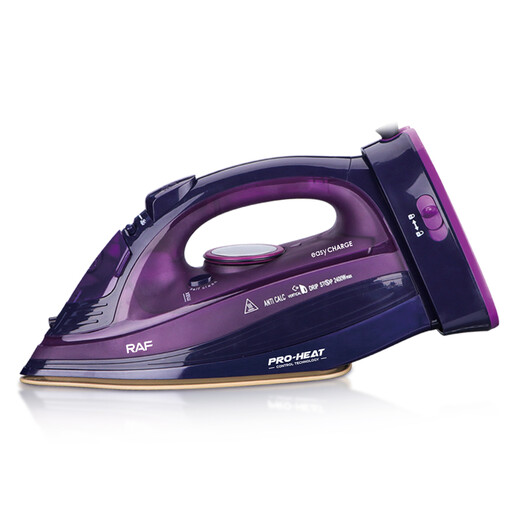 No image available
A cordless steam iron for pressing at home; check that the way it works suits your ironing set-up.
2400 W; 320 ml tank; steam output of 15–25 g/min; ceramic soleplate.
Set the maximum temperature according to the scarf’s care label.
 No image available
A steam iron for pressing at home on a suitable surface.
Violet version.
Set the maximum temperature according to the scarf’s care label.
No. Choose the maximum temperature according to the care label, not just the fact that the fibre is linen. An iron symbol with a cross through it means you shouldn’t iron the item; also take note of any finishes and embellishments.
To press a scarf flat with a standard iron, you’ll need a suitable, stable and heat-resistant surface. A handheld steamer can refresh a suitable scarf while it’s hanging, but the result is different from pressing.
Follow the model-specific instructions for water and descaling. Philips notes that limescale can build up and that descaling instructions may vary by range; don’t automatically use those instructions for another brand.
Electrical appliances covered by the relevant EU rules must carry the CE marking required by those rules. The marking indicates conformity with the applicable requirements; it isn’t an independent assessment of ironing performance.