
Vandaag of morgen in huis

Kwaliteit gegarandeerd

Welkomstaanbiedingen ontgrendelen: GRATIS bezorging | Tot 80% korting | Gratis 30 dagen JoyPlus-proefperiode
Download de app
A light with a motion sensor seems simple: movement is detected and the light switches on automatically. Yet many buyers run into the same problems. The light responds too late, the battery runs out quickly or the housing proves unsuitable for the chosen location. Choosing the right specifications helps you avoid an unsuitable purchase.
This guide will help you choose the right LED light with a motion sensor, wireless light, cabinet light or outdoor light for your home, balcony, garden, drive or entrance.
A manufacturer may state a generous range or wide angle, but real-world performance depends on the mounting height, the direction in which the sensor faces and any obstacles. A sensor aimed at a cupboard does not necessarily need to detect movement on the other side of the room.
So don’t just look at the maximum range. Also check:
More lumens do not automatically mean more pleasant light. A modest light output may be sufficient for a kitchen cupboard or hallway. A powerful solar floodlight is more suitable for a drive, garage or large garden.
For practical use, you can broadly consider:
Also check the colour temperature. Around 2700K to 3200K produces warm light, while 4000K to 5000K looks more neutral. Above approximately 6000K, the light is noticeably cooler and more functional.
A wireless light is only practical if you know how often it needs charging or battery replacement. Check the battery type, capacity and charging port. For example, a built-in 1100 mAh battery is easy to charge via USB, but operating time varies depending on how often it is used and which light setting is selected.
With a solar light with a motion sensor, hours of sunlight, shade and the position of the panel all play an important role. A light fitted to a north-facing wall or beneath a canopy may store less energy than the product name suggests.
A PIR sensor responds to changes caused by heat movement. For a cupboard, hall or staircase, a range of a few metres is often sufficient. The 30 cm model of the ultra-thin cabinet light, for example, states a PIR range of 3 to 5 metres. This suits a kitchen, wardrobe or short hallway, but not a large drive.
Dimmable lighting gives you extra control. A model with several settings prevents a small room from being lit unnecessarily brightly. The 2-pack night light lists five dimming settings and three colour temperatures, which is useful when the same light is used in both a bedroom and hallway.
Choose a rechargeable LED light if you do not want to use a power socket and can charge it regularly. Check whether it uses USB-A, USB-C or another connection, and whether a cable is included. Magnetic mounting is flexible, but the surface must be flat and sturdy.
Permanent 230V lighting, such as a traditional outdoor wall light, generally needs to be connected to the mains. Have this type of installation carried out by a qualified installer. A light supplied without a bulb, such as the Brilliant Todd, does give you the freedom to choose a suitable E27 LED bulb yourself.
The IP code provides information about protection against solid particles and water. IP44 means protection against splashing in practice; this type of light is suitable for many sheltered outdoor locations, but not for immersion or direct jets of water. IP65 offers greater protection against dust and water jets, making it more suitable for a more exposed location.
Always check the installation instructions. Even a product with an IP rating must be fitted and maintained correctly. With solar lighting, keep the panel free from dirt and leaves.
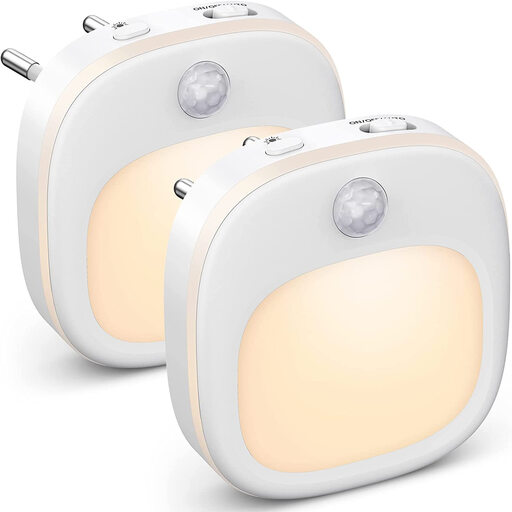
Why it suits this profile: A set of two lights is practical for a hallway, bedroom or nursery. The three colour temperatures and five dimming settings allow you to adjust the lighting to suit your needs.
The dimming settings help prevent a small space from being lit too brightly. Before buying, however, check that the power supply meets your requirements.
2-pack, 1 W SMD LED, three colour temperatures and five dimming levels, according to the product listing.

Why it suits this profile: This solar outdoor light is designed for an entrance, balcony or garden wall with direct sunlight, where you do not want to install wiring.
The IP44 rating makes the limitation clear: it is suitable for splashing, but not for immersion. Do not position the panel in permanent shade.
400 lumens per light, 2700K warm white light, two settings and an integrated motion sensor, according to the product details.

Why it suits this profile: The three adjustable light heads and wide coverage are designed for large outdoor areas such as a drive, garage or spacious garden.
The stated IP65 rating offers greater protection than IP44, but correct installation and a clean solar panel are still essential.
302 LEDs, a stated light output of 3000 lumens, 180° detection angle and three lighting settings, according to the product listing.

Why it suits this profile: The slim cabinet light with sensor can be installed without drilling in a kitchen, wardrobe, bedroom or rented home.
The dimensions of 300 x 38 x 10 mm make it easier to check in advance whether the light will fit in a narrow space.
2 lights, 41 LEDs, PIR detection from 3 to 5 metres, three colour temperatures and a built-in 1100mAh battery.
We have put together a complete, up-to-date list of products that fully meet these strict selection criteria and the applicable European safety regulations.
Mount or place the light where the sensor has an unobstructed view of the route people take. Do not point the sensor directly at a heat source, a window with strong sunlight or a moving curtain. After installation, test whether the light switches on at the desired distance. For adhesive mounting, the surface must be clean, dry and flat.
Operating time depends on the number of activations, the light intensity, the timer setting and the battery capacity. With a rechargeable LED light, you recharge it via USB; with a solar light with a motion sensor, the available solar energy is the deciding factor. So don’t just check the stated battery capacity, but also whether the light receives enough daylight in practice.
An LED light that only comes on when movement is detected generally uses less energy than lighting that stays on continuously. With a battery-powered or solar light, you do not pay directly for mains electricity during normal use, but the battery does need to be recharged or receive enough sunlight. For permanent lighting, you can assess consumption based on the wattage and estimated operating time.
