
Vandaag of morgen in huis

Kwaliteit gegarandeerd

Welkomstaanbiedingen ontgrendelen: GRATIS bezorging | Tot 80% korting | Gratis 30 dagen JoyPlus-proefperiode
Download de app
Good lighting for your home does more than brighten a room. You might want warm light in the living room, while in the kitchen, study or hallway, good visibility is more important. In a bedroom or gaming room, ambient lighting may matter more than high light output.
There’s plenty of choice, from LED bulbs and ceiling lights to smart lighting, floor lamps, wall lights and string lights. But an attractive design doesn’t automatically mean a light is right for your space. Check the technical specifications first, then consider the style.
Wattage tells you how much electricity a bulb uses, not how much light it produces. To check light output, look at lumens. For example, an 8 W LED bulb may produce 806 lumens according to its product specifications, while another bulb with similar wattage may perform differently.
For general lighting, it’s worth considering:
A 2400-lumen ceiling light may be suitable for a living room or workspace, while a 40-lumen USB night light is mainly designed to provide gentle light for finding your way around.
Kelvin (K) describes the colour of the light. A rating of around 2200–3000 K looks warm and suits a bedroom, seating area or decorative lamp. Around 4000 K gives a more neutral white light, which is often practical in a kitchen, hallway or study. Higher ratings can look cooler and brighter.
So a bulb with a high lumen output isn’t automatically right for a relaxing space. Always check both the lumen rating and the colour temperature.
Smart bulbs and RGB lighting can be appealing, with app controls, schedules and voice assistants. Check in advance that the bulb works with your Wi-Fi network, app and preferred platform. Some models work without a hub, while others need extra equipment.
Also check the difference between dimmable bulbs and bulbs with adjustable colour. A product may change colour but not necessarily work with a traditional wall dimmer.
First, check the fitting required by your light. Common types include:
For ceiling lights, also measure the available space. An ultra-slim ceiling light that’s 2.9 cm high can be practical if you have a low ceiling. For a floor lamp, check the height, base size and cable length to avoid trip hazards and awkward placement.
Compare bulbs by lumens per watt if you’re looking for an energy-efficient option. The energy rating on the product label can help you compare products, but also check the stated consumption per 1000 hours. A bulb with a long lifespan may need replacing less often, but check whether the claim comes from the official product specifications.
According to the product description, the Aigostar A60 E27 bulb produces 1500 lumens at 15 W, has a colour temperature of 3000 K and a stated lifespan of 15,000 hours. Philips’ own product information gives the Hue Essential A60 a stated lifespan of 25,000 hours. Treat these figures as the manufacturer’s product specifications, not as a guarantee for every use.
Check that a light is designed for indoor use and look at its IP rating. IP20, for example, is intended for dry indoor spaces and not for direct contact with water. Only use a light fitting with the maximum wattage specified, and don’t install LED bulbs in fully enclosed fittings if the manufacturer advises against it.
Switch off the power before installing ceiling lights. For fixed electrical connections, it’s advisable to follow local regulations and, where necessary, have the work carried out by a qualified person. A visible CE mark is listed for various products on offer; always check the latest product information and safety instructions too.
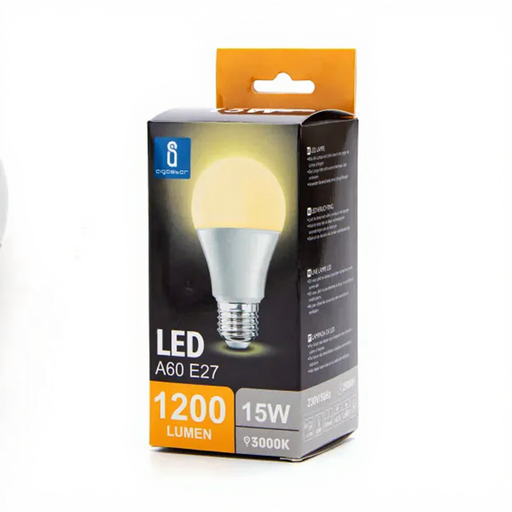
Why it suits this type of user: This LED bulb is designed for a standard E27 fitting and gives off warm 3000 K light according to its product details. That makes it a practical choice for general lighting in a living room or bedroom, for example.
The product specifications state 1500 lumens, 15 W and a 190° beam angle. This makes it easier to assess the light output than by looking at wattage alone.
E27 fitting, 1500 lumens, 3000 K and a stated lifespan of 15,000 hours according to the product description.
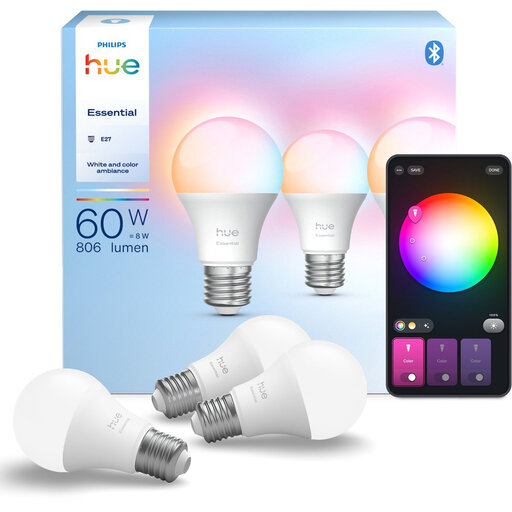
Why it suits this type of user: This set is a good fit if you want to control several lights centrally and switch between white light and colour in your living room, bedroom or gaming room.
The description mentions control via an app, wall controls and compatible voice assistants. Check in advance whether you want to use Bluetooth or a Hue Bridge.
Three E27 bulbs, dimming function, RGBW light, 806 lumens per light and a stated lifespan of 25,000 hours.

Why it suits this type of user: This integrated LED ceiling light is designed to provide even general lighting in a living room, hallway, kitchen or workspace.
Its height of 2.9 cm and diameter of 29.3 cm are clearly stated. This lets you check in advance whether it will fit your ceiling.
2400 lumens, 4000 K, integrated LED and a slim design according to the product specifications.
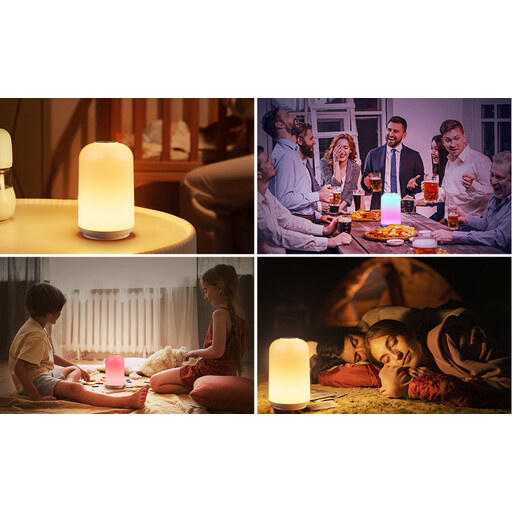
Why it suits this type of user: Compact, with a built-in battery and USB charging, this light is easy to place on a bedside table, shelf or child's furniture.
The 40-lumen output makes it clear that this is accent lighting and a guide light, not a replacement for a ceiling light.
Warm white light at 2600–2800 K, seven RGB colours, stepless dimming in warm white mode and USB charging.
We’ve put together a complete, up-to-date list of products that meet these strict selection criteria and the applicable European safety regulations.
Many people choose warm white light of around 2200–3000 K for a bedroom. It looks softer than neutral white light at around 4000 K. Choose a dimmable bulb if you want to adjust the brightness at different times.
It depends on the size and layout of the room, as well as the number of lights. A 2400-lumen ceiling light can provide the basic lighting, but additional floor lamps, wall lights or decorative lighting can brighten darker corners. So consider the overall distribution of light, not just one bulb.
LED bulbs generally use fewer watts than traditional light sources for a similar light output. For a realistic estimate, compare the power in watts, the expected number of hours in use and the consumption per 1000 hours. The actual cost depends on your electricity tariff and how long you use the bulbs.
