
Vandaag of morgen in huis

Kwaliteit gegarandeerd

Welkomstaanbiedingen ontgrendelen: GRATIS bezorging | Tot 80% korting | Gratis 30 dagen JoyPlus-proefperiode
Download de app
Good lighting is about more than looks. A lamp may look attractive in a product photo, yet disappoint in practice because of the wrong fitting, insufficient protection against moisture or awkward installation. Terms such as “energy efficient”, “weather resistant” and “smart” only mean something when you check the technical specifications.
In this guide, you’ll learn what to look for when choosing a wall light, outdoor lighting, solar wall light, GU10 LED spotlight, smart LED strip or gaming light. This allows you to compare products based on verifiable features rather than marketing claims.
A lamp with a GU10 fitting will not fit an E14 or E27 fixture. So, check the fitting of your existing lamp first. Also pay attention to the maximum wattage and the space available. For example, a Philips GU10 LED spotlight with a diameter of 50 mm will only fit a fixture with enough recessed or surface-mounting space.
With a wall light, the light source is not always included either. The Brilliant Newport outdoor light uses an E27 fitting and is supplied without a bulb. The Philips Fylx outdoor wall light has a GU10 fitting, but you’ll still need to choose a suitable light source yourself.
An IP44 outdoor light is protected against splashing water, but is not designed for submersion or powerful water jets. This makes IP44 suitable for many sheltered façades, balconies and covered areas, but not automatically for every location in the garden.
It’s best not to install an IP44 light where rainwater falls directly from a roof edge. For an exposed façade or an unsheltered location, a higher IP rating may be more suitable. Also check that the cable connection and wall mounting are suitable for outdoor use.
Wattage indicates how much power a lamp uses. Lumens indicate the amount of light produced. A higher wattage therefore does not automatically mean more light, particularly with LED lighting. Also consider the colour temperature:
With outdoor lighting, also check the light distribution. A lamp with a focused beam works differently from a fixture that provides diffuse light all around.
For a warm atmosphere, 2700 K GU10 spotlights are a practical choice. According to the product information, the Philips GU10 LED spotlights for warm white light provide 255 lumens per light source, use 3.5 watts and are not dimmable. Use them with a standard wall switch rather than a conventional dimmer.
4000 K may be more comfortable for a workspace. According to the product specifications, the Philips GU10 spotlights for cool white light provide 390 lumens per light source, use 4.6 watts and also have no dimming function. Always check that both the fixture and the light source are intended for indoor use; the spotlights mentioned have an IP20 rating.
A wall light needs to suit the surface and the way you plan to connect it to the electricity supply. The Atmosphera Lio wall light is intended for indoor use and has an adjustable spotlight, an E14 fitting and a maximum power of 25 watts. According to the product description, the shade is made from FSC-certified bamboo. The light can also be used as a ceiling light, but the installation method and surface must be suitable for this purpose.
A fixed mains-powered outdoor light, such as the Brilliant Newport, requires a 220–240 volt connection. According to the product information, it must be installed by a qualified electrician. A solar wall light or rechargeable lamp avoids fixed wiring, but it does require sufficient daylight or regular charging.
A motion sensor is useful at an entrance, shed or garden path. Pay attention to the detection area, installation height and how the light is activated. A sensor facing a busy pavement may switch on more often than you want.
According to the product specifications, the Philips Swyn solar wall light has two light modes, a motion sensor, a daylight sensor, 400 lumens and IP44 protection. The Brilliant Parson solar wall light has an integrated LED, 180 lumens, 2700 K, a motion sensor and IP44 protection. The light should be positioned so that the solar panel receives direct light. Shade from a balcony edge or tree can affect charging performance.
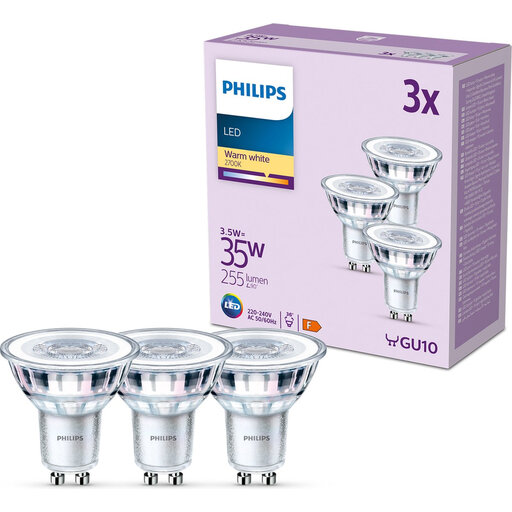
Why it suits this profile: A set of three GU10 spotlights is practical when you want to replace several existing indoor fixtures without investing in a complete lighting system.
The fitting, colour temperature, light output and number of items are clearly stated. The spotlights are not dimmable, so you can take this into account before buying.
GU10 fitting, 2700 K warm white light, 255 lumens per light source and three lamps in the pack.

Why it suits this profile: This smart LED strip is ideal if you want adjustable mood lighting behind a television, beneath a shelf or behind furniture.
The strip is dimmable and can be cut to length. Check in advance which functions are available without a Hue Bridge, as advanced controls may depend on it.
5-metre length, control via app and remote control, Matter support and compatibility with multiple smart home platforms.
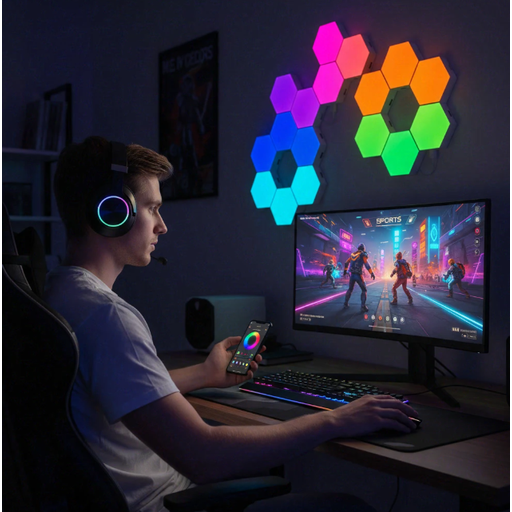
Why it suits this profile: The eight RGB panels are designed for gaming rooms, a wall behind a desk or decorative lighting where patterns and colour changes take centre stage.
The panels work via USB and are intended for dry indoor spaces. This prevents confusion with outdoor lighting; moisture and water must be avoided.
Eight RGB panels, music synchronisation, remote-control operation and flexible positioning with the mounting tape included.
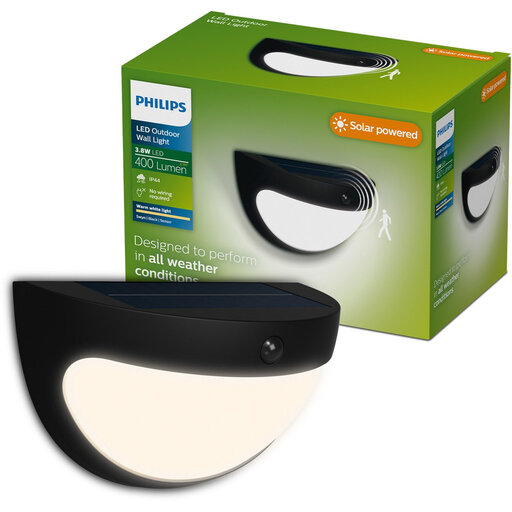
Why it suits this profile: This solar wall light is suitable for a balcony, terrace or entrance where you do not want to install a power cable.
The IP44 rating makes the limits clear: it is suitable for splashing water, but not for submersion. The solar panel needs to receive direct daylight.
No fixed wiring, two light modes, daylight and motion sensors, and 400 lumens according to the product details.
We’ve put together a complete, up-to-date list of products that fully meet these strict selection criteria and the applicable European safety regulations.
Choose a fixture with a suitable IP rating. IP44 is suitable for splashing water and many sheltered outdoor locations, such as a covered area, balcony or entrance. Fully exposed locations may require a higher level of protection. Also check whether the light runs on solar power, batteries or mains electricity.
Lifespan varies depending on the product and conditions of use. The product information for some Philips LED spotlights states an average lifespan of 15,000 hours. With integrated LED lamps, the light source is often not replaceable. With a GU10 lamp, you can usually replace only the light source, provided the fixture is designed for this.
According to the product description, a solar wall light uses a solar panel and internal battery, so it does not need a fixed connection to the mains. Operating time depends on the amount of daylight, positioning and use of the motion sensor. Clean the solar panel regularly and allow for reduced charging in low-light conditions.
