
Pilot with limited desk space
You want to add a separate throttle without turning your workspace into a permanent cockpit. The placement, mounting method and overall dimensions all affect which model will fit.


Start by checking how much desk space you have and which axes you want to control separately for your light aircraft. For throttle, propeller and mixture, you’ll need three assignable axes. Then choose between a simple quadrant, a GA module with push-pull controls or a more extensive layout. Before buying, check the space required, including the mount and room for your hands to move, as well as the connection and your simulator settings.
You want to add a separate throttle without turning your workspace into a permanent cockpit. The placement, mounting method and overall dimensions all affect which model will fit.
You mainly fly simulated piston-engine aircraft and want to control the throttle, propeller and mixture separately.
You’re pairing a throttle with an existing stick or yoke and want to know in advance which connection, simulator settings or additional controller you’ll need.
First, measure the space needed for the unit, mount, cables and your hands. Then decide which engine functions you want to control separately and check that the connection will work with your existing setup.
| What to consider | What should you check? | Who should consider this? |
|---|---|---|
| Desk space | Measure the available surface and desk edge, then compare them with the model’s dimensions and mounting method. | I want to use the throttle on a small workspace, taking the clamp and room for my hands to move into account too. Around 36% of consumers give available desk space top priority. |
| GA engine controls | Check which axes your aircraft uses and how many levers or push-pull controls can be assigned separately. | I want to control the throttle, propeller and mixture separately in a light aircraft. Around 29% of consumers prioritise these GA engine controls. |
| Connection | Check your platform and simulator, and whether you’ll need a base or a separate USB controller. | I want to connect the throttle to my existing stick, yoke or computer without overlooking a controller I might need. Around 21% of consumers put connectivity first. |
| Components required | Check which base, controller, mount and cables you’ll need for the complete setup. | I want to know in advance which components I’ll need to use the throttle with my setup. Around 14% of consumers give clarity about the complete setup top priority. |
Honeycomb lists the Bravo LITE’s unit depth as 330 mm, excluding the mounting plate or clamp. So you’ll need more workspace than just the area taken up by the unit itself.
Before choosing a model, also measure the mount, allow for the cables and make sure there’s room for your hands to move.
VKB says a GNX USB Controller is required for a direct, standalone USB connection; it isn’t included.
Check whether you’re using a compatible Gladiator base or add the required controller to your setup.
A separate controller is required for standalone USB use, so allow for an additional connection and another component in your setup.
The Thrustmaster TCA Quadrant Airbus Edition has two thrust levers, while the Honeycomb Sierra TPM is laid out with separate throttle, propeller and mixture controls.
Make a note of which functions you want to control separately for your aircraft, then check that the number and layout of the axes are suitable.
According to the Dutch government, the Netherlands has no fixed statutory warranty period; if a product is faulty, the seller must provide a solution.
Check the manufacturer’s warranty terms separately and report faulty products to the seller.
The Flight Throttle Quadrant has three interchangeable lever knobs, including controls for throttle, mixture and propeller pitch.
The GNX THQ is a desktop module with three axes. It can also be used alongside compatible GNX or Gladiator components.
The Sierra TPM is designed around a GA layout with push-pull controls, while the Bravo and Bravo LITE have interchangeable lever layouts.
The TCA Quadrant Airbus Edition has an Airbus-inspired layout with two thrust levers.
The VelocityOne Dual Throttle has two linked main thrust levers and additional assignable controls.
These products offer a choice between a separate Boeing Edition quadrant and a flight stick with integrated controls. For light aircraft, check whether you can assign the controls to the functions you need in your simulator.
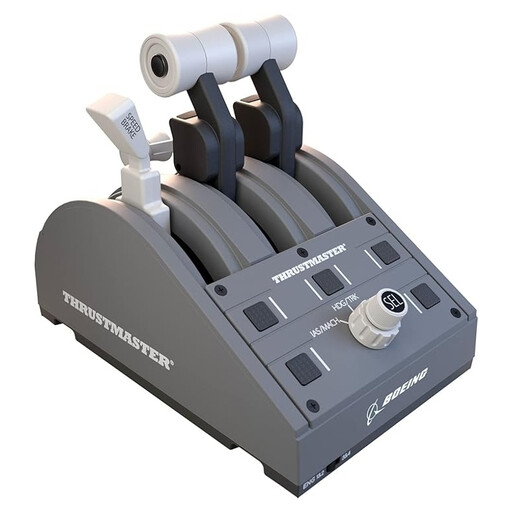 Image unavailable
The product description lists three axes and four interchangeable levers for controls including throttle, brakes and flaps. Check whether you can assign those axes to your light aircraft’s functions in your simulator.
The product name lists compatibility with PC, Xbox, Xbox One X and Xbox Series S. Check compatibility with your own simulator and platform.
 Image unavailable
The product description lists two levers, including one for engine power. This is a flight stick with integrated controls, not a separate throttle, so check that the layout suits the GA functions you need.
The product name lists USB-C and compatibility with PC Windows 10/11, Xbox Series X|S and Xbox One. Check compatibility with your simulator and platform.
Not as a general rule when buying: consider which axes you want to assign for the specific aircraft and in your simulator. The VKB GNX THQ has three axes, while the Honeycomb Sierra TPM has three push-pull controls for throttle, propeller and mixture.
For a standalone, direct USB connection, the European VKB product page says you’ll need a separate GNX USB Controller, which isn’t included. If you want to use the module with your existing base, check that it’s compatible.
Before buying, measure the space needed for the unit, mounting and hand movements. Once connected, assign the axes to the aircraft functions you want in your simulator. Honeycomb lists the Bravo and Bravo LITE dimensions excluding the mounting plate or clamp.
For a consumer purchase in the Netherlands, the Dutch government says the seller must provide a solution if a product is faulty. The Netherlands has no fixed statutory warranty period, so contact the seller if there’s a problem.
For distance purchases from a business, a 14-day cooling-off period applies in many cases, according to the Dutch government. Purchases from private sellers aren’t covered by the distance-selling rules, so check which terms apply to your purchase.