Start with a microphone close to the speaker and make the room as quiet as possible: a microphone placed further away is more likely to pick up household noise and echo. Choose a lapel microphone if the speaker needs to move around, a directional dynamic microphone for a fixed position, or a recorder with separate inputs if you need to record both voices on separate tracks. Make a test recording first, and check the connections, monitoring and storage.
Who is this for?
A storyteller in a noisy room
You want to record the interviewee’s voice close up when household noise or echo is hard to avoid. The Goldring/Woldenberg Institute of Southern Jewish Life emphasises that placing a microphone close to the speaker can reduce background noise in the recording.
An interviewer who wants to capture both voices
You want to be able to listen back to both questions and answers, so you’re considering two microphones or separate recording tracks. The Oral History Society provides guidance on microphone set-ups for interviews; the right choice depends on how you want to record both voices.
Someone recording without a permanent studio
You want to be able to move your set-up and record without relying on a single fixed computer location. Decide in advance which recording device you’ll use and how the microphone, power supply and storage will connect to it.
What should you look for?
A lapel microphone close to the storyteller
Choose this option when: the storyteller needs to move around or can’t keep speaking towards a microphone on the table. The Oral History Society recommends a lapel microphone for indoor interviews.
Bear in mind: clothing rustle and, with a wireless set, the receiver and recording device you’ll need. Placing the microphone close to the speaker doesn’t remove the need to make the room quieter.
A directional dynamic USB or XLR microphone
Choose this option when: one speaker will be sitting in more or less the same place and you can keep the microphone close. USB can connect directly to a compatible computer; XLR requires a suitable recorder or interface.
Bear in mind: one microphone may pick up two speakers unevenly if it isn’t positioned carefully. Audio-Technica describes the ATR2100x-USB as having a cardioid pattern that picks up less sound from the sides and rear, but this won’t make a noisy room quiet.
A standalone recorder with external microphones
Choose this option when: you want to record without a computer or capture the interviewer and storyteller separately. Check how many suitable inputs and recording tracks the model offers.
Bear in mind: external microphones, storage and power make the set-up more involved. A recorder with built-in microphones won’t automatically solve the problem of distance from the speakers or room echo.
| What to consider |
What to look for when buying |
Who should pay particular attention? |
| Clarity amid household noise and echo |
Check how close you can keep the microphone to the storyteller and make a test recording in the intended location. |
If my main aim is to keep answers clear despite household noise, I’ll first consider microphone placement and the sound of the room; around 36% of consumers put clarity first. |
| Recording both people in the conversation |
Decide whether you need the questions on the final recording too; check the number of transmitters, inputs and separate tracks. |
If I want to hear both the questions and answers clearly, I’ll look at options for positioning both voices separately; around 29% of consumers give top priority to being able to hear both voices. |
| Connection and monitoring while recording |
Check the required USB, XLR or analogue connection, power supply and storage, and whether you can monitor the recording with headphones. |
If I want to check that my device is recording properly during a long conversation, I’ll look at the connection and monitoring options; around 21% of consumers prioritise a recording that works and can be checked. |
| Keeping and using the recording later |
Check whether WAV recording suits your archiving needs and plan how you’ll transfer and securely copy the file afterwards. |
If I want to find and preserve the life story later, I’ll also consider the file format and transfer options; around 14% of consumers name long-term usability as their top priority. |
Common buying mistakes
-
Choosing a microphone for the middle of the table because it can pick up both people
A microphone placed further away can also pick up room noise and echo clearly, making voices harder to understand.
First, make a test recording with the microphone close to the storyteller, then listen back to check that the questions are audible enough too.
-
Assuming noise reduction or 32-bit float will solve every noisy-room problem
A recording feature doesn’t prove that words masked by background noise will become clear afterwards.
Reduce sources of interference and improve microphone placement before relying on processing or a particular recording format.
-
Buying a two-transmitter set or XLR microphone without the rest of the recording chain
A RØDE Wireless ME doesn’t record on its own via the transmitter. An XLR microphone won’t create a recording file without a suitable recording device either.
Map out the route from microphone to saved file and check every component you’ll need before buying, such as a receiver, recorder, interface or memory card.
Brands to compare
Audio-Technica
The ATR2100x-USB is a dynamic handheld microphone for a fixed recording position, with USB and XLR connections.
- Audio-Technica Netherlands lists a cardioid pickup pattern, headphone monitoring, and the included cables and desktop stand.
- To record two speakers equally, you’ll need to move the microphone or set up a second recording channel.
Shure
The MV7+ offers a dynamic USB-C or XLR option for a speaker who can sit close to a fixed microphone.
- Shure lists headphone monitoring and digital settings for the MV7+.
- You’ll need additional recording equipment to use the XLR connection. Also check that your device and software are supported.
RØDE
The Wireless ME Dual is a wireless option with two transmitters for conversations where both speakers may move around.
- RØDE specifies two transmitters and connections to devices including cameras, computers and phones.
- RØDE states that the Wireless ME transmitter doesn’t record on its own: you still need a receiver and recording device. Check which version of the set you’re buying and which cables are included.
Zoom
The H4essential is a standalone recorder with inputs for external microphones; the H1essential has built-in microphones and one 3.5mm microphone/line input.
- According to Zoom, the H4essential has two XLR/TRS inputs and 32-bit float recording.
- To record two voices with microphones close to the speakers, you’ll need external microphones and a suitable set-up. The built-in microphones won’t automatically solve problems with distance or room echo.
DJI
The Mic Mini set with two transmitters is a portable option for two speakers; check that you choose the version you want.
- DJI states that the receiver can be paired with two transmitters at the same time.
- The product’s noise reduction feature doesn’t tell you how well it will work in a particular home. Check what’s included in the set and test the set-up in the room.
Joybuy products for interviews with a lapel microphone
These products are designed to keep the microphone close to the storyteller, with wireless sets available for recording two speakers. Check that the receiver and connection are compatible with your phone, computer or recorder.
 No image available
DJI Mic Mini 2S (2 TX + 1 RX + Charging Case)
This set is designed for interviews where two speakers wear microphones close to them; before recording, check how the transmitters are attached and whether the receiver connects to your device.
Joybuy
 No image available
Moman M1CXT Wireless Lavalier Microphone, USB-C, 2TX+1RX, 150m Range
This set with two transmitters is an option for conversations with two speakers; check that the USB-C receiver works with the device you’ll use to record.
Joybuy
 No image available
DJI Mic 3 (2 TX + 1 RX + Charging Case)
The version with two transmitters is designed to record two speakers; before buying, check that the connection is compatible with your camera, smartphone or computer.
Joybuy
 No image available
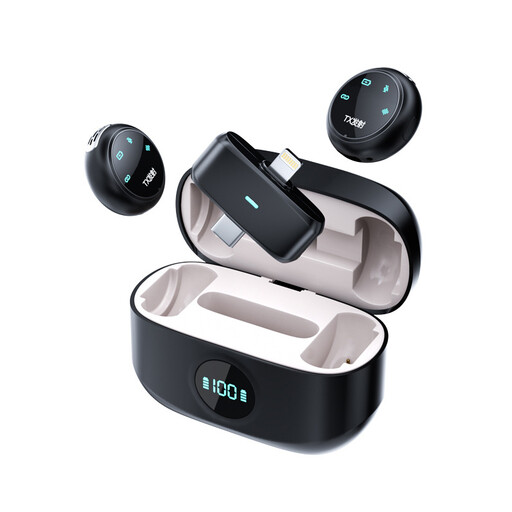
Verbex K31Pro-Black Dual Microphone, iOS and Type-C
This dual-microphone set-up is designed for conversations with two speakers; check that the listed iOS or Type-C connection matches your recording device.
Joybuy
 No image available
Verbex ST5 Dual-Mic Type-C Mini Wireless Lavalier Microphone
This dual-mic set-up is designed for two microphones in a portable interview kit; check that the Type-C connection is suitable for your device.
Joybuy
Frequently asked questions
Where should I put the microphone if the room is echoey?
Start in the quietest room available and place the microphone close to the storyteller. The Goldring/Woldenberg Institute of Southern Jewish Life points out that a nearby microphone can reduce background noise in the recording. Listen to a test recording first and check for clothing rustle.
Do I automatically need two microphones to record two voices?
Not necessarily: it depends on whether you need both questions and answers to be clear in the final recording. Recording them separately requires two suitable microphones and compatible inputs; according to Zoom, the H4essential has two XLR/TRS inputs.
Can I record a conversation in the Netherlands and publish the life story online later?
A 2019 Dutch disciplinary ruling describes recording a conversation you’re taking part in as generally permitted under criminal law; that doesn’t mean every recording or publication is automatically allowed. The Dutch Data Protection Authority states that permission is usually required to publish personal data online. So discuss the purpose, storage and any potential publication with the storyteller in advance.
What are my rights if a microphone I bought online isn’t suitable for my set-up?
According to ACM ConsuWijzer, online purchases generally come with a statutory cooling-off period that ends 14 days after delivery, although there are exceptions. Check the connections and what’s included in the box beforehand; this can help prevent compatibility problems.


